
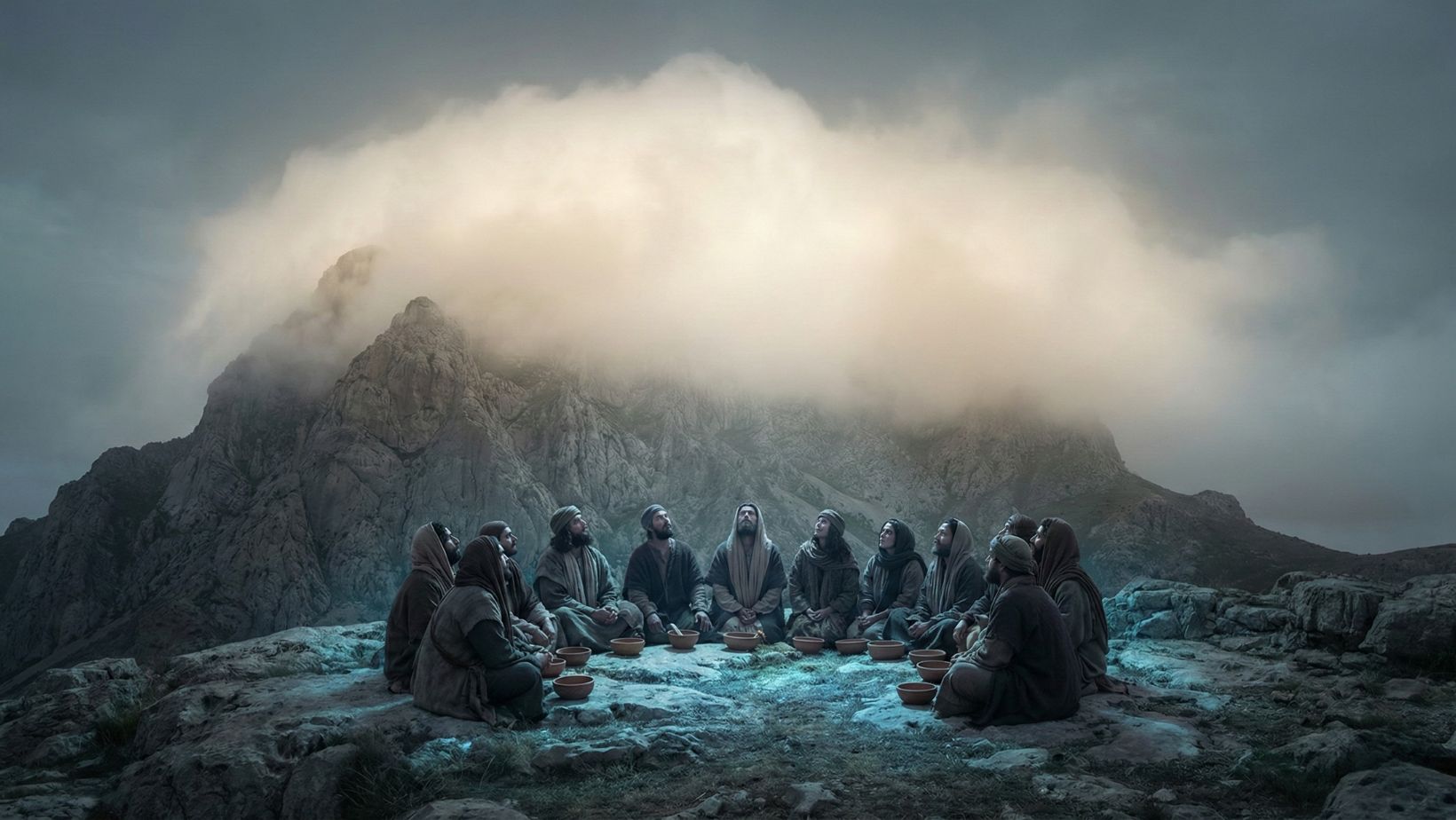
Exodus 24 marks the climax of the Covenant at Sinai. After receiving the Ten Commandments (Exodus 20) and the Book of the Covenant (Exodus 21–23), the nation of Israel formally ratifies their relationship with Yahweh. This chapter bridges the gap between the giving of the Law and the instructions for the Tabernacle (Exodus 25). It describes a ceremony of blood, a communal meal in the presence of God, and Moses’ ascent into the glory cloud to receive the stone tablets. It establishes the legal and spiritual constitution of Israel as a theocracy.
1. The Ratification Ceremony (Exodus 24:1–8 NLT)
1 Then the Lord instructed Moses: “Come up here to me, and bring along Aaron, Nadab, Abihu, and seventy of Israel’s elders. All of you must worship from a distance. 2 Only Moses is allowed to come near to the Lord. The others must not come near, and none of the other people are allowed to climb up the mountain with him.”
3 Then Moses went down to the people and repeated all the instructions and regulations the Lord had given him. All the people answered with one voice, “We will do everything the Lord has commanded.”
4 Then Moses carefully wrote down all the Lord’s instructions. Early the next morning Moses got up and built an altar at the foot of the mountain. He also set up twelve pillars, one for each of the twelve tribes of Israel. 5 Then he sent some of the young men of Israel to offer burnt offerings and to sacrifice young bulls as peace offerings to the Lord.
6 Moses drained half the blood from these animals into basins. The other half he splashed against the altar.
7 Then he took the Book of the Covenant and read it aloud to the people. Again they all responded, “We will do everything the Lord has commanded. We will obey.”
8 Then Moses took the blood from the basins and splattered it over the people, declaring, “Look, this blood confirms the covenant the Lord has made with you in giving you these instructions.”
Commentary:
- The Hierarchy of Access (v. 1–2): The narrative establishes distinct zones of holiness, foreshadowing the Tabernacle structure:
- The People: Remain at the foot of the mountain (Outer Court).
- The Elders/Priests: Allowed partly up but must worship “from a distance” (Holy Place).
- Moses: Invited to “come near” (Holy of Holies).
- Oral Consent (v. 3): Before the ritual, the people verbally accept the terms. Their response (“We will do everything”) is enthusiastic but, as history shows, overly optimistic regarding their ability to obey.
- The Altar and Pillars (v. 4):
- The “Young Men” (v. 5): The Levitical priesthood had not yet been formally established (that happens in Exodus 28). Here, young men (likely firstborns acting as family priests) perform the sacrifices.
- The Blood of the Covenant (v. 6–8): This is the most critical ritual in the chapter.
- Division of Blood: Half on the altar (God’s share) and half on the people (Israel’s share).
- Significance: Sharing the same blood symbolizes that the two parties share one life. They are bound together in a life-and-death bond.
- New Testament Link: Jesus references this verse at the Last Supper: “This is my blood of the covenant” (Matthew 26:28). The old covenant was sealed with the blood of bulls; the new covenant is sealed with the blood of Christ.
- The Book of the Covenant (v. 7): Moses reads the laws from Exodus 20–23. This is the first canonization of Scripture—a written document recognized as binding authority.
2. The Vision of God (Exodus 24:9–11 NLT)
9 Then Moses, Aaron, Nadab, Abihu, and the seventy elders of Israel climbed up the mountain. 10 There they saw the God of Israel. Under his feet there seemed to be a surface of brilliant blue lapis lazuli, as clear as the sky itself. 11 And though these nobles of Israel gazed upon God, he did not destroy them. In fact, they ate a covenant meal, eating and drinking in his presence.
Commentary:
- The Ascent (v. 9): The leadership climbs the mountain. The “70 elders” represent the nation’s governance.
- Seeing God (v. 10): This creates a theological tension with Exodus 33:20 (“No one may see me and live”).
- The Description: They likely saw a manifestation of His glory (theophany) rather than His full essence. The text focuses on what was under His feet—”brilliant blue lapis lazuli” (sapphire)—suggesting they were looking up from below, perhaps seeing the “floor” of heaven (firmament).
- Blue/Sapphire: Often associated with the throne of God (Ezekiel 1:26).
- Mercy and Fellowship (v. 11):
- “He did not destroy them”: In the ancient world, seeing a deity was considered fatal. God’s restraint here indicates His acceptance of the covenant.
- Eating and Drinking: A shared meal was the cultural sign of peace and friendship. This is a “peace offering” feast. They are not consumed by fire; they consume a meal in safety. It is a foretaste of the Messianic Banquet (Revelation 19:9).
3. Moses Enters the Cloud (Exodus 24:12–18 NLT)
12 Then the Lord said to Moses, “Come up to me on the mountain. Stay there, and I will give you the tablets of stone on which I have inscribed the instructions and commands so you can teach the people.”
13 So Moses and his assistant Joshua set out, and Moses climbed up the mountain of God.
14 Moses told the elders, “Stay here and wait for us until we come back. Aaron and Hur are here with you. If anyone has a dispute while I am gone, consult with them.”
15 Then Moses climbed up the mountain, and the cloud covered it. 16 And the glory of the Lord settled down on Mount Sinai, and the cloud covered it for six days. On the seventh day the Lord called to Moses from inside the cloud. 17 To the Israelites at the foot of the mountain, the glory of the Lord appeared at the summit like a consuming fire. 18 Then Moses disappeared into the cloud as he climbed higher up the mountain. He remained on the mountain forty days and forty nights.
Commentary:
- The Stone Tablets (v. 12): God promises written tablets. Unlike the Book of the Covenant (written by Moses), these are “inscribed” by God, emphasizing their permanence and divine origin.
- Joshua’s Role (v. 13): Joshua accompanies Moses further than the elders but stops before the summit. He is being groomed as the successor, witnessing the glory up close.
- Delegation (v. 14): Moses leaves Aaron and Hur in charge. This proves disastrous, as Aaron will succumb to pressure and build the Golden Calf in Moses’ absence (Exodus 32).
- The Cloud and the Fire (v. 15–17):
- The Cloud: Represents mystery and separation.
- The Fire: Represents purity and judgment.
- Six Days: A period of preparation/purification, recalling the creation week. God calls on the seventh day, signaling that revelation is a form of “sabbath” rest/completion.
- Forty Days and Nights (v. 18): This period is significant in Scripture (flood, wilderness wandering, Jesus’ temptation). It represents a time of testing and complete consecration. Moses is sustained supernaturally, fasting from earthly food to feast on divine revelation.
Theological Significance of Exodus 24
- The Blood Covenant: Salvation and relationship with God are mediated through blood. The sprinkling of the people signifies that they have been consecrated (set apart) and cleansed. It is the Old Testament equivalent of the believer being “washed in the blood” of Jesus.
- Mediated Access: The chapter highlights that while God desires to dwell with His people, approach is restricted by holiness. The people need a mediator (Moses) and a sacrifice (blood) to survive the encounter.
- Theophany and Communion: The ultimate goal of the covenant is fellowship. The elders eating in God’s presence shows that God’s law is not just about rules, but about relationship.
- The Written Word: The transition from oral instruction to written text (“Book of the Covenant,” “Tablets of Stone”) ensures that God’s will is preserved objectively, not subject to memory or manipulation.
Practical Applications
- Commitment Requires Action: The people said, “We will do everything.” Faith is not just hearing God’s word but committing to obey it.
- The Importance of Waiting: Moses waited six days in the cloud before God spoke. Spiritual depth often requires waiting in silence before receiving direction.
- Fellowship with God: We are invited to “eat and drink” in God’s presence through Communion (The Lord’s Supper), celebrating that we are at peace with Him through the blood of the New Covenant.
- Leadership Accountability: Moses left Aaron in charge, but Aaron failed. Leaders must be vigilant even when the primary leader is absent.







Leave a Reply