
Exodus 25 marks a pivotal shift in the book of Exodus. Having delivered Israel from Egypt and established the Covenant at Sinai, God now provides instructions for a physical dwelling place—the Tabernacle (Mishkan). This chapter focuses on the voluntary offerings required for construction and the specific designs for the most sacred furniture: the Ark of the Covenant, the Table of Presence, and the Gold Lampstand. The underlying theme is God’s desire to dwell among His people, transitioning from the distant thunder of the mountain to an intimate presence in the center of the camp.
1. Offerings for the Tabernacle (Exodus 25:1–9 NLT)
1 The Lord said to Moses, 2 “Tell the people of Israel to bring me their sacred offerings. Accept the contributions from everyone whose heart is moved to give. 3 Here is a list of sacred offerings you may accept from them: gold, silver, and bronze; 4 blue, purple, and scarlet thread; fine linen and goat hair for cloth; 5 tanned ram skins and fine goatskin leather; acacia wood; 6 olive oil for the lamps; spices for the anointing oil and the fragrant incense; 7 onyx stones, and other gemstones to be set in the ephod and the priest’s chestpiece. 8 “Have the people of Israel build me a holy sanctuary so I can live among them. 9 You must build this Tabernacle and its furnishings exactly according to the pattern I will show you.
- Willing Hearts (v. 2): God does not demand a tax; He requests a “sacred offering” from those whose hearts are moved. This emphasizes that true worship and the building of God’s kingdom must spring from a spirit of generosity rather than compulsion.
- The Materials (vv. 3–7): The materials listed (precious metals, dyed yarns, fine linens, and acacia wood) represent the best of what the Israelites possessed. Many of these items were likely the “plunder” given to them by the Egyptians during the Exodus (Exodus 12:35–36).
- The Purpose (v. 8): The goal is stated clearly: “so I can live among them.” This is the climax of the Exodus—not just liberation from slavery, but liberation for relationship with the Creator.
- The Divine Pattern (v. 9): Moses is not the architect; he is the foreman. The Tabernacle is a “copy and shadow” of heavenly realities (Hebrews 8:5). Precision is required because every element carries theological significance.
2. The Ark of the Covenant (Exodus 25:10–22 NLT)
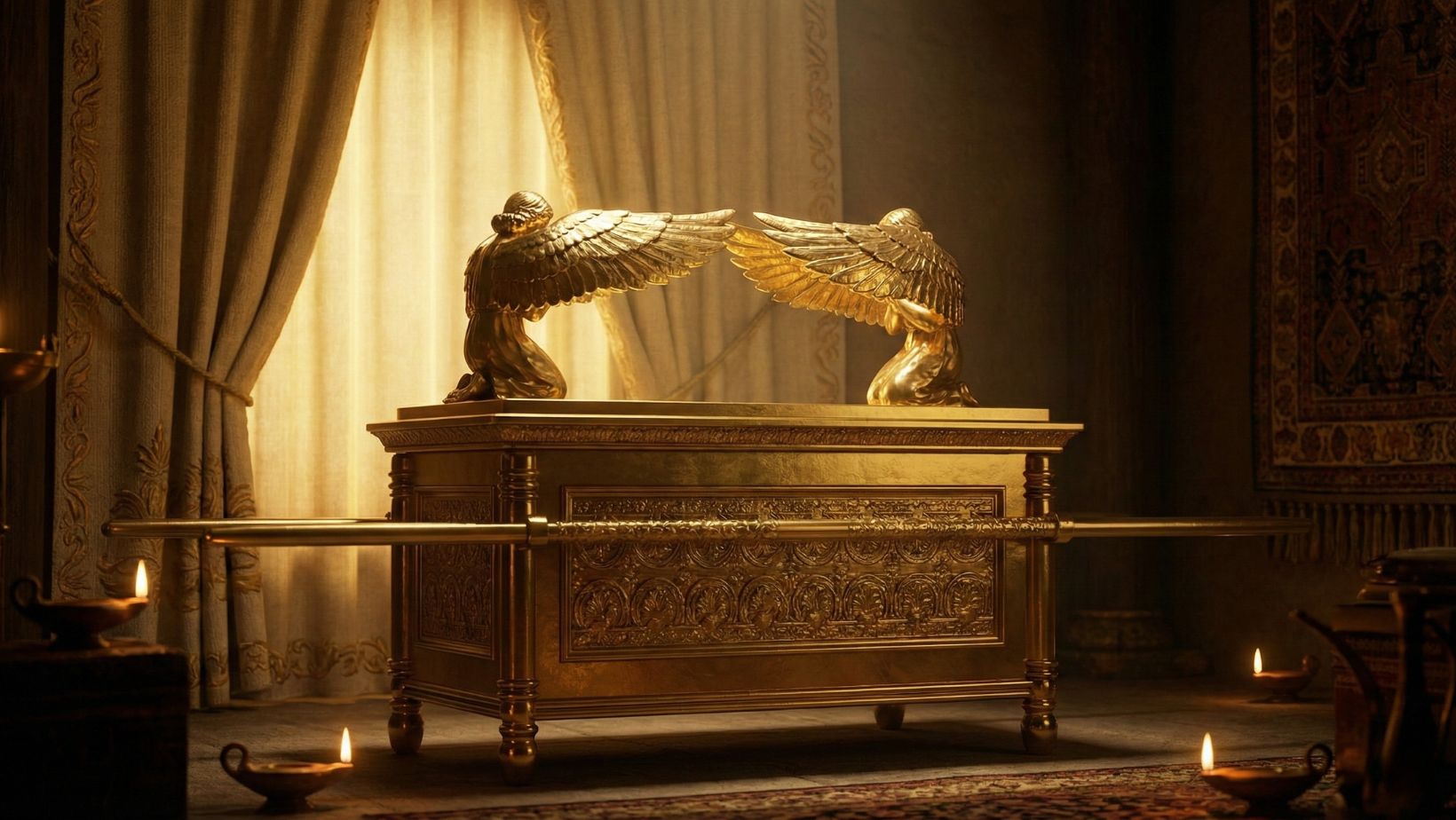
10 “Have the people make an Ark of acacia wood—a sacred chest 45 inches long, 27 inches wide, and 27 inches high. 11 Overlay it inside and outside with pure gold, and run a molding of gold all around it. 12 Cast four gold rings and attach them to its four feet, two rings on each side. 13 Make poles from acacia wood and overlay them with gold. 14 Insert the poles into the rings at the sides of the Ark to carry it. 15 These carrying poles must stay into the rings; never remove them. 16 When the Ark is finished, place inside it the stone tablets inscribed with the terms of the covenant, which I will give to you. 17 “Then make the Ark’s cover—the place of atonement—from pure gold. It must be 45 inches long and 27 inches wide. 18 Then make two cherubim from hammered gold, and place them on the two ends of the atonement cover. 19 Mold the cherubim on each end of the atonement cover, making it all of one piece of gold. 20 The cherubim will face each other and look down on the atonement cover. With wings spread out above, they will protect the cover. 21 Place the atonement cover on top of the Ark, and put inside the Ark the tablets of the covenant that I will give to you. 22 I will meet with you there and talk to you from above the atonement cover between the gold cherubim that hover over the Ark of the Covenant. From there I will give you my commands for the people of Israel.
- The Ark (v. 10): The first item described is the most important. It is the only furniture placed in the Most Holy Place. It represents the throne of God on earth.
- The Content (v. 16): It contains the “terms of the covenant” (the Ten Commandments). This signifies that God’s presence is founded upon His holy Law.
- The Atonement Cover (v. 17): Often called the “Mercy Seat” (Hebrew kapporet). It is made of pure gold, separate from the chest. It is here that blood was sprinkled on the Day of Atonement to satisfy the requirements of the Law for the sins of the people.
- The Cherubim (vv. 18–20): These celestial beings represent the guardians of God’s holiness (reminiscent of the cherubim guarding Eden). Their downward gaze toward the cover suggests that even the heavenly host marvels at God’s mercy.
- The Meeting Place (v. 22): God promises to meet Moses “above the atonement cover.” Redemption (mercy) is the specific location where a holy God can commune with a sinful people.
3. The Table for the Bread of Presence (Exodus 25:23–30 NLT)
23 “Then make a table of acacia wood, 36 inches long, 18 inches wide, and 27 inches high. 24 Overlay it with pure gold and run a gold molding around the edge. 25 Make a rim 3 inches wide and decorate it with a gold molding. 26 Make four gold rings for the table and attach them at the four corners, next to the four legs. 27 Attach the rings near the rim to hold the poles used to carry the table. 28 Make these poles from acacia wood and overlay them with gold. 29 Make special containers of pure gold for the table—bowls, ladles, pitchers, and jars—to be used in pouring out liquid offerings. 30 Place the Bread of the Presence on the table to remain before me at all times.
- The Table (v. 23): Located in the Holy Place, this piece of furniture emphasizes fellowship. In the ancient Near East, eating a meal together was a sign of peace and a ratified covenant.
- The Bread of Presence (v. 30): Also called “Showbread.” There were twelve loaves (representing the twelve tribes). It symbolized God’s constant provision for His people and their constant presence before Him.
4. The Pure Gold Lampstand (Exodus 25:31–40 NLT)
31 “Make a lampstand of pure, hammered gold. Make the entire lampstand and its decorations of one piece—the base, center stem, lamp cups, buds, and petals. 32 Make it with six branches going out from the center stem, three on each side. 33 Each of the six branches will have three lamp cups shaped like almond blossoms, complete with buds and petals. 34 Craft the center stem of the lampstand with four lamp cups shaped like almond blossoms, complete with buds and petals. 35 There will also be a bud beneath each pair of branches where the six branches extend from the center stem, all made of one piece. 36 The buds and branches must all be of one piece with the center stem of pure, hammered gold. 37 Then make the seven lamps for the lampstand, and set them up so they shed light on the area in front of it. 38 The lamp tongs and trays must also be made of pure gold. 39 You will need 75 pounds of pure gold for the lampstand and its accessories. 40 “Be sure that you make everything according to the pattern I have shown you here on the mountain.
- The Lampstand (Menorah) (v. 31): This provided the only light in the Tabernacle. It was hammered from a single talent (approx. 75 lbs) of pure gold.
- Almond Blossom Design (v. 33): The almond tree is the first to bloom in Israel, symbolizing watchfulness and the quickening of life. It also points back to the Tree of Life in Eden.
- Source of Light (v. 37): The seven lamps represent the fullness of God’s Spirit and His role as the light of the world, guiding His people through the darkness of the wilderness.
Theological Significance of Exodus 25
- Immanuel (God with Us): This chapter is the blueprint for God’s dwelling. It foreshadows John 1:14, where the Word became flesh and “tabernacled” among us.
- The Way to God: The order of the furniture moves from the inside out (from the Ark to the outer structures). God initiates the movement toward man from His throne of grace.
- Christological Shadows: * The Ark represents Christ as the intersection of Law and Mercy.
- The Table represents Christ as the Bread of Life.
- The Lampstand represents Christ as the Light of the World.
Practical Applications
- Giving from the Heart: God values the motive of the giver over the amount given. We are called to contribute to God’s work with joy, not out of legalistic debt.
- Attention to Detail: God cares about the “pattern.” In our walk with Him, obedience to His specific Word matters more than our creative shortcuts.
- The Centrality of God’s Presence: The camp was arranged around the Tabernacle. Our lives should be structured with God’s presence at the absolute center, not as a peripheral addition.







Leave a Reply