
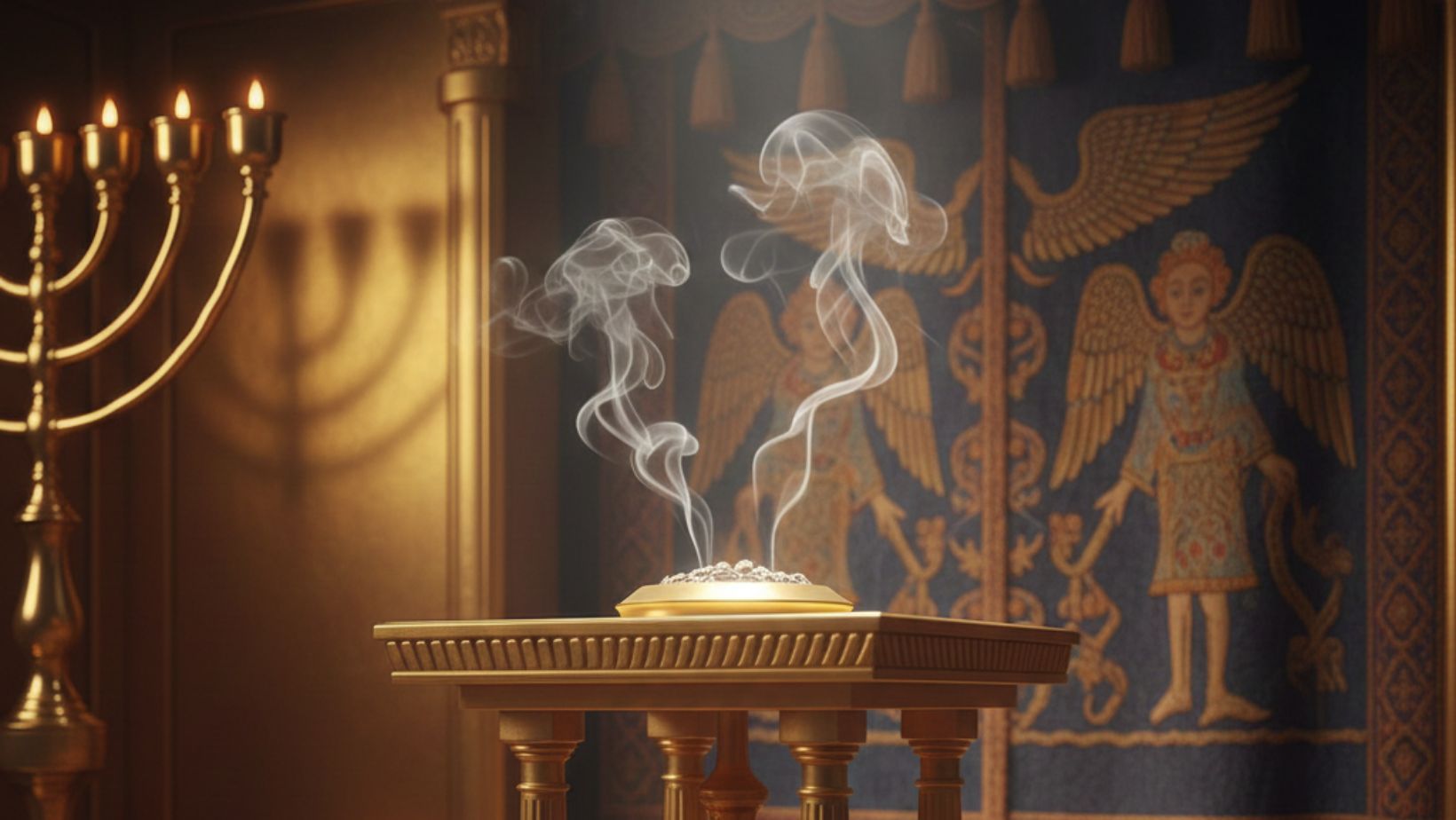
Exodus 30 completes the instructions for the Tabernacle’s interior furniture and introduces vital regulations for maintaining the priesthood and the sanctuary. It describes the Altar of Incense (the place of prayer), the Census Tax (the support for the sanctuary), the Bronze Basin (the means of daily cleansing), and the Holy Anointing Oil and Incense (the exclusive elements of worship). The chapter emphasizes that approaching God requires specific preparation: intercession, ransom, cleansing, and setting apart what is holy from what is common.
1. The Altar of Incense (Exodus 30:1–10 NLT)
1 “Then make another altar of acacia wood for burning incense. 2 Make it 18 inches square and 36 inches high, with horns at the corners carved from the same piece of wood as the altar itself. 3 Overlay the top, sides, and horns of the altar with pure gold, and run a gold molding around the entire altar. 4 Make two gold rings, and attach them on opposite sides of the altar below the gold molding to hold the carrying poles. 5 Make the poles of acacia wood and overlay them with gold. 6 Place the incense altar just outside the inner curtain that shields the Ark of the Covenant, in front of the atonement cover of the Ark. I will meet with you there. 7 “Every morning when Aaron maintains the lamps, he must burn fragrant incense on the altar. 8 And each evening when he lights the lamps, he must again burn incense in the Lord’s presence. This must be done from generation to generation. 9 Do not offer any unholy incense on this altar, or any burnt offerings, grain offerings, or liquid offerings. 10 “Once a year Aaron must purify the altar by smearing its horns with blood from the offering made to purify the people from their sin. This will be a regular, annual event from generation to generation, for this is the Lord’s most holy altar.”
Commentary:
- Location and Purpose (v. 1, 6): Unlike the large Bronze Altar outside (for sacrifice), this smaller Golden Altar stood inside the Holy Place, directly before the veil. It represents the prayers of the saints (Revelation 5:8, 8:3-4) ascending to God. It was the closest piece of furniture to the Ark of the Covenant, separated only by the curtain.
- Dimensions and Materials (v. 2-3): It was relatively small (1.5 feet square, 3 feet high) compared to the sacrificial altar. Its overlay of “pure gold” signifies the divine nature and purity required in prayer and intercession.
- Perpetual Incense (v. 7-8): Incense was burned morning and evening, coinciding with the daily sacrifices and the tending of the lamps. This teaches that prayer should be as constant and rhythmic as the daily maintenance of our spiritual lives.
- “Strange” Fire (v. 9): The prohibition against “unholy incense” (or “strange incense”) warns against worshiping God in self-invented ways or with wrong motives. Nadab and Abihu later died for violating this principle (Leviticus 10:1-2).
- Day of Atonement Connection (v. 10): Once a year (Yom Kippur), blood was applied to the horns of this altar. This signifies that even our worship and prayers need cleansing because they are offered by imperfect people.
2. The Ransom Money (Exodus 30:11–16 NLT)
11 And the Lord said to Moses, 12 “Whenever you take a census of the people of Israel, each man who is counted must pay a ransom for himself to the Lord. Then no plague will strike the people as you count them. 13 Each person who is counted must give a small piece of silver as a sacred offering to the Lord. This payment is half a shekel, based on the sanctuary shekel, which equals twenty gerahs. 14 All who have reached their twentieth birthday must give this sacred offering to the Lord. 15 When this offering is given to the Lord to purify your lives, making you right with him, the rich must not give more than the specified amount, and the poor must not give less. 16 Receive this ransom money from the Israelites, and use it for the care of the Tabernacle. It will bring the Israelites to the Lord’s attention, and it will purify your lives.”
Commentary:
- The Danger of Counting (v. 12): Taking a census in the ancient world was often an act of pride (measuring military strength) or ownership. God required a “ransom” to remind them that they belonged to Him, not to the king or the nation. This prevented a “plague” of judgment.
- Equality of Souls (v. 15): The flat rate of half a shekel (approx. 6 grams of silver) for everyone—rich and poor alike—establishes a profound spiritual truth: every soul has equal value before God. Redemption cannot be bought with wealth; the price of a soul is constant.
- Purpose of the Silver (v. 16): This money was used for the “service of the tent of meeting.” Historically, this silver was melted down to make the sockets (bases) for the Tabernacle’s frames (Exodus 38:27). Thus, the very foundation of the sanctuary rested on the redemption of the people.
- Atonement (v. 16): The text says it is to “make atonement” (purify lives). While silver cannot forgive sin, this payment was a memorial acknowledging that their lives were forfeited to sin and bought back by God.
3. The Bronze Basin (Exodus 30:17–21 NLT)
17 Then the Lord said to Moses, 18 “Make a bronze washbasin with a bronze stand. Place it between the Tabernacle and the altar, and fill it with water. 19 Aaron and his sons will wash their hands and feet there. 20 They must wash with water whenever they go into the Tabernacle to appear before the Lord and when they approach the altar to burn up their special gifts to the Lord—or they will die! 21 They must always wash their hands and feet, or they will die. This is a permanent law for Aaron and his descendants, to be kept from generation to generation.”
Commentary:
- Placement (v. 18): The basin (or laver) was positioned between the Altar of Burnt Offering and the entrance to the Holy Place. This signifies that after atonement (the altar), one must still undergo cleansing (the basin) before entering fellowship (the Holy Place).
- Mirror Connection: Although not mentioned here, Exodus 38:8 reveals this basin was made from the bronze mirrors of the women. Instruments of vanity were transformed into instruments of cleansing—a powerful picture of repentance.
- Sanctification (v. 19): Washing hands and feet symbolized the removal of the daily defilement gathered from walking in a sinful world. Jesus alluded to this in John 13:10 (“He who is bathed needs only to wash his feet”).
- Severity (v. 20-21): The phrase “or they will die” is repeated. This underscores that God’s holiness is not a trivial matter. Casual approach to the divine presence was fatal. Cleanliness was quite literally next to Godliness.
4. The Anointing Oil and Incense (Exodus 30:22–38 NLT)
22 Then the Lord said to Moses, 23 “Collect choice spices—12 1/2 pounds of pure myrrh, 6 1/4 pounds of fragrant cinnamon, 6 1/4 pounds of fragrant calamus, 24 and 12 1/2 pounds of cassia—as measured by the weight of the sanctuary shekel. Also get one gallon of olive oil. 25 Like a skilled incense maker, blend these ingredients to make a holy anointing oil. 26 Use this sacred oil to anoint the Tabernacle, the Ark of the Covenant, 27 the table and all its utensils, the lampstand and all its accessories, the incense altar, 28 the altar of burnt offering and all its utensils, and the washbasin with its stand. 29 Consecrate them to make them most holy. After this, whatever touches them will become holy. 30 “Anoint Aaron and his sons also, consecrating them to serve me as priests. 31 And say to the people of Israel, ‘This holy anointing oil is reserved for me from generation to generation. 32 It must never be used to anoint anyone else, and you must never make any blend like it for yourselves. It is holy, and you must treat it as holy. 33 Anyone who makes a blend like it or acts like a priest by anointing someone who is not a priest will be cut off from the community.’” 34 Then the Lord said to Moses, “Gather fragrant spices—resin droplets, mollusk shell, and galbanum—and mix these fragrant spices with pure frankincense, weighing out equal amounts of each. 35 Using the usual techniques of the incense maker, blend the spices together and sprinkle them with salt to produce a pure and holy incense. 36 Grind some of the mixture into a very fine powder and put it in front of the Ark of the Covenant, where I will meet with you in the Tabernacle. You must treat this incense as most holy. 37 Never use this formula to make this incense for yourselves. It is reserved for the Lord, and you must treat it as holy. 38 Anyone who makes incense like this for personal use will be cut off from the community.”
Commentary:
- The Recipe (v. 23-25): The anointing oil was a precise mixture of liquid myrrh (suffering/death), sweet cinnamon (uprightness), calamus (fragrance), and cassia (humility), in an olive oil base (the Spirit).
- Most Holy (v. 29): The application of this oil changed the status of objects from “common” (wood, gold, bronze) to “most holy.” It marked them as God’s exclusive property.
- Prohibition (v. 32-33, 37-38): The strict ban on reproducing this oil or incense for personal use (“perfume”) teaches that the things of the Spirit are not for fleshly enjoyment or commercial gain. Worship is not for our entertainment; it is for God’s pleasure.
- Salted Incense (v. 35): Salt was a preservative and a symbol of the covenant (“covenant of salt”). It suggests that true prayer is enduring and free from corruption.
Theological Significance of Exodus 30
- Intercession: The Altar of Incense typifies Christ’s heavenly ministry. Just as incense rose constantly, Christ “always lives to make intercession” for us (Hebrews 7:25).
- Universal Atonement: The census tax shows that all people, regardless of status, have an equal need for redemption. The “price” of a soul is the same.
- Sanctification: The Bronze Basin teaches that while justification (the Altar) happens once, sanctification (washing) is a daily necessity for fellowship with God.
- Exclusivity of Worship: The specific recipes for oil and incense remind us that God determines how He is to be worshiped. We cannot approach Him on our own terms or with “counterfeit” spirituality.
Practical Applications
- Prayer Discipline: The morning and evening incense (v. 7-8) encourages us to begin and end our days in prayer, keeping the “aroma” of Christ in our homes.
- Giving: The half-shekel offering reminds us that supporting the work of God’s kingdom is a corporate responsibility where everyone participates.
- Confession: Just as the priests washed daily, we should regularly confess our sins to maintain a clear conscience and open fellowship with God (1 John 1:9).
- Reverence: The warnings “or they will die” and “cut off from the community” serve as a sobering reminder to treat holy things with reverence in an age that often treats God casually.







Leave a Reply