
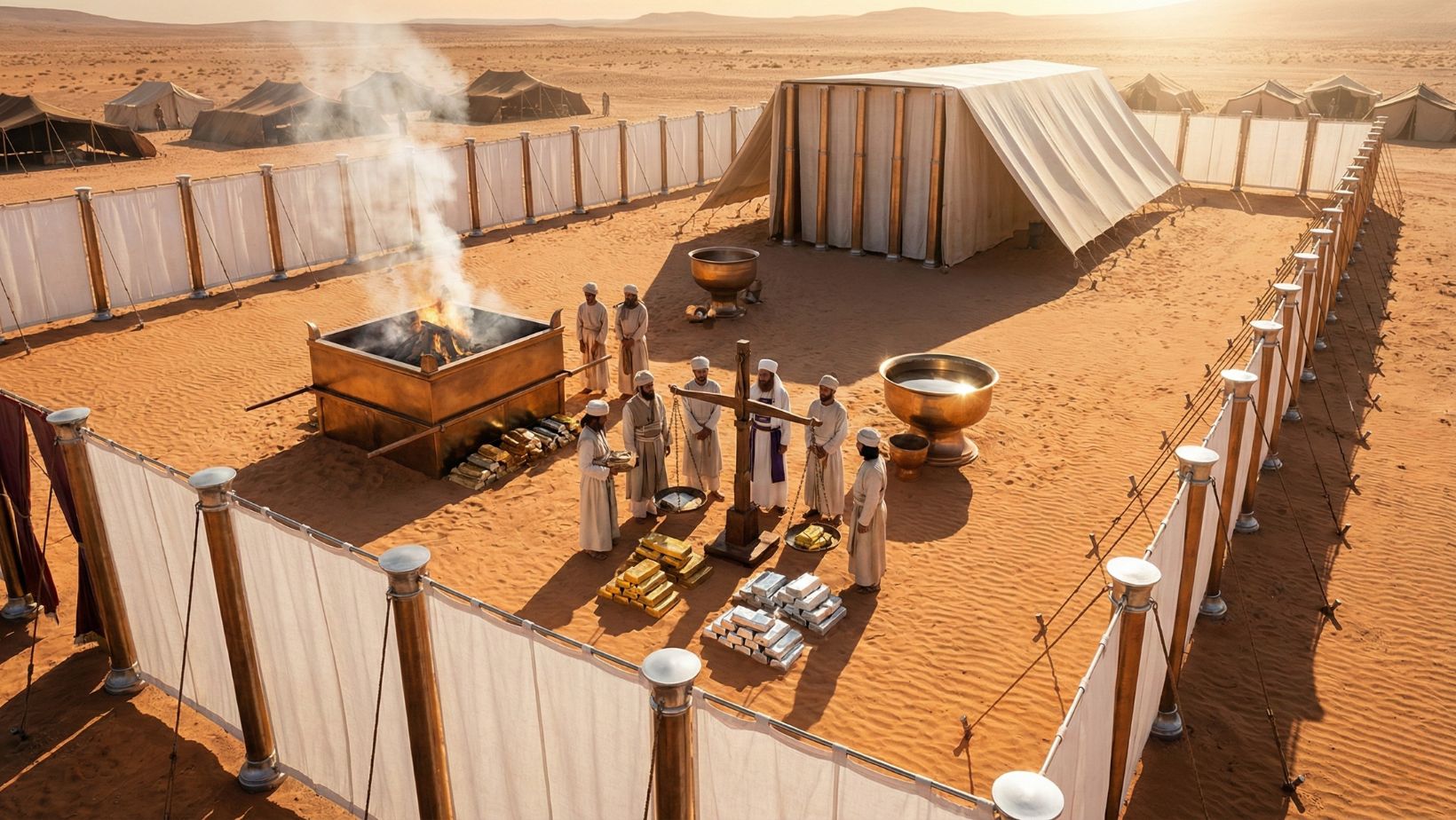
Exodus 38 moves from the “inner sanctum” to the “outer courtyard.” This chapter documents the construction of the furniture used for sacrifice and cleansing—the Bronze Altar and the Bronze Washbasin—and the assembly of the courtyard walls. While the interior furniture was made of gold, these outer items were made of bronze, symbolizing judgment and durability. A unique highlight of this chapter is the record of the “women who served at the entrance,” whose donation of bronze mirrors provided the material for the washbasin. The chapter concludes with a detailed “inventory” or accounting of the metals used, demonstrating the transparency and stewardship of the leaders.
1. The Altar of Burnt Offering (Exodus 38:1–7 NLT)
1 Then Bezalel used acacia wood to construct the altar of burnt offering. It was 7½ feet square and 4½ feet high. 2 He made horns at each of the four corners so that the horns and altar were all one piece. He overlaid the altar with bronze. 3 He made all the altar utensils of bronze—the ash buckets, shovels, basins, meat forks, and firepans. 4 He made a bronze grating and installed it halfway down from the top, under the ledge. 5 He cast four rings and attached them to the four corners of the bronze grating to hold the carrying poles. 6 He made the poles of acacia wood and overlaid them with bronze. 7 He inserted the poles through the rings on the sides of the altar to carry it. The altar was hollow and was made from planks.
Commentary:
- The Place of Sacrifice (v. 1): This altar was the first thing a person would see upon entering the courtyard. It was much larger than the Altar of Incense. Its size and position emphasized that no one could approach God without a sacrifice for sin.
- The Use of Bronze (v. 2): Bronze (an alloy of copper and tin) has a much higher melting point than gold or silver, making it the perfect material for an altar characterized by constant fire. In biblical symbolism, bronze often represents judgment.
- The Grating (v. 4): The bronze mesh inside allowed ashes to fall through while keeping the sacrifice in the fire. This ensured the fire remained oxygenated and the offering was completely consumed.
Insight: The Bronze Altar is a clear type of the Cross. It reminds us that “without the shedding of blood, there is no forgiveness” (Hebrews 9:22). Before we can enjoy fellowship (at the Table) or light (at the Lampstand), our sin must be dealt with by fire and blood.
2. The Washbasin from Mirrors (Exodus 38:8 NLT)
8 Bezalel made the bronze washbasin and its bronze stand from the bronze mirrors donated by the women who served at the entrance of the Tabernacle.
Commentary:
- The Source of the Material (v. 8): In ancient times, mirrors were made of highly polished bronze, not glass. The women gave up a tool used for self-examination and vanity to create a tool for spiritual cleansing.
- The Purpose of Cleansing: The basin (Laver) was located between the Altar and the Tent. Priests had to wash their hands and feet before entering God’s presence.
- The Women who Served: This brief mention honors the women who had a dedicated role in the sanctuary’s daily operations, showing that the Tabernacle was a community effort involving both genders.
Insight: The mirrors revealed the dirt; the washbasin removed it. This is a picture of the Word of God and the Holy Spirit. The Word shows us our true condition (James 1:23-25), and the Spirit cleanses us from the “dust” of the world.
3. The Courtyard Walls (Exodus 38:9–20 NLT)
9 Then Bezalel made the courtyard, which was enclosed with curtains made of finely woven linen. On the south side, the curtains were 150 feet long. 10 They were held up by twenty posts set securely in twenty bronze bases. The curtains were held up with silver hooks and rings. 11 He made a similar set of curtains for the north side—150 feet of curtains held up by twenty posts set securely in twenty bronze bases. The curtains were held up with silver hooks and rings. 12 The curtains on the west side of the courtyard were 75 feet long, hung from ten posts set in ten bases, with silver hooks and rings. 13 The east side, the front, was also 75 feet long. 14 The courtyard entrance was on the east side, flanked by two curtains. The curtain on the right side was 22½ feet long and was hung from three posts set in three bases. 15 The curtain on the left side was also 22½ feet long and was hung from three posts set in three bases. 16 All the curtains used in the courtyard were made of finely woven linen. 17 Each post had a bronze base, and the hooks and rings were silver. The tops of the posts were overlaid with silver, and the rings to hold the curtains were made of silver. All the posts of the courtyard were tied together with silver rods. 18 He made the curtain for the entrance to the courtyard of finely woven linen, and he decorated it with beautiful embroidery in blue, purple, and scarlet thread. It was 30 feet long and 7½ feet high, just like the curtains of the courtyard walls. 19 It was hung from four posts set securely in four bronze bases. The tops of the posts were overlaid with silver, and the hooks and rings were made of silver. 20 All the tent pegs used in the Tabernacle and courtyard were made of bronze.
Commentary:
- Boundary and Separation (v. 9): The white linen fence created a clear boundary between the “common” desert and the “holy” ground. It stood 7.5 feet high, meaning a person could not see over it; they had to enter through the gate.
- The Gate (v. 18): Like the inner curtains, the gate featured blue, purple, and scarlet thread. There was only one gate into the courtyard, emphasizing that there is only one way to God.
- Silver Hooks and Rods (v. 17): The silver “connecting rods” held the posts in unity. Since silver represents redemption, the wall of the sanctuary was literally held together by the “price of redemption.”
Insight: The white linen fence represents the righteousness of God. From a distance, the Tabernacle appeared as a wall of pure white—a reminder that God is holy and separate from sin.
4. The Inventory of Materials (Exodus 38:21–31 NLT)
21 This is an inventory of the materials used in building the Tabernacle of the Covenant. The Levites compiled the figures, as Moses directed, and Ithamar son of Aaron the priest served as recorder. 22 Bezalel son of Uri, grandson of Hur, of the tribe of Judah, made everything the Lord had commanded Moses. 23 He was assisted by Oholiab son of Ahisamach, of the tribe of Dan, a craftsman expert at engraving, designing, and embroidering with blue, purple, and scarlet thread on fine linen cloth. 24 The people brought special offerings of gold totaling 2,193 pounds, as measured by the weight of the sanctuary shekel. 25 The silver was collected from the men of the community who were registered in the census. The silver totaled 7,545 pounds, as measured by the weight of the sanctuary shekel. 26 This silver came from the tax of one beka (which is half a shekel) collected from each person registered in the census. The total number of men 20 years old or older was 603,550. 27 The 100 bases for the frames of the sanctuary and for the inner curtain required 7,500 pounds of silver—about 75 pounds for each base. 28 The remaining 45 pounds of silver were used to make the hooks and rings and to overlay the tops of the posts. 29 The people also brought special offerings of bronze, which totaled 5,310 pounds. 30 Bezalel used the bronze to make the bases for the posts at the entrance to the Tabernacle, the bronze altar and its bronze grating, and all the altar utensils. 31 He also used it to make the bases for the posts that supported the curtains around the courtyard, the bases for the posts at the entrance to the courtyard, and all the tent pegs for the Tabernacle and the courtyard.
Commentary:
- Accountability (v. 21): Moses ensures a public accounting of the massive wealth donated. This prevented any rumors of embezzlement and established a standard for integrity in religious leadership.
- The Gold (v. 24): Over a ton of gold was used. Much of this would be inside, where only God and the priests would see it.
- The Silver and the Census (v. 25–26): The silver did not come from a “freewill” offering, but from a “ransom” tax (see Exodus 30:11-16). Every man, regardless of wealth, paid the same amount. This proves that every soul is of equal value to God and that everyone had a literal “stake” in the foundation of the Tabernacle.
- The Bronze (v. 29): About 2.5 tons of bronze were used for the heavy-duty equipment of the courtyard.
Theological Significance of Exodus 38
- The Order of Approach: One must first pass the Altar (Sacrifice) and the Washbasin (Cleansing) before entering the Sanctuary. You cannot have the “Gold” of God’s presence without first dealing with the “Bronze” of His judgment.
- Transparency in Ministry: The detailed inventory shows that God cares about administrative integrity. Sacred work must be done with secular honesty.
- Sacrificial Vanity: The women’s gift of their mirrors teaches that we must be willing to give up our “self-image” to better reflect the “image of God.”
- Equality in Redemption: The silver tax paid by the 603,550 men shows that redemption is not bought by wealth, but is a requirement for all.
Practical Applications
- Visit the Altar Daily: Start your day by acknowledging the sacrifice of Jesus. Don’t try to “do” for God until you have accepted what He has “done” for you.
- Wash Your Hands: Before you serve or worship, ask the Holy Spirit to cleanse you from the day’s “dust”—bitterness, pride, or worldly thoughts.
- Be Accountable: If you handle money or resources for God’s work, be beyond reproach. Transparency builds trust and honors God.
- Give Your “Mirrors”: What are the things you use to build up your own ego? Are you willing to surrender them to God so He can use them for His glory?
Possible Sermon Titles from the Chapter
- The Altar Before the Door.
- From Mirrors to Ministry.
- The Price of a Soul: The Silver of the Census.
- Counting the Cost: Integrity in the House of God.
- Behind the White Linen Fence.







Leave a Reply