
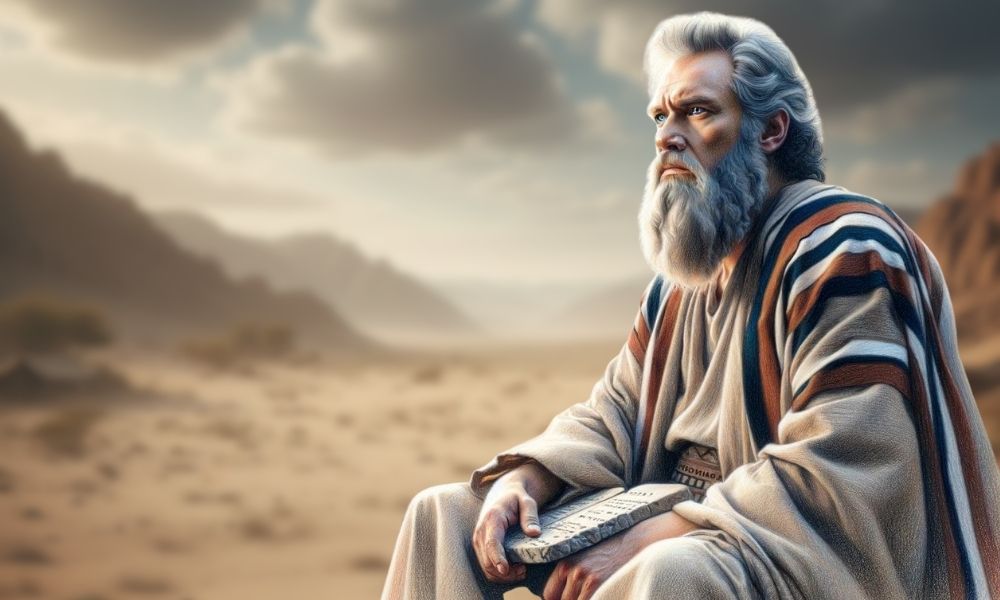
The Ten Commandments, also called the Decalogue, are the divine laws spoken by God to Moses and the people of Israel at Mount Sinai. They reveal God’s moral will for humanity, establishing how His people are to live in relationship with Him and with one another. These ten divine words form the heart of the covenant between God and His chosen nation — a covenant of holiness, justice, and love.
Quick Facts
Name: The Ten Commandments (Hebrew: Aseret ha-Dibrot, “Ten Words”)
Given By: God Himself
Delivered Through: Moses, the lawgiver and prophet
Location: Mount Sinai (also called Mount Horeb)
Date: c. 13th–15th century BCE (during Israel’s Exodus from Egypt)
Language: Hebrew
Medium: Two tablets of stone written by the finger of God (Exodus 31:18)
Scriptural Sources: Exodus 20:1–17; Deuteronomy 5:6–21
Purpose: To define God’s covenant relationship and moral law for His people
Symbol: The Two Tablets — representing love for God and love for others
Legacy: Foundation of Biblical morality and Western ethics
The Story of the Ten Commandments
1. God’s People Freed from Slavery
After centuries of bondage in Egypt, the children of Israel cried out to God for deliverance. The Lord raised up Moses, a Hebrew man once raised in Pharaoh’s palace, to lead His people to freedom. Through miraculous plagues and the parting of the Red Sea, God revealed His mighty power, rescuing Israel from their oppressors.
As they journeyed through the wilderness, the people learned that freedom was not simply the absence of chains, but the call to live under God’s rule and holiness. Redemption demanded obedience — not as slavery, but as covenant relationship.
2. The Journey to Mount Sinai
Three months after leaving Egypt, the Israelites came to the wilderness of Sinai and camped before the mountain. There, the Lord called to Moses from the summit:
“You have seen what I did to the Egyptians, and how I bore you on eagles’ wings and brought you to Myself.
Now therefore, if you will indeed obey My voice and keep My covenant, you shall be My treasured possession among all peoples.”
— Exodus 19:4–5
The people answered with one voice:
“All that the Lord has spoken, we will do.”
A covenant was about to be sealed — not of mere ritual, but of heart and obedience.
3. The Mountain Trembles
On the appointed day, Mount Sinai became wrapped in thick smoke, for the Lord descended upon it in fire. Thunder roared, lightning flashed, and a trumpet blast grew louder and louder. The mountain quaked violently, and the people trembled at the foot of it.
Then God Himself spoke — His voice rolling like thunder across the wilderness — declaring His eternal law to His people.
The Ten Commandments (Exodus 20:1–17)
- “You shall have no other gods before Me.”
God alone is to be worshiped. No rival or false deity can stand beside Him. He is Israel’s Redeemer and Lord. - “You shall not make for yourself an idol.”
God cannot be contained in any image or likeness. True worship is spiritual, pure, and from the heart. - “You shall not take the name of the LORD your God in vain.”
God’s name is holy. It must never be spoken carelessly, falsely, or irreverently. - “Remember the Sabbath day, to keep it holy.”
Six days shall you labor, but the seventh is for rest and worship — a sign of God’s creation and covenant. - “Honor your father and your mother.”
Respect for parents is the foundation of family, community, and long life in the land. - “You shall not murder.”
Life is sacred, for humanity is made in the image of God. - “You shall not commit adultery.”
Faithfulness in marriage reflects God’s own covenant faithfulness. - “You shall not steal.”
Respect what belongs to others; walk in honesty and contentment. - “You shall not bear false witness.”
Speak truth. Do not deceive, lie, or destroy another’s reputation. - “You shall not covet…”
Guard your heart from envy and greed; desire what is good in God’s sight.
4. The Tablets of Stone
After the people heard God’s voice, they trembled and said to Moses, “You speak to us, and we will listen; but let not God speak with us, lest we die.”
So Moses drew near to the cloud where God’s presence burned. There, for forty days and forty nights, God gave him two tablets of stone, written by His own finger — a visible sign of the covenant between heaven and earth.
These tablets were not mere words; they were the foundation of divine law — expressing God’s holiness and the pattern of righteous living for His people.
5. The Sin of the Golden Calf
But while Moses was on the mountain, the people grew restless. They gathered around Aaron and said, “Make us gods who will go before us!” Aaron took their gold and shaped it into a golden calf, and the people bowed down to it.
When Moses descended and saw their sin, his anger burned. He threw down the tablets, breaking them — a powerful symbol that Israel had already broken God’s covenant.
Yet God, in mercy, called Moses to ascend once more. He renewed the covenant and rewrote the Ten Commandments on new tablets — a sign of forgiveness and God’s enduring grace.
6. The Law and Its Purpose
The Ten Commandments were more than a national code; they revealed the character of God:
- Holy — demanding purity and reverence.
- Just — upholding life, truth, and righteousness.
- Loving — protecting family, community, and faith.
They also exposed humanity’s sinfulness. No one could perfectly keep them, and thus they pointed forward to the need for a Savior — one who would fulfill the law in righteousness and love.
7. Fulfillment in Christ
Centuries later, Jesus Christ came, the Word made flesh, perfectly obedient to the law. He declared:
“Do not think that I came to destroy the Law or the Prophets; I did not come to destroy but to fulfill.”
— Matthew 5:17
When asked which commandment was greatest, Jesus summarized the entire law in two commands:
- Love the Lord your God with all your heart, soul, and mind.
- Love your neighbor as yourself.
(Matthew 22:37–40)
Through Christ, the moral law was not abolished but fulfilled and written on the hearts of believers by the Holy Spirit (Jeremiah 31:33).
8. Legacy and Lasting Impact
The Ten Commandments remain central to Jewish and Christian faith, shaping moral law, worship, and justice for over three millennia. Their influence extends beyond religion — forming the foundation for Western ethics, law, and human rights.
They remind every generation that:
- God is sovereign.
- Life and truth are sacred.
- Love fulfills the law.
9. Closing Thoughts
When Moses came down from the mountain, his face shone with the glory of God. The tablets were placed in the Ark of the Covenant, kept in the Most Holy Place as a symbol of God’s presence and law among His people.
The story of the Ten Commandments is, above all, the story of a holy God drawing near to a redeemed people, teaching them how to live in covenant love and obedience — a story ultimately completed in Jesus Christ, the living Word.
“For the law was given through Moses; grace and truth came through Jesus Christ.”
— John 1:17







Leave a Reply