
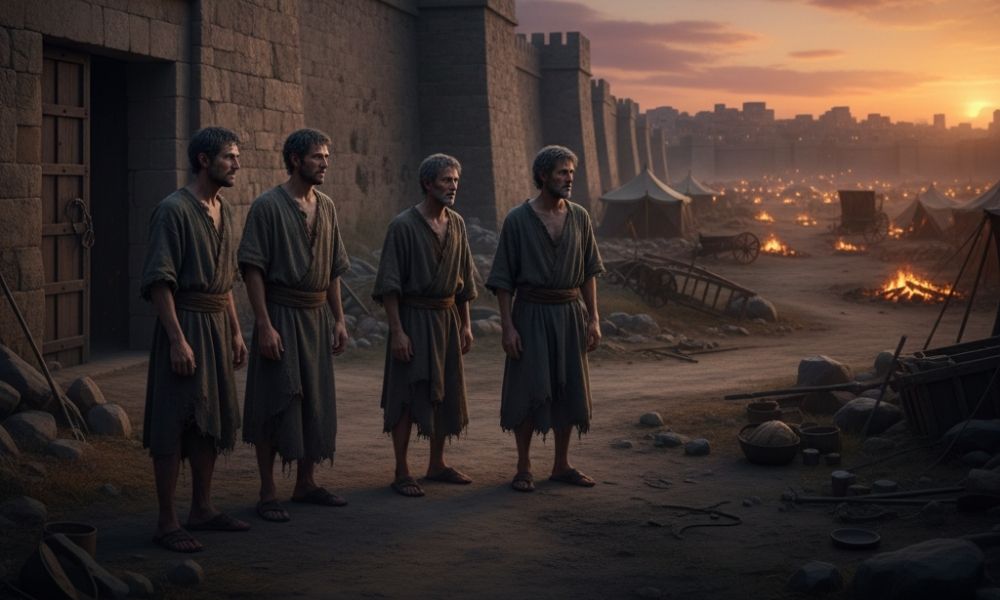
The story of The Four Lepers at the City Gate (2 Kings 7:3–20) is a powerful account of faith, courage, and divine intervention during one of Israel’s darkest moments. As Samaria lay under siege and famine ravaged the land, four outcast lepers made a desperate decision that would change the fate of an entire nation. Through their simple act of courage, God brought deliverance to His people and proved once again that His power often works through the most unlikely individuals.
Quick Facts
Event Name: The Four Lepers at the City Gate
Scripture Reference: 2 Kings 7:3–20
Location: City Gate of Samaria (Capital of the Northern Kingdom of Israel)
Time Period: ~9th century BCE, during the reign of King Jehoram (son of Ahab)
Main Characters: Four unnamed lepers, Prophet Elisha, King Jehoram, Syrian (Aramean) army
Historical Context: Syrian siege of Samaria leading to a severe famine
Divine Intervention: God causes the Syrian army to hear a supernatural sound and flee
Outcome: The city of Samaria is delivered; Elisha’s prophecy is fulfilled
Key Theme: Faith, divine providence, courage, and the sharing of good news
Key Verse: “Why sit we here until we die?” — 2 Kings 7:3
Moral Lesson: God can use the most unlikely people to bring deliverance and fulfill His word.
Background: The Siege and the Famine
The King of Syria (Ben-Hadad) waged war against Israel and besieged Samaria, the capital city. The siege dragged on until famine gripped the land. Prices for food skyrocketed — a donkey’s head sold for eighty pieces of silver — and desperation filled the city.
The situation was so dreadful that some resorted to unthinkable acts of cannibalism (2 Kings 6:28–29). When the king of Israel, Jehoram, heard of this, he tore his clothes in anguish and blamed Elisha, the prophet of God, vowing to have him killed.
But Elisha, calm and confident in God’s word, declared a stunning prophecy:
“Thus says the LORD, Tomorrow about this time shall a measure of fine flour be sold for a shekel, and two measures of barley for a shekel, in the gate of Samaria.”
— 2 Kings 7:1
One of the king’s officers scoffed, saying that such a thing was impossible even if God opened windows in heaven. Elisha warned that the man would see it happen but would not eat of it.
The Four Lepers’ Decision
Outside the city walls sat four leprous men — outcasts by law and shunned by society. They could not enter the city, yet there was no food outside either. Facing certain death, they reasoned among themselves:
“Why sit we here until we die?
If we say, We will enter into the city, then the famine is in the city, and we shall die there:
and if we sit still here, we die also.
Now therefore come, and let us fall unto the host of the Syrians: if they save us alive, we shall live; and if they kill us, we shall but die.”
— 2 Kings 7:3–4
With nothing left to lose, they decided to risk going to the enemy’s camp at twilight.
God’s Miracle at the Syrian Camp
As the lepers approached the Syrian camp, God performed a miraculous intervention. He caused the Syrian army to hear the sound of a mighty force—chariots, horses, and a great army—so real that they believed Israel had hired the Hittite and Egyptian armies to attack them.
Panic struck them, and they fled for their lives at dusk, abandoning everything: tents, horses, donkeys, food, silver, and gold.
“Wherefore they arose and fled in the twilight, and left their tents, and their horses, and their asses, even the camp as it was, and fled for their life.”
— 2 Kings 7:7
The Lepers Discover the Abundance
When the four lepers reached the camp, they were astonished to find it deserted. Hungry and exhausted, they entered a tent, ate and drank freely, and took silver and gold, hiding them away. Then they repeated this in another tent.
But after a while, their conscience spoke:
“We do not well: this day is a day of good tidings, and we hold our peace. If we tarry till the morning light, some mischief will come upon us: now therefore come, that we may go and tell the king’s household.”
— 2 Kings 7:9
They realized it was wrong to keep the good news to themselves while their people were starving, so they hurried back to the city gate to announce what they had found.
The Good News Reaches Samaria
At first, the city guards were skeptical, fearing a Syrian trap. But after scouts were sent to investigate, they found the Syrian camp truly deserted, with the road littered with abandoned garments and equipment.
When the truth was confirmed, the starving people of Samaria rushed out and plundered the camp. Just as Elisha had prophesied, food became plentiful, and prices dropped overnight.
“So a measure of fine flour was sold for a shekel, and two measures of barley for a shekel, according to the word of the LORD.”
— 2 Kings 7:16
In the chaos, the skeptical officer who had mocked Elisha’s prophecy was trampled to death at the gate — fulfilling Elisha’s final word to him.
Lessons and Spiritual Insights
1. God’s Word Never Fails
Elisha’s prophecy was fulfilled exactly as spoken. No circumstance is too desperate for God to change overnight.
“The grass withers, the flower fades, but the word of our God will stand forever.” — Isaiah 40:8
2. God Uses the Weak and Outcast
The deliverers of Samaria were four lepers—men rejected by society. Yet God chose them to bring salvation to the city, proving He often works through the humble and overlooked.
“God has chosen the weak things of the world to confound the mighty.” — 1 Corinthians 1:27
3. Faith Takes Courageous Action
The lepers’ question — “Why sit we here until we die?” — represents faith in action. They stepped forward in desperation and trust, and God moved on their behalf.
Faith does not always wait for ideal conditions; it acts on the word and hope of God.
4. The Good News Must Be Shared
The lepers realized it was wrong to keep silent about the miracle they’d found. This foreshadows the believer’s duty to share the Gospel — the good news of salvation — with a world dying in spiritual famine.
“Go and tell the good news.” — Mark 16:15
Symbolism / Typology
| Symbol | Meaning |
|---|---|
| The Lepers | Humanity—unclean, rejected, yet chosen as messengers of grace |
| The City of Samaria | The world trapped in spiritual famine and fear |
| The Syrian Camp | God’s unexpected provision and victory |
| Elisha’s Prophecy | The certainty of God’s Word |
| The Officer’s Death | The consequence of unbelief |
Summary Table
| Aspect | Description |
|---|---|
| Event | Four lepers discover the empty Syrian camp and save Samaria |
| Location | Samaria, Northern Kingdom of Israel |
| Time Period | ~9th century BCE |
| Key Prophet | Elisha |
| Miracle | Syrians hear phantom army and flee |
| Result | Famine ended, prophecy fulfilled |
| Main Lesson | Faith and obedience lead to divine breakthrough |







Leave a Reply