
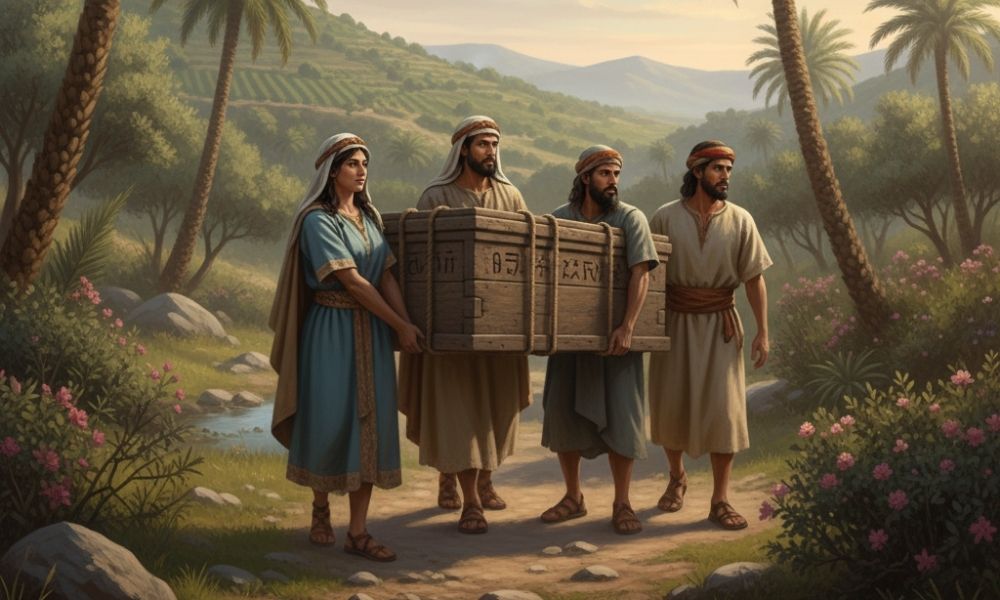
The story of Joseph’s remains being carried from Egypt is a profound testament to faith, covenant, and God’s enduring promises. Though Joseph died centuries before the Exodus, his faith in God’s word was so strong that he made Israel promise to carry his bones to the Promised Land — a promise Moses faithfully fulfilled.
Quick Facts
Name: Joseph (Hebrew: Yosef, meaning “He will add”)
Tribe: Ephraim (son of Jacob and Rachel)
Role in Story: His remains symbolize faith and God’s covenant promise
Event: The Israelites carry Joseph’s bones from Egypt during the Exodus
Main Scriptures: Genesis 50:24–26; Exodus 13:19; Joshua 24:32
Location: Egypt → Wilderness → Shechem (in Canaan)
Key Figures: Joseph, Moses, the Israelites
Symbolism: Faith in God’s promises; continuity of the covenant; hope of resurrection
Background: Joseph’s Life and Faith
Joseph, the beloved son of Jacob and Rachel, was sold into slavery by his brothers but rose to become the second-in-command of Egypt through God’s providence (Genesis 37–41). During a great famine, he saved Egypt and his own family, leading the children of Israel to settle in the land of Goshen.
Even at the height of his power, Joseph’s heart remained tied to God’s promise to Abraham — that his descendants would inherit Canaan, not Egypt.
Before his death, Joseph expressed unshakable faith that God would deliver His people from Egypt:
“God will surely visit you, and you shall carry up my bones from here.”
— Genesis 50:25
Joseph died at the age of 110, and his body was embalmed and placed in a coffin in Egypt (Genesis 50:26).
The Exodus: Fulfilling the Oath
Centuries later, when Moses led the Israelites out of Egypt, he remembered Joseph’s solemn request. Amid the chaos of departure, Moses took care to carry the bones of Joseph, ensuring that Israel’s exodus was not just physical liberation but also the continuation of God’s ancient promise.
“And Moses took the bones of Joseph with him, for he had made the sons of Israel solemnly swear, saying, ‘God will surely visit you, and you shall carry up my bones with you from here.’”
— Exodus 13:19
This act symbolized faithfulness to God’s word and continuity between generations — from the patriarchs to the liberated nation of Israel.
Journey Through the Wilderness
As the Israelites journeyed through the desert, Joseph’s coffin traveled with them, a visible reminder of God’s faithfulness and of the hope that His people would one day inherit the Promised Land.
Through trials, hunger, and wandering, Joseph’s remains became a symbol of perseverance and covenant hope.
The Final Resting Place
After the Israelites entered the Promised Land under Joshua, they finally fulfilled the last part of Joseph’s wish:
“And the bones of Joseph, which the Israelites had brought up from Egypt, were buried at Shechem, in the piece of land that Jacob bought from the sons of Hamor.”
— Joshua 24:32
There, in the heart of Canaan, Joseph’s faith was honored — his bones laid to rest in the very land God had promised.
Lessons and Symbolism
- Faith Beyond Death: Joseph trusted God’s promises even when fulfillment seemed impossible.
- Continuity of Covenant: The act of carrying his bones connected the patriarchal age to the Exodus generation.
- Hope in God’s Faithfulness: What God promises, He will fulfill — even across centuries.
- Legacy of Belief: Joseph’s faith inspired future generations to remember God’s covenant and trust in His timing.
Summary
The story of Joseph’s remains is not merely about carrying bones — it’s about carrying faith, memory, and promise. From the tombs of Egypt to the hills of Canaan, Joseph’s unshakable trust in God testified that His promises never fail.
“By faith Joseph, when his end was near, spoke about the exodus of the Israelites from Egypt and gave instructions concerning the burial of his bones.”
— Hebrews 11:22







Leave a Reply