
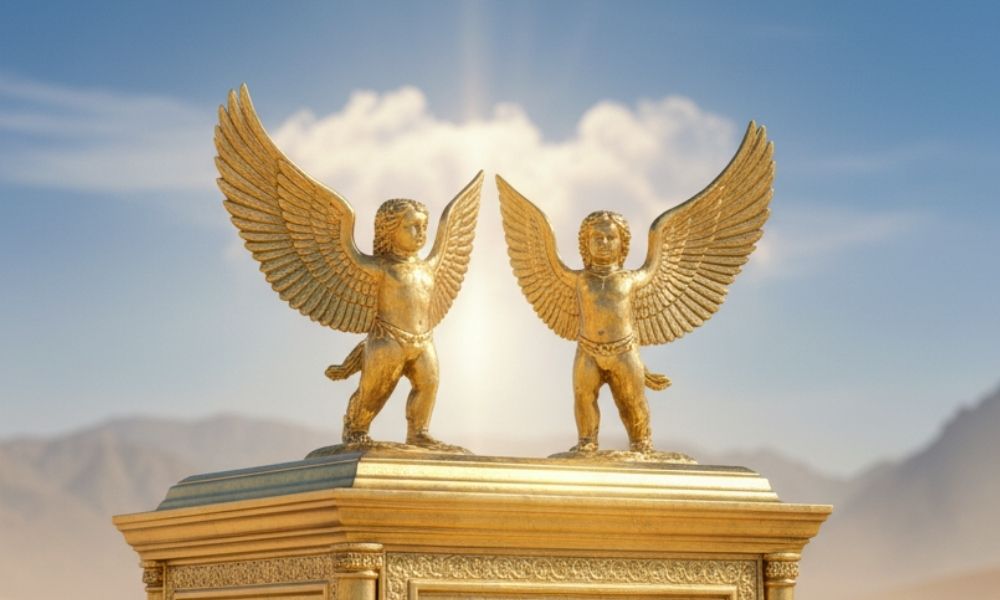
The Mercy Seat (Hebrew: kappōret, meaning “covering” or “place of atonement”) was the golden lid placed atop the Ark of the Covenant in the Most Holy Place (Holy of Holies) within the Tabernacle — later, the Temple. It was the focal point of God’s presence among His people, where atonement for sin was made through the sprinkling of sacrificial blood. The Mercy Seat symbolized God’s throne of grace and justice, where His glory dwelt and where His mercy covered the law beneath it.
Quick Facts
Name: Mercy Seat (kappōret)
Meaning: “Covering,” “propitiation,” or “atonement cover”
Material: Pure gold
Location: On top of the Ark of the Covenant, inside the Holy of Holies
Dimensions: 2½ cubits long (~45 inches) × 1½ cubits wide (~27 inches)
Purpose: Place of divine presence and atonement for sin
Associated Ceremony: Day of Atonement (Yom Kippur)
Key Scriptures: Exodus 25:17–22; Leviticus 16; Hebrews 9:5
Symbolism: God’s throne of mercy; His justice satisfied through blood
Foreshadowing: Jesus Christ as the ultimate atonement and living Mercy Seat
1. Biblical Description and Construction
God commanded Moses to make the Mercy Seat as part of the Ark of the Covenant:
“You shall make a mercy seat of pure gold; two cubits and a half shall be its length, and a cubit and a half its breadth. And you shall make two cherubim of gold… and the cherubim shall stretch out their wings above, covering the mercy seat with their wings.”
— Exodus 25:17–20
The Mercy Seat covered the Ark, which contained:
- The tablets of the Law (God’s covenant commands),
- Aaron’s rod that budded (symbol of divine authority), and
- A golden pot of manna (God’s provision).
This placement was deeply symbolic — the Law (which condemned sin) was beneath the Mercy Seat, but blood was sprinkled above it, showing that mercy triumphs over judgment (cf. James 2:13).
The two cherubim represented heavenly beings who guard God’s holiness. Between them, the Shekinah Glory — the visible presence of God — would appear (Exodus 25:22).
“There I will meet with you, and I will speak with you from above the mercy seat.”
— Exodus 25:22
2. The Mercy Seat and the Day of Atonement (Yom Kippur)
The Mercy Seat played a central role in Israel’s holiest ceremony — the Day of Atonement (Leviticus 16). Once each year, the high priest entered the Holy of Holies, carrying the blood of a sacrificed bull (for his own sins) and a goat (for the sins of the people).
The Ritual Steps:
- The high priest entered with incense to cover the ark with smoke — a sign of reverence.
- He sprinkled the blood of the bull and goat seven times upon and before the Mercy Seat.
- This act symbolized the covering (atonement) of sin — God’s wrath was appeased, and His people were reconciled.
The Hebrew concept of kippur (atonement) literally means “to cover.” Through the blood, sin was symbolically covered, and fellowship with God was restored.
3. Spiritual and Symbolic Meaning
a. God’s Throne of Grace
The Mercy Seat was understood as the earthly throne of God — the point where heaven touched earth. It combined justice and mercy: the Law beneath declared guilt, while the blood above declared forgiveness.
“Righteousness and justice are the foundation of Your throne; mercy and truth go before Your face.”
— Psalm 89:14
b. The Meeting Place Between God and Man
The Mercy Seat was where God said He would “meet” His people — the place of divine revelation and communion. This foreshadowed Christ, who would become the ultimate mediator between God and man (1 Timothy 2:5).
c. The Blood of Atonement
The sprinkled blood signified that sin’s penalty (death) had been paid. It prefigured the blood of Jesus, which not only covers but removes sin entirely (Hebrews 9:11–14).
4. The Mercy Seat Fulfilled in Jesus Christ
The New Testament reveals that the Mercy Seat finds its ultimate fulfillment in Christ.
“God presented Christ as a propitiation (hilastērion) through faith in His blood.”
— Romans 3:25
The Greek word hilastērion is the same term used for Mercy Seat in the Greek Old Testament (Septuagint). Thus, Paul identifies Jesus Himself as the Mercy Seat — the place where God’s justice and mercy meet perfectly.
Christ’s Fulfillment:
- The blood of animals could only cover sin temporarily; Christ’s blood removes it eternally.
- The high priest entered yearly with blood; Christ entered once for all into heaven with His own blood (Hebrews 9:12).
- The veil that separated the Holy of Holies was torn at Christ’s death, signifying open access to God (Matthew 27:51).
Through His sacrifice, believers can now approach the “throne of grace” with confidence (Hebrews 4:16).
5. Symbolism and Typology
| Old Testament Symbol | Meaning | Fulfillment in Christ |
|---|---|---|
| Ark of the Covenant | God’s dwelling and covenant | Christ is God’s presence among us (Emmanuel) |
| Law inside the Ark | Standard of holiness | Christ fulfills the Law (Matthew 5:17) |
| Blood on the Mercy Seat | Temporary covering for sin | Christ’s blood removes sin forever (Hebrews 9:26) |
| Cherubim | Guardians of God’s holiness | Heaven’s witness to redemption |
| High Priest | Mediator for Israel | Christ our eternal High Priest (Hebrews 7:24–25) |
6. Theological Insights
- Mercy Over Judgment: The Mercy Seat illustrates how God’s mercy triumphs over judgment through the shedding of blood (James 2:13).
- Divine Justice Satisfied: Sin must be punished, but atonement allows God to remain just while justifying the sinner (Romans 3:26).
- Heavenly Reality: The earthly Mercy Seat was only a shadow of the heavenly one (Hebrews 8:5). Christ now ministers in the true sanctuary in heaven.
- Access Restored: What Adam lost in Eden — direct fellowship with God — is restored through the blood of Christ at the true Mercy Seat.
7. Legacy and Christian Understanding
The Mercy Seat continues to shape Christian theology and worship:
- It reveals the heart of the Gospel — that salvation is by grace through faith in the shed blood of Christ.
- It transforms the symbol of judgment (the Law) into a symbol of mercy (atonement).
- It inspires confidence for believers to approach God’s presence without fear, knowing that His wrath has been satisfied through Jesus.
“Having therefore, brethren, boldness to enter into the holiest by the blood of Jesus…”
— Hebrews 10:19
8. Summary
The Mercy Seat represents the divine intersection of holiness, justice, and mercy.
In the Old Covenant, it was a golden cover that concealed sin through sacrifice.
In the New Covenant, it is personified in Jesus Christ, whose blood doesn’t merely cover sin — it cleanses it completely.
At the Mercy Seat, sin is confronted, justice is satisfied, and mercy is revealed.







Leave a Reply