
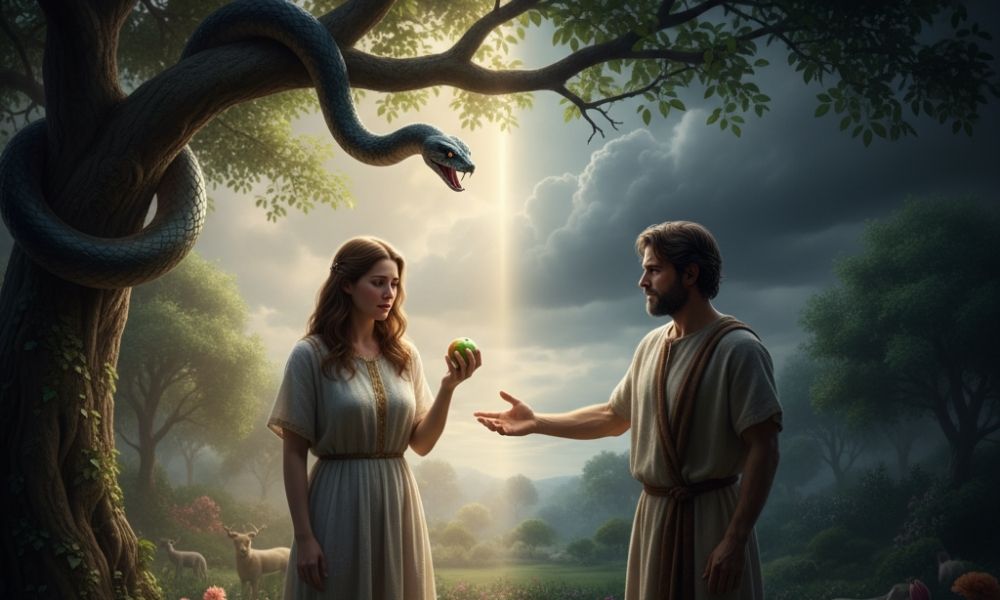
The Fall of Adam and Eve is one of the most pivotal events in all of Scripture — the moment when humanity chose disobedience over trust in God. Set in the paradise of Eden, this event explains the origin of sin, suffering, and death. Though tragic, it also reveals God’s mercy and the first promise of redemption through Christ.
Quick Facts
Event Name: The Fall of Adam and Eve
Location: The Garden of Eden (Genesis 3)
Key Figures: God, Adam, Eve, the Serpent (Satan)
Cause: Disobedience to God’s command not to eat from the Tree of the Knowledge of Good and Evil
Consequence: Introduction of sin, death, and separation from God
Key Scripture: Genesis 3:1–24
Symbolism: The loss of innocence, temptation, free will, and the beginning of God’s redemptive plan
Meaning and Context
The “Fall” refers to humanity’s moral and spiritual descent from innocence and fellowship with God into sin and corruption. This act of disobedience transformed the human condition and the world itself — a single choice that altered creation’s destiny.
Biblical Era / Timeline
Era: Early Creation (Pre-Flood)
Setting: The Garden of Eden — a perfect paradise where Adam and Eve lived in harmony with God, nature, and each other before temptation entered.
The Story of the Fall
1. The Command (Genesis 2:16–17)
God gave Adam a simple, clear command:
“You may freely eat from every tree in the garden, but you must not eat from the Tree of the Knowledge of Good and Evil, for when you eat from it, you will surely die.”
This command tested humanity’s love, obedience, and trust in God’s goodness.
2. The Temptation (Genesis 3:1–6)
- The Serpent, cunning and deceptive, questioned God’s word and planted doubt in Eve’s heart: “Did God really say, ‘You must not eat from any tree in the garden’?”
- Eve, deceived by the serpent’s lies, saw that the fruit was “good for food, pleasing to the eye, and desirable for gaining wisdom.”
- She ate the fruit and gave some to Adam, who also ate — an act of conscious rebellion against God.
3. The Awareness of Sin (Genesis 3:7–8)
- Immediately, their eyes were opened.
- They realized their nakedness, felt shame, and sewed fig leaves to cover themselves.
- When God walked in the garden, they hid, symbolizing the separation that sin brings between humanity and God.
4. The Confrontation and Judgment (Genesis 3:9–19)
God confronted them lovingly but truthfully:
- Adam blamed Eve, and Eve blamed the serpent — revealing the breakdown of unity and trust.
- Judgment fell upon all:
- Yet in judgment, God gave a promise of hope — the first prophecy of a coming Savior (Genesis 3:15): “He will crush your head, and you will strike His heel.”
5. The Mercy of God (Genesis 3:21–24)
- God made garments of animal skins for Adam and Eve — a sign of His mercy and a foreshadowing of the sacrificial covering for sin.
- He then banished them from Eden, placing cherubim with a flaming sword to guard the way to the Tree of Life, preventing eternal life in a fallen state.
Symbolism & Meaning
| Symbol | Represents |
|---|---|
| Tree of Knowledge | Humanity’s moral choice and responsibility |
| Serpent | Satan’s deceit and rebellion against God |
| Fruit | Temptation and the lure of self-will |
| Nakedness | Loss of innocence and awareness of sin |
| Garments of Skin | God’s grace through substitutionary sacrifice |
| Expulsion | Separation from God and the consequence of sin |
Theological Significance
- Origin of Sin: The Fall explains why humanity is inherently sinful (Romans 5:12).
- Free Will: It demonstrates that love and obedience to God require choice.
- Judgment and Grace: God’s justice demands consequence, yet His mercy offers redemption.
- Protoevangelium (First Gospel): Genesis 3:15 foretells Christ’s victory over Satan.
- Christ as the Second Adam: Jesus reverses the curse brought by Adam’s sin (1 Corinthians 15:22, 45).
Key Lessons
- Temptation begins with doubt in God’s word and goodness.
- Disobedience always brings consequence — spiritual, emotional, and physical.
- Sin separates us from God, but He still seeks the sinner.
- God’s mercy prevails — even in judgment, He promises redemption.
- Jesus Christ restores what was lost in Eden, granting eternal life through faith.
Legacy & Impact
- The Fall defines the human condition — the struggle between sin and righteousness.
- It introduces the need for salvation, fulfilled in Jesus Christ.
- The consequences of the Fall echo through history: death, suffering, conflict, and spiritual brokenness.
- The Bible closes with a reversal of the Fall in Revelation 21–22 — paradise restored, humanity redeemed, and God dwelling once again with His people.







Leave a Reply