
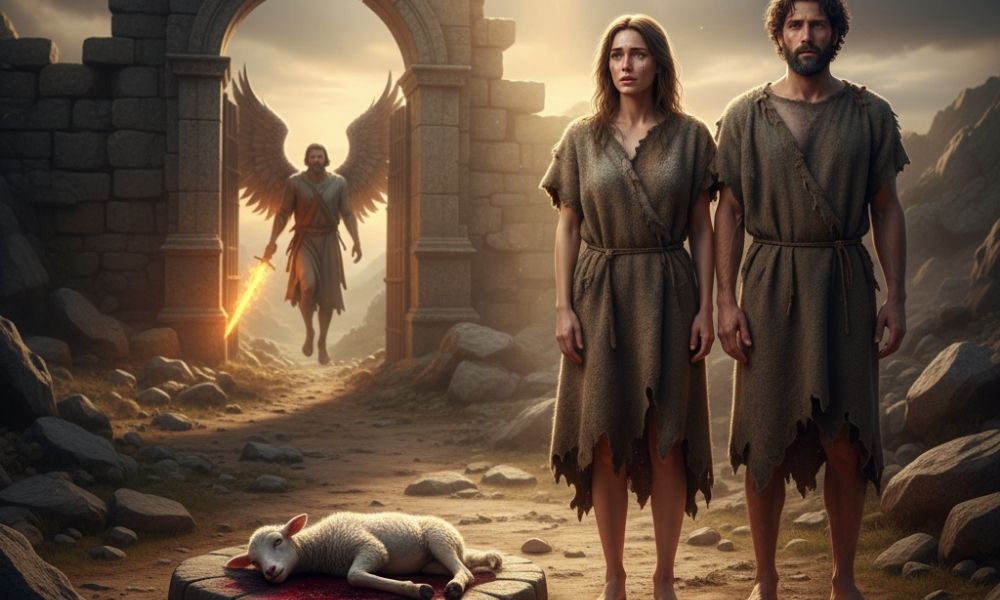
The first sacrifice in the Bible took place immediately after the Fall of Adam and Eve. When humanity disobeyed God and sin entered the world, innocence was lost. Yet in mercy, God Himself provided garments of animal skins to cover Adam and Eve’s nakedness — the first shedding of blood, symbolizing atonement and foreshadowing the ultimate sacrifice of Jesus Christ, the Lamb of God.
Quick Facts
Event Name: The First Sacrifice
Location: The Garden of Eden (Genesis 3:21)
Key Figures: God, Adam, Eve
Cause: Humanity’s sin and loss of innocence after disobedience
Action: God provides animal skins to clothe Adam and Eve
Symbolism: Atonement, substitution, divine mercy, and the foreshadowing of Christ’s sacrifice
Key Verse: “The LORD God made garments of skin for Adam and his wife and clothed them.” — Genesis 3:21
Meaning of the Event
This moment reveals the first act of bloodshed in Scripture — not by man’s hand, but by God’s. Though the text does not explicitly describe the killing, the creation of “garments of skin” implies the death of an innocent animal. This act represents the principle of substitutionary atonement: an innocent life given to cover the guilt of sinners.
Biblical Context
Following the Fall (Genesis 3:1–19), Adam and Eve realized their nakedness and attempted to cover themselves with fig leaves — a human attempt to hide guilt. But their covering was inadequate. God, in His mercy, provided a lasting covering through sacrifice, demonstrating that only God’s provision can truly atone for sin.
Theological Significance
1. The First Shedding of Blood
The death of an innocent creature introduced the truth that sin brings death (Romans 6:23). The blood of the animal symbolized the cost of sin and pointed toward the necessity of a future, greater sacrifice.
2. Substitutionary Atonement
An innocent being died in place of the guilty — a principle later expressed in the Law of Moses and ultimately fulfilled in Jesus Christ (Hebrews 9:22).
3. God’s Initiative in Redemption
Adam and Eve did not seek this sacrifice — God provided it. This emphasizes divine grace: salvation begins not with human effort, but with God’s mercy.
4. Foreshadowing Christ
This first act of covering prefigures the cross, where Christ’s blood covers the sins of all who believe. As the animals’ skins covered Adam and Eve’s bodies, Christ’s righteousness covers humanity’s guilt (2 Corinthians 5:21).
Symbolism & Imagery
| Symbol | Meaning |
|---|---|
| Garments of Skin | God’s provision for covering sin |
| The Sacrificed Animal | Innocent life given for the guilty |
| Blood | Atonement and the cost of sin |
| Covering | Restoration of relationship and dignity |
| Fig Leaves | Inadequate human attempts to deal with sin |
Lessons from the First Sacrifice
- Sin requires a substitute — the guilty cannot atone for themselves.
- God’s mercy provides a covering — He does not leave humanity in shame.
- Human effort is insufficient — only God’s provision truly redeems.
- The pattern of redemption begins here — pointing to the Lamb of God.
- Grace follows judgment — even in exile, God’s compassion endures.
Connection to the Cross
The first sacrifice in Eden begins a divine thread that runs through Scripture — from Abel’s offering (Genesis 4:4), to the Passover lamb (Exodus 12), to the Levitical sacrifices, and finally to Jesus Christ, whose blood once for all secured eternal redemption (Hebrews 10:10).
“Behold, the Lamb of God, who takes away the sin of the world!” — John 1:29
Legacy & Impact
- Introduced the principle of sacrifice as the means of reconciliation with God.
- Set the stage for the entire biblical system of atonement.
- Revealed the character of God — both just and merciful.
- Pointed forward to the ultimate fulfillment in Christ, the final and perfect sacrifice.
- Demonstrated that even in humanity’s darkest moment, God’s plan of salvation had already begun.







Leave a Reply