
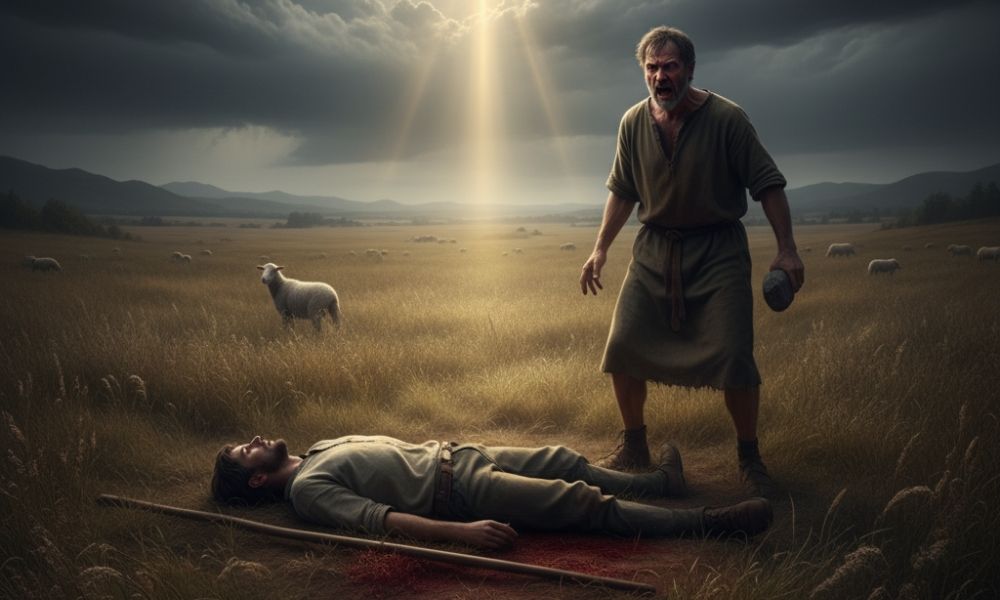
The story of Cain and Abel reveals how sin, first introduced in Eden, quickly corrupted human relationships. Born to Adam and Eve after their expulsion from the Garden, Cain and Abel both offered sacrifices to God — but only Abel’s was accepted. In jealousy and anger, Cain murdered his brother, committing the first homicide in human history. This tragic event shows how unchecked sin leads to destruction but also how God’s justice and mercy continue to operate side by side.
Quick Facts
Event Name: Cain Kills Abel
Location: Near Eden (Genesis 4:1–16)
Key Figures: Cain, Abel, God
Cause: Jealousy and resentment over God’s acceptance of Abel’s offering
Consequence: The first murder, divine punishment, and Cain’s exile
Key Scripture: Genesis 4:8 — “And while they were in the field, Cain attacked his brother Abel and killed him.”
Symbolism: Jealousy, sin’s dominion, judgment, and divine mercy
Meaning of the Event
This account demonstrates how the sin that began in the Garden of Eden did not stop with Adam and Eve. It passed to their children, showing the fallen nature of humanity. Cain’s act of murder fulfills God’s warning that sin “crouches at the door” and seeks to rule over the heart (Genesis 4:7).
Biblical Era / Timeline
Era: Early Post-Edenic Period (First Generation after the Fall)
Setting: The land east of Eden — a world still near its beginnings but already marked by sin and separation from God.
The Story
1. The Offerings (Genesis 4:3–5)
- Abel, a shepherd, brought the firstborn of his flock as an offering — a blood sacrifice symbolizing faith and devotion.
- Cain, a farmer, offered fruit from the ground, but without faith or true obedience.
- God accepted Abel’s offering but rejected Cain’s, not because of the gift itself but because of the giver’s heart (Hebrews 11:4).
2. The Jealousy and Warning (Genesis 4:6–7)
- Anger filled Cain’s heart, and his face fell.
- God lovingly warned him: “If you do what is right, will you not be accepted? But if you do not, sin is crouching at your door; it desires to have you, but you must rule over it.”
- Cain ignored the warning, allowing sin to master him instead of resisting it.
3. The Murder (Genesis 4:8)
- Cain invited Abel into the field and attacked and killed him, becoming the world’s first murderer.
- This act marked the culmination of unchecked anger and envy, transforming inner sin into outward violence.
4. The Confrontation (Genesis 4:9–10)
- God asked Cain, “Where is your brother Abel?”
- Cain lied: “I don’t know. Am I my brother’s keeper?”
- God replied, “Your brother’s blood cries out to Me from the ground!” — revealing that nothing escapes His justice.
5. The Judgment and Mercy (Genesis 4:11–15)
- God cursed Cain, making him a restless wanderer upon the earth.
- The ground would no longer yield fruit for him — a poetic justice for one who worked the soil.
- Yet even in judgment, God placed a mark on Cain to protect him from being killed, showing divine mercy amid justice.
6. The Legacy of Cain (Genesis 4:16–24)
- Cain settled in the land of Nod, east of Eden.
- His descendants became builders, musicians, and metalworkers — showing human progress, yet apart from God.
- His line illustrates the growth of civilization alongside the spread of corruption.
Symbolism & Meaning
| Symbol | Meaning |
|---|---|
| Abel’s Offering | Faith, obedience, and righteousness |
| Cain’s Offering | Empty religion and self-will |
| Blood of Abel | Innocent suffering and God’s awareness of injustice |
| Mark of Cain | Divine mercy and protection amid punishment |
| Field | The place where sin’s hidden intentions are revealed |
Theological Significance
- The Power of Sin: God’s warning to Cain applies to all — sin desires to dominate, but we must resist it (Romans 6:12).
- Faith over Form: God values the heart’s sincerity more than the external act of worship.
- Human Responsibility: We are indeed our “brother’s keeper” — called to love and protect, not harm.
- God’s Justice and Mercy: Though Cain was punished, God’s protective mark shows His unwillingness to abandon even the guilty.
- Foreshadowing Christ: Abel’s innocent blood foreshadows Jesus, whose blood “speaks a better word than the blood of Abel” (Hebrews 12:24).
Key Lessons
- Unchecked anger leads to destruction.
- True worship requires faith and obedience.
- Sin begins in the heart before it shows in action.
- God sees injustice and will hold the guilty accountable.
- Even in judgment, God’s mercy endures.
Legacy & Impact
- Cain’s sin represents the spread of human wickedness after the Fall.
- Abel became the first martyr of righteousness (Matthew 23:35).
- The event foreshadows humanity’s ongoing struggle between righteousness and rebellion.
- Abel’s faith and Cain’s failure continue to teach about the importance of the heart’s posture before God.
- Through Christ, the curse of sin that began with Cain finds its redemption and reversal.







Leave a Reply