
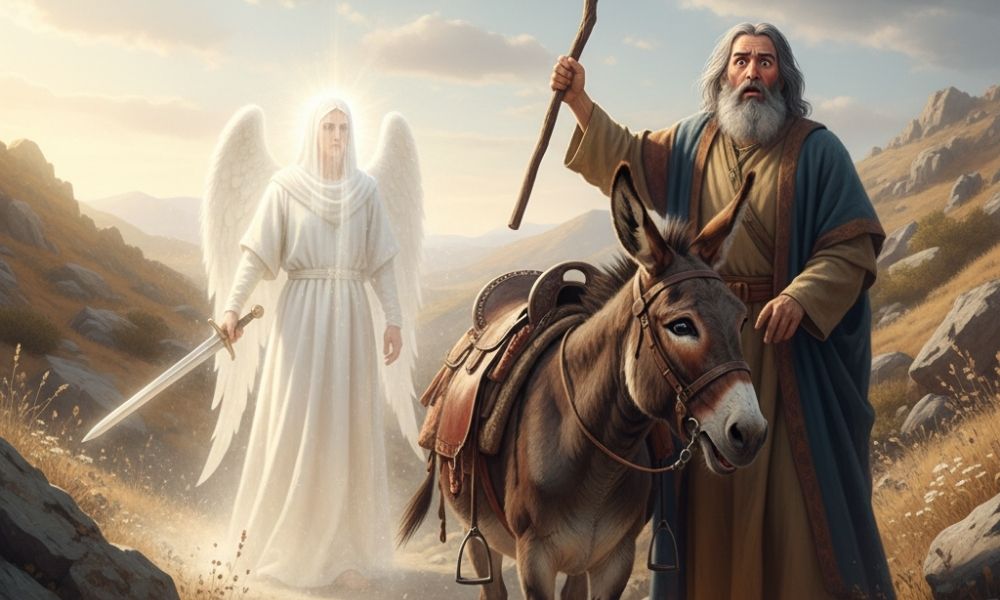
The story of Balaam’s donkey speaking (Numbers 22:21–35) is one of the most unusual and powerful moments in Scripture. It reveals how God can use even an animal to deliver His message and correct a disobedient heart. The account of Balaam—a prophet who lost sight of God’s will because of greed and ambition—teaches vital lessons about spiritual blindness, divine sovereignty, and mercy. Through this miracle, we see that God will not allow His servants to go astray without warning, even if He must open the mouth of a donkey to do it.
Quick Facts
Name: Balaam (Hebrew: Bil‘am, meaning “not of the people” or “devourer”)
Occupation: Prophet / Diviner from Pethor, near the Euphrates River
Time Period: Late Bronze Age (~1400–1200 BCE)
Nation/Tribe: Aram or Mesopotamia (non-Israelite)
Key Location: Road to Moab, on the way to meet King Balak
Event: Balaam’s donkey miraculously speaks and reveals the Angel of the Lord
Scripture Reference: Numbers 22:21–35
Main Theme: God’s power to reveal truth, correct rebellion, and humble the proud
Symbolism: Even creation obeys God when His servants resist His voice
Background
When the Israelites were camped near Moab, Balak, the king of Moab, grew fearful of them and sought Balaam’s help to curse Israel (Numbers 22:5–6). Balaam, known for his prophetic words, inquired of the Lord, who clearly told him not to go, for Israel was a blessed people.
However, Balak persisted, offering Balaam rich rewards and great honor. Greedy and tempted, Balaam sought God again, and God allowed him to go—but only on the condition that he speak only what God commanded. Though God permitted the journey, His anger burned because Balaam’s heart was set on personal gain.
The Angel and the Donkey
As Balaam rode his donkey toward Moab, the Angel of the Lord stood in his path with a drawn sword. Balaam couldn’t see the angel, but his donkey could. Three times the donkey turned aside to protect Balaam:
- Turned into a field to avoid the angel.
- Pressed Balaam’s foot against a wall when the path narrowed.
- Lay down under Balaam when there was nowhere to turn.
Each time, Balaam beat the donkey, furious at her behavior. Then, the Lord opened the donkey’s mouth, and she spoke:
“What have I done to you to make you beat me these three times?” (Numbers 22:28)
Amazingly, Balaam responded to the donkey, arguing with her—revealing how blind and irrational he had become in his anger.
God Opens Balaam’s Eyes
Then the Lord opened Balaam’s eyes, and he saw the Angel of the Lord standing with a drawn sword. Terrified, Balaam fell facedown before the angel, who rebuked him for his reckless path and declared that the donkey had saved his life.
Balaam confessed his sin, saying,
“I have sinned. I did not realize you were standing in the road to oppose me.” (Numbers 22:34)
The Angel permitted him to continue his journey—but warned him again to speak only the words of God.
Key Lessons and Themes
- God’s Sovereignty: The Lord can speak through anyone—or anything—to fulfill His purposes.
- Spiritual Blindness: Balaam, a prophet, was blind to what his donkey could see. Greed and pride can cloud spiritual vision.
- Divine Mercy: God’s warning through the donkey was an act of grace—He spared Balaam’s life.
- Obedience Over Ambition: Balaam’s downfall came from loving reward more than righteousness.
Symbolism and Meaning
The donkey symbolizes humility, faithfulness, and obedience—qualities Balaam lacked. The Angel of the Lord represents God’s holiness and judgment against sin. The talking donkey shows that God’s truth cannot be silenced, even when His chosen messenger is unfaithful.
New Testament Reflection
The New Testament uses Balaam’s story as a warning against greed and corruption in spiritual leadership:
- 2 Peter 2:15–16 — Balaam is rebuked for loving “the wages of wickedness,” and his madness is restrained by a talking donkey.
- Jude 1:11 — Warns of those who follow “the error of Balaam.”
- Revelation 2:14 — Condemns the “teaching of Balaam,” which led others into idolatry and immorality.
Summary
The story of Balaam’s donkey reminds us that God’s will cannot be bought, ignored, or manipulated. When we stray from His path, He graciously sends correction—sometimes from the most unexpected places. The true wisdom of faith is to listen to God’s voice early, before He must use extraordinary means to get our attention.







Leave a Reply