
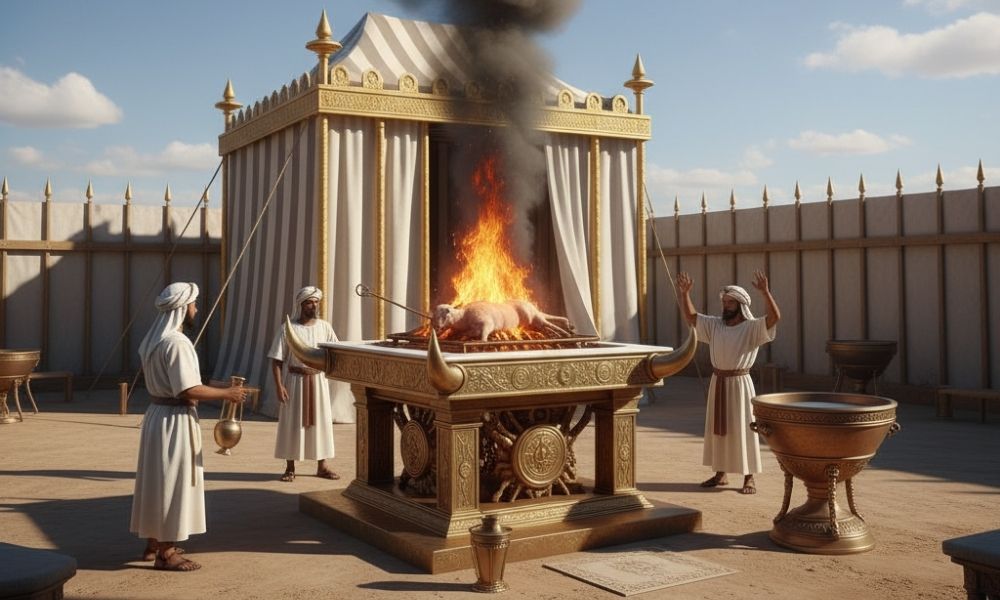
The Altar of Burnt Offering, also known as the Brazen Altar or Bronze Altar, was a central element in the worship system of ancient Israel. It stood in the courtyard of the Tabernacle (and later in the Temple) and was the place where animal sacrifices were offered to God for the atonement of sins and dedication of the people. It symbolized substitutionary sacrifice, forgiveness, and reconciliation between God and humanity.
Quick Facts
Name: Altar of Burnt Offering (Brazen/Bronze Altar)
Hebrew Name: Mizbeach ha-olah (מִזְבֵּחַ הָעֹלָה) — “Altar of Ascending Offering”
Location: Outer court of the Tabernacle (Exodus 40:6)
Material: Acacia wood overlaid with bronze (Exodus 27:1–2)
Dimensions: 5 cubits long × 5 cubits wide × 3 cubits high (~7.5 ft × 7.5 ft × 4.5 ft)
Main Function: Burnt offerings and sacrifices for atonement
Transport: Carried by poles inserted through bronze rings (Exodus 27:4–7)
Associated Tribe: Levites (priests oversaw sacrifices)
Symbolism: Atonement, purification, surrender, and the foreshadowing of Christ’s sacrifice
Biblical Description
The Altar of Burnt Offering was constructed according to precise instructions given by God to Moses (Exodus 27:1–8). It was made of acacia wood, a durable desert hardwood, and covered with bronze, symbolizing judgment. The altar had four horns, one on each corner, signifying power, refuge, and atonement (Leviticus 4:7).
A grating of bronze was placed inside the altar, halfway up, and rings and poles allowed it to be transported as the Israelites journeyed through the wilderness. It was positioned just inside the entrance of the Tabernacle courtyard, the first object one encountered when approaching God’s presence — signifying that forgiveness through sacrifice was the first step toward fellowship with God.
Purpose and Function
The altar served as the site for daily sacrifices and special offerings, including:
- Burnt Offerings (olah): total dedication to God (Leviticus 1)
- Peace Offerings: fellowship and thanksgiving (Leviticus 3)
- Sin and Guilt Offerings: atonement for transgressions (Leviticus 4–5)
Fire on the altar was never to go out (Leviticus 6:12–13), representing continual worship and atonement.
Symbolism and Spiritual Meaning
- Judgment and Atonement: The bronze symbolizes divine judgment against sin, while the sacrifice represents substitution — an innocent life for the guilty.
- Forgiveness through Blood: The sprinkling of blood on the altar symbolized cleansing and forgiveness (Leviticus 17:11).
- Access to God: The altar stood between the sinner and the sanctuary, teaching that no one approaches God without atonement.
- Foreshadowing of Christ:
- Jesus Christ is the ultimate sacrifice (Hebrews 10:10–14).
- The cross became the true altar of atonement, where Christ’s blood was shed once for all (Hebrews 13:10–12).
In the Temple Period
When Solomon built the Temple in Jerusalem, a much larger bronze altar replaced the original (2 Chronicles 4:1). The same principles applied — sacrifice and atonement remained at the heart of worship until Christ’s ultimate sacrifice fulfilled the system.
Typology and Fulfillment in Christ
| Element | Altar Symbolism | Fulfillment in Christ |
|---|---|---|
| Bronze | Judgment | Christ bore our judgment on the cross |
| Fire | Purifying presence of God | Christ’s suffering purified and redeemed humanity |
| Blood | Atonement for sin | Christ’s blood cleanses from all sin (1 John 1:7) |
| Sacrifice | Substitutionary death | “The Lamb of God who takes away the sin of the world” (John 1:29) |
Key References
- Exodus 27:1–8 – Instructions for the altar’s construction
- Leviticus 1–7 – Sacrificial laws
- Numbers 16:46–50 – Altar associated with atonement during a plague
- Hebrews 9:13–14; 10:10–12 – Christ as the ultimate sacrifice
- Hebrews 13:10–12 – The cross as the Christian altar
Legacy and Lessons
The Altar of Burnt Offering reminds believers that:
- Approaching God requires cleansing through sacrifice.
- Sin demands atonement, but God graciously provides a substitute.
- True worship begins with repentance and surrender.
- Jesus Christ fulfills all sacrificial symbolism — through Him, believers have direct access to God (Hebrews 4:16).







Leave a Reply