
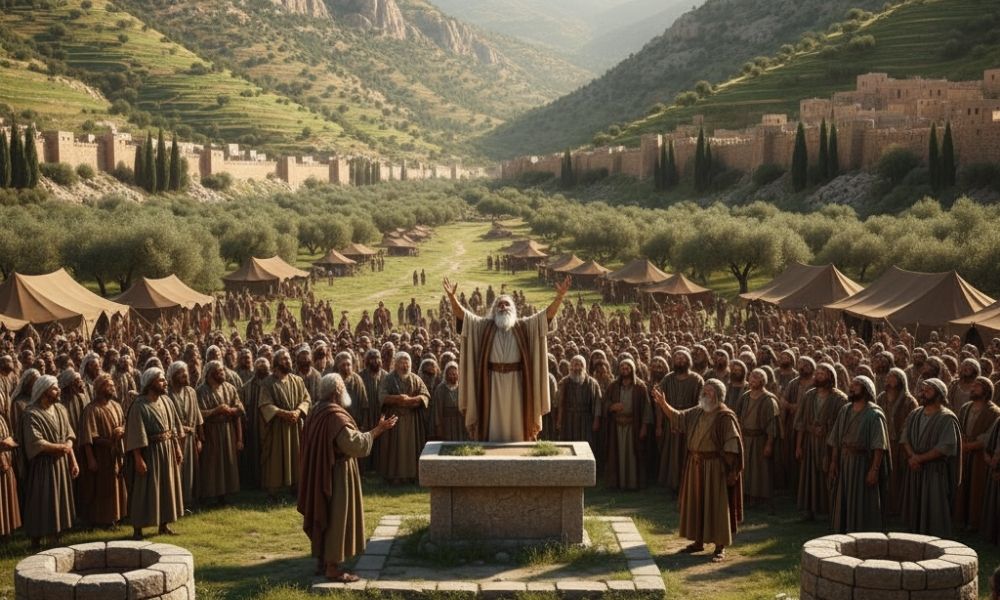
Shechem was one of the most ancient and historically significant cities in the land of Canaan, centrally located between Mount Ebal and Mount Gerizim. It served as a spiritual, political, and geographical center for many pivotal events in Israel’s history. From Abraham’s first altar to the covenant renewal under Joshua, Shechem stands as a powerful symbol of covenant, decision, and divine encounter.
Quick Facts
Name: Shechem (Hebrew: שְׁכֶם – Shekhem, meaning “shoulder” or “ridge”)
Location: Central Canaan, between Mount Ebal and Mount Gerizim (modern Nablus, West Bank)
Region/Tribe: Ephraim
Coordinates: Approximately 41 miles north of Jerusalem
Founded: Early Canaanite period (3rd millennium BCE)
Notable Periods: Patriarchal era, Conquest and Judges, United and Divided Kingdoms
Modern Site: Tell Balata (archaeological ruins near Nablus)
Meaning: “Shoulder” — possibly referring to its position between two mountains like a shoulder between arms
Historical and Biblical Overview
1. Abraham’s First Altar (Genesis 12:6–7)
When Abraham first entered Canaan, he came to the great tree of Moreh at Shechem. There, the Lord appeared to him and promised the land to his descendants. In faith, Abraham built his first altar to the Lord at Shechem — marking it as the first place of worship in the Promised Land.
“Abram passed through the land to the place of Shechem, to the oak of Moreh… Then the Lord appeared to Abram and said, ‘To your offspring I will give this land.’” (Genesis 12:6–7)
2. Jacob’s Return and Altar (Genesis 33:18–20)
After returning from Paddan-aram, Jacob purchased land near Shechem from the sons of Hamor. He built an altar and named it El-Elohe-Israel (“God, the God of Israel”), signifying his renewed relationship and commitment to God.
It was near Shechem that the tragic event involving Dinah and the Shechemites occurred (Genesis 34), which revealed both the dangers of assimilation and the zeal of Jacob’s sons for family honor.
3. Covenant Renewal with Joshua (Joshua 24:1–25)
At the end of his life, Joshua gathered all the tribes of Israel at Shechem for a national covenant renewal ceremony. Here, he reminded them of God’s faithfulness, called them to serve the Lord alone, and set up a stone of witness under the oak by the sanctuary.
“As for me and my house, we will serve the Lord.” (Joshua 24:15)
This moment at Shechem represented Israel’s collective choice to serve God, reinforcing Shechem as a place of decision.
4. Joseph’s Burial (Joshua 24:32)
The bones of Joseph, which the Israelites carried from Egypt, were buried at Shechem in the tract of land Jacob had bought centuries earlier. This fulfilled Joseph’s faith-filled request (Genesis 50:25), linking Shechem directly to the fulfillment of God’s promises.
5. Shechem in the Time of the Kings
- Rehoboam’s Coronation: After Solomon’s death, Rehoboam went to Shechem to be made king. There, Jeroboam led a revolt, resulting in the division of the kingdom (1 Kings 12:1–20).
- Capital of the Northern Kingdom: For a short time, Shechem served as the first capital of the northern kingdom of Israel under Jeroboam before it was moved to Tirzah and later to Samaria.
Symbolism and Spiritual Themes
| Theme | Meaning at Shechem | Scriptural Example |
|---|---|---|
| Covenant | Renewal and reaffirmation of faith | Joshua 24 |
| Promise | God’s first promise to Abraham of the land | Genesis 12 |
| Decision | “Choose this day whom you will serve” | Joshua 24:15 |
| Faithfulness | God’s enduring commitment to His people | Genesis 33, Joshua 24 |
| Fulfillment | Joseph’s burial fulfilled God’s promises | Joshua 24:32 |
Shechem repeatedly became the crossroads of spiritual decision—where God’s people had to choose obedience or disobedience, blessing or curse (Deuteronomy 27–28; Joshua 24).
Geographical and Archaeological Notes
- Topography: Situated in a fertile valley between Mount Ebal (to the north) and Mount Gerizim (to the south).
- Mount Gerizim and Mount Ebal: Chosen by Moses and Joshua for the reading of blessings and curses (Deuteronomy 11:29; Joshua 8:33).
- Excavations: Archaeologists have uncovered ancient walls, a gate complex, and a massive altar platform, consistent with early Israelite worship.
Spiritual Legacy
Shechem stands as a timeless reminder of:
- God’s faithful promises to His covenant people.
- The necessity of renewing one’s commitment to serve the Lord wholeheartedly.
- The importance of obedience in the place of blessing.
Summary
Shechem was more than a city—it was a spiritual landmark of promise, worship, and choice. From Abraham’s first altar to Joshua’s final covenant, it marked moments when God’s people encountered His presence and made defining decisions of faith.
“Choose this day whom you will serve… but as for me and my house, we will serve the Lord.”
— Joshua 24:15







Leave a Reply