
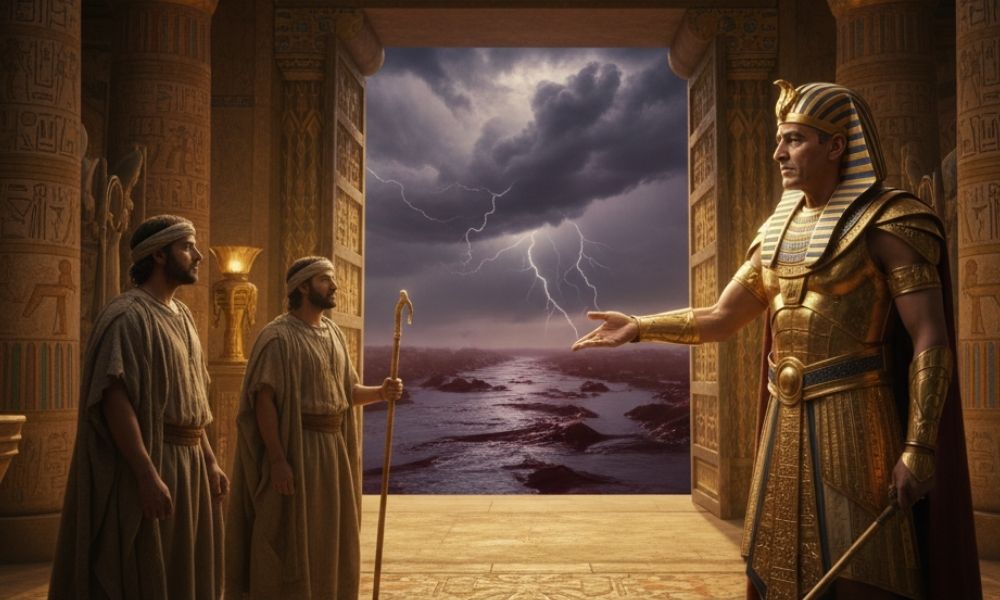
Pharaoh, the king of Egypt during the Exodus, stands as one of the most powerful yet defiant figures in the Bible. His hardened heart, pride, and resistance to God’s command through Moses led to Egypt’s ruin and Israel’s miraculous deliverance. Pharaoh’s story is a timeless lesson on the danger of arrogance before divine authority.
Quick Facts
Name: Pharaoh (Egyptian title meaning “Great House”)
Title: King of Egypt
Dynasty: Likely a ruler of the 18th or 19th Dynasty (c. 15th–13th century BCE, depending on the Exodus dating)
Capital: Memphis or Thebes (ancient Egypt)
Contemporaries: Moses, Aaron, Miriam
Key Scriptures: Exodus 1–14; Romans 9:17
Symbol: Crown and scepter — representing worldly power and pride against God’s will
Name Meaning
“Pharaoh” was not a personal name but a royal title meaning “Great House,” referring to the royal palace or dynasty. In the Bible, it symbolizes absolute power — often contrasted with God’s ultimate sovereignty.
Lineage / Background
The Pharaoh of the Exodus was the supreme ruler of Egypt, regarded by his people as a god incarnate, the son of Ra (the sun god). He ruled during Israel’s enslavement and resisted God’s command to release them. Egypt, at this time, was one of the most advanced and powerful civilizations on earth, rich in culture, science, and military strength — yet Pharaoh’s pride brought it to the brink of destruction.
Biblical Era / Timeline
Era: The Exodus (c. 15th–13th century BCE).
Context: The Israelites had been enslaved in Egypt for centuries. God called Moses to confront Pharaoh and demand their freedom, declaring, “Let My people go.” Pharaoh’s repeated refusal brought ten devastating plagues upon Egypt.
Major Roles / Identity
- King of Egypt: Political and divine ruler of the most powerful empire of the time.
- Oppressor of Israel: Enslaved the Hebrews and ordered the death of their male infants (Exodus 1:22).
- Adversary of God: Repeatedly hardened his heart against God’s commands through Moses.
- Instrument of divine justice: His defiance showcased God’s power to deliver His people and judge the proud.
Key Character Traits
Strengths:
- Commanding authority and courage as a ruler.
- Determined and politically shrewd.
Weaknesses:
- Pride and self-deification — saw himself as divine.
- Hardness of heart — repeatedly resisted clear evidence of God’s power.
- Stubbornness — valued power over truth, leading to destruction.
Main Life Events
- Oppression of Israel: Pharaoh enslaved the Israelites to suppress their growing population (Exodus 1:8–14).
- Infanticide decree: Ordered all Hebrew baby boys to be thrown into the Nile (Exodus 1:22) — a decree that ironically led to Moses being raised in Pharaoh’s own household.
- Confrontation with Moses: When Moses returned to demand Israel’s release, Pharaoh scoffed, saying, “Who is the LORD, that I should obey His voice?” (Exodus 5:2).
- The Ten Plagues: Each plague demonstrated God’s supremacy over Egypt’s gods and Pharaoh’s impotence — turning the Nile to blood, unleashing frogs, gnats, flies, disease, boils, hail, locusts, darkness, and finally the death of Egypt’s firstborn (Exodus 7–12).
- The Passover Night: God spared the Israelites who obeyed His command to mark their doors with lamb’s blood. Pharaoh’s own son died, breaking his resistance — he finally let Israel go (Exodus 12:29–32).
- The Red Sea Pursuit: Pharaoh changed his mind and pursued the Israelites with his army. God parted the sea for His people but closed it over Pharaoh’s chariots, destroying them all (Exodus 14:5–31).
Notable Stories / Passages
- Exodus 5:1–2: Pharaoh’s defiant question — “Who is the LORD?”
- Exodus 7–12: The Ten Plagues — God’s judgments against Egypt’s false gods.
- Exodus 14: The Red Sea — Pharaoh’s army destroyed, symbolizing the triumph of divine deliverance.
- Romans 9:17: “For the Scripture says to Pharaoh, ‘I raised you up for this very purpose, that I might display My power in you.’”
Legacy & Impact
- Symbol of human pride: Pharaoh’s story demonstrates the futility of opposing God’s will.
- Example of hardened hearts: His repeated rejection of God’s word serves as a warning in both Old and New Testaments.
- Contrast to Moses: While Pharaoh’s heart grew harder, Moses’ heart grew humbler — showing the difference between rebellion and submission.
- Divine sovereignty revealed: Through Pharaoh’s resistance, God displayed His power, justice, and mercy in rescuing His people.
Symbolism / Typology
- Pharaoh as a type of Satan: Just as Pharaoh enslaved Israel, Satan enslaves humanity in sin — and just as God delivered Israel through Moses, He delivers believers through Christ.
- The Red Sea crossing: Symbol of baptism — deliverance from bondage into freedom under God’s protection.
- The hardened heart: A spiritual warning of resisting conviction and rejecting truth.
Legacy in Faith and Teaching
Pharaoh’s downfall is a lasting testimony that no earthly power can stand against the purposes of God. His story reminds believers that pride leads to destruction, but humility before God brings life and freedom. The same God who broke Pharaoh’s might still delivers His people from every form of bondage today.







Leave a Reply