
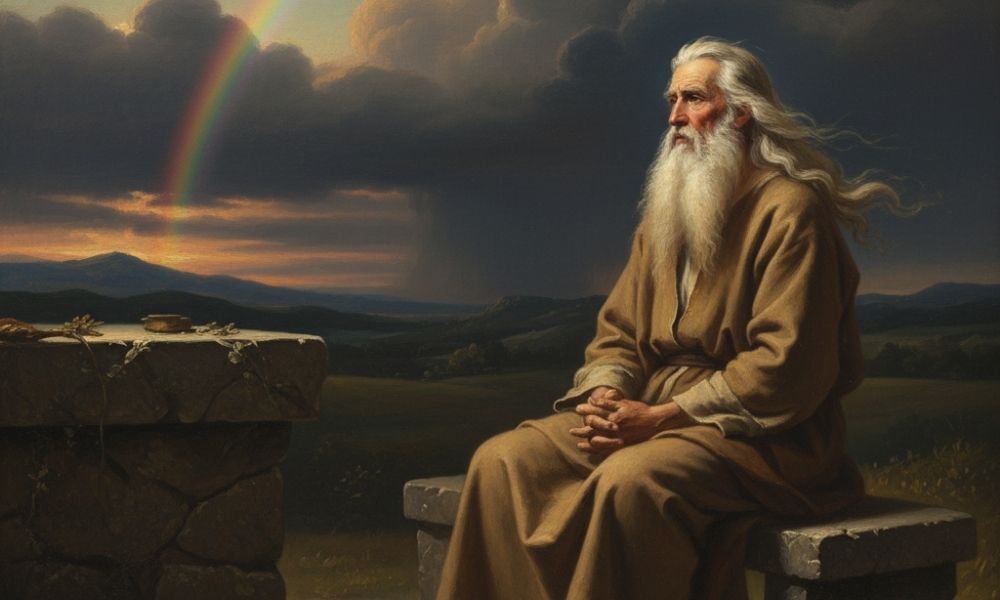
Methuselah is remembered in the Bible as the oldest person to ever live, reaching the age of 969 years. A descendant of Seth and the grandfather of Noah, Methuselah stands as a symbol of God’s patience and the longevity of early mankind before the Flood. His life bridges the righteous heritage of Enoch and the redemptive story of Noah — representing both divine mercy and impending judgment.
Quick Facts
Name: Methuselah (Hebrew: Metûšelaḥ, meaning “man of the dart,” or “when he dies, it shall come”)
Father: Enoch
Son: Lamech
Grandson: Noah
Lineage: From the godly line of Seth
Era: Antediluvian (before the Flood)
Age at Death: 969 years — the longest lifespan recorded in Scripture
Scriptural References: Genesis 5:21–27; 1 Chronicles 1:3; Luke 3:37
Symbol: Hourglass or flowing river — representing time, patience, and the long-suffering mercy of God
Name Meaning
The meaning of Methuselah is interpreted in two ways:
- “Man of the dart/spear” — possibly referencing strength or judgment.
- “When he dies, it shall come” — a prophetic name suggesting that the Flood would begin upon his death.
Many Bible scholars hold the second interpretation as most fitting, since Methuselah died in the very year of the Flood (Genesis 7), symbolizing that his long life represented God’s extended mercy before judgment.
Lineage and Family Background
Methuselah was the son of Enoch, the man who “walked with God” and was taken to heaven without dying. He was the father of Lamech and the grandfather of Noah, through whom the human race continued after the Flood. Methuselah’s lineage marks a line of faithful men who upheld worship of the true God amidst a world steeped in sin and violence.
Biblical Context
Methuselah appears in Genesis 5, within the genealogical record of Adam’s descendants through Seth. His life overlaps the early patriarchs, including Adam himself (Methuselah lived over 200 years during Adam’s lifetime). His death marks the threshold of divine judgment — the Flood that swept away the corruption of the earth.
His remarkable age — 969 years — emphasizes both God’s patience toward a sinful world and the slow decay of creation following the Fall.
Key Character Traits
- Longevity: Lived longer than any recorded person in history.
- Patience: His extended life reflected God’s long-suffering mercy toward humanity.
- Faithfulness: Born into the godly line of Enoch; upheld the spiritual heritage passed to his descendants.
- Bridge Figure: Connected the pre-Flood patriarchs — from Adam to Noah — as a living witness to God’s unfolding plan.
Main Life Events
- Birth: Born to Enoch at age 65 (Genesis 5:21).
- Fatherhood: Became father of Lamech (Genesis 5:25).
- Lived Long: Survived 969 years, witnessing centuries of human history and decline.
- Death: Died the same year the Flood began — a prophetic fulfillment of his name (Genesis 5:27).
Major Relationships
- Enoch (Father): Walked with God; passed down a legacy of righteousness.
- Lamech (Son): Father of Noah; looked for comfort from the curse of sin (Genesis 5:29).
- Noah (Grandson): Found favor with God and preserved humanity through the Ark.
Notable Passages
- Genesis 5:25–27: “Altogether, Methuselah lived a total of 969 years, and then he died.”
- 1 Chronicles 1:3: Lists Methuselah in the genealogical line from Adam to Noah.
- Luke 3:37: Mentions Methuselah in the genealogy of Jesus, showing his connection to the Messianic line.
Legacy & Impact
Methuselah’s life symbolizes God’s enduring patience before judgment. For nearly a millennium, his existence delayed the coming Flood — a powerful image of divine mercy holding back wrath. His legacy lived on through Noah, the righteous man who continued the covenant line leading ultimately to Jesus Christ.
Methuselah also reminds believers that long life, while a blessing, gains its true meaning only when lived in faithfulness to God.
Symbolism / Typology
- Methuselah’s Long Life: Symbol of divine patience and mercy.
- His Death Before the Flood: Represents the transition from grace to judgment.
- Lineage of Faith: A living link between the righteousness of Enoch and the salvation of Noah.
- Typology of Christ: Points to God’s long-suffering desire that none should perish, but all come to repentance (2 Peter 3:9).
Extra-Biblical Tradition
In Jewish tradition, Methuselah is revered as a wise and righteous patriarch who helped preserve divine teaching before the Flood.
According to ancient rabbinic texts and the Book of Enoch, he warned others of coming judgment and guided his grandson Noah in preparing for God’s deliverance. His extraordinary age became a symbol of the mercy and patience of God toward humankind.







Leave a Reply