
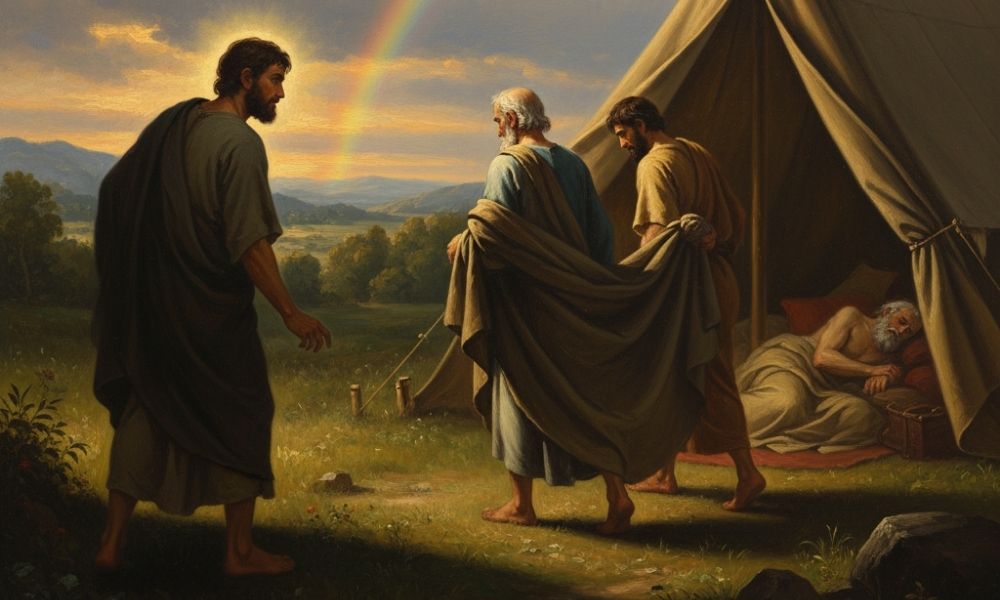
Ham was one of Noah’s three sons and the father of several ancient nations, including Egypt, Canaan, and Cush. Though blessed with survival through the Flood, Ham’s disrespect toward his father brought a curse upon his descendants, shaping much of the early biblical world’s moral and spiritual contrast. His story serves as a warning about dishonor, pride, and the lasting effects of sin.
Quick Facts
Name: Ham (Hebrew: Cham, meaning “hot,” “burnt,” or “black”)
Father: Noah
Brothers: Shem and Japheth
Sons: Cush, Mizraim (Egypt), Put, and Canaan (Genesis 10:6)
Grandsons: Nimrod, Sidon, the Philistines, and others
Era: Postdiluvian (after the Flood)
Scriptural References: Genesis 5:32; 9:18–27; 10:6–20; 1 Chronicles 1:8–16
Symbol: Broken branch or shadow — representing moral failure and division
Name Meaning
Ham likely means “hot” or “burnt,” possibly referring to the regions his descendants inhabited — warm southern lands like Africa and parts of Arabia. It may also symbolize passion or impulsiveness, traits that align with his actions after the Flood.
Lineage and Family Background
Ham was born to Noah before the Flood and entered the Ark with his father, mother, and brothers. After the Flood, his descendants became the founders of powerful ancient civilizations, including Egypt (Mizraim), Cush (Ethiopia), Canaan (the Canaanites), and Put (Libya).
These nations often stood in contrast to Israel, representing the world’s moral and spiritual opposition to God’s covenant people.
Biblical Context
Ham’s defining moment comes in Genesis 9:20–27, after the Flood:
When Noah became drunk and lay uncovered in his tent, Ham saw his father’s nakedness and told his brothers rather than showing respect. In response, Shem and Japheth covered Noah discreetly, preserving their father’s dignity.
When Noah awoke, he declared:
“Cursed be Canaan! The lowest of slaves will he be to his brothers.” (Genesis 9:25)
This curse fell not directly on Ham, but on his son Canaan, symbolizing the spiritual consequences of Ham’s disrespect and moral carelessness.
Key Character Traits
- Disrespectful: Failed to honor his father’s dignity.
- Reckless: Acted thoughtlessly, spreading shame rather than restoring honor.
- Worldly: His descendants often became nations opposed to God’s people.
- Influential: Fathered many major ancient civilizations.
Main Life Events
- Survived the Flood: Entered the Ark with his family (Genesis 7:13).
- Act of Disrespect: Mocked Noah’s nakedness (Genesis 9:22).
- Cursed Through Canaan: Received prophetic consequences through his son (Genesis 9:25–27).
- Father of Nations: His lineage formed many nations around the Mediterranean and Africa (Genesis 10:6–20).
Major Relationships
- Noah (Father): His dishonor led to the curse on his son Canaan.
- Shem and Japheth (Brothers): Contrasted by their reverence and blessing.
- Canaan (Son): Bearer of the curse; ancestor of the Canaanites, often in conflict with Israel.
Notable Passages
- Genesis 9:22: “Ham, the father of Canaan, saw his father naked and told his two brothers outside.”
- Genesis 9:25: “Cursed be Canaan; a servant of servants shall he be unto his brethren.”
- Genesis 10:6–7: Lists the nations descending from Ham.
Legacy & Impact
Ham’s legacy is both vast and tragic. His descendants established great empires — Egypt, Babylon, and Canaan — yet many became enemies of Israel. His story underscores the principle that disrespect and sin bring generational consequences, while honor and obedience bring blessing.
Spiritually, Ham represents the worldly line — those who turn from reverence toward God’s covenant path.
Symbolism / Typology
- Ham: Symbol of dishonor and moral carelessness.
- Canaan’s Curse: Represents the natural consequence of sin and rebellion.
- Contrast with Shem: Highlights the separation between the godly and the ungodly.
Extra-Biblical Tradition
Jewish and early Christian traditions portray Ham as the father of pagan nations. Some texts describe him as having perpetuated moral corruption after the Flood, paralleling his descendants’ spiritual decline. His lineage played a central role in biblical history as both builders of civilization and opposers of God’s chosen line.







Leave a Reply