
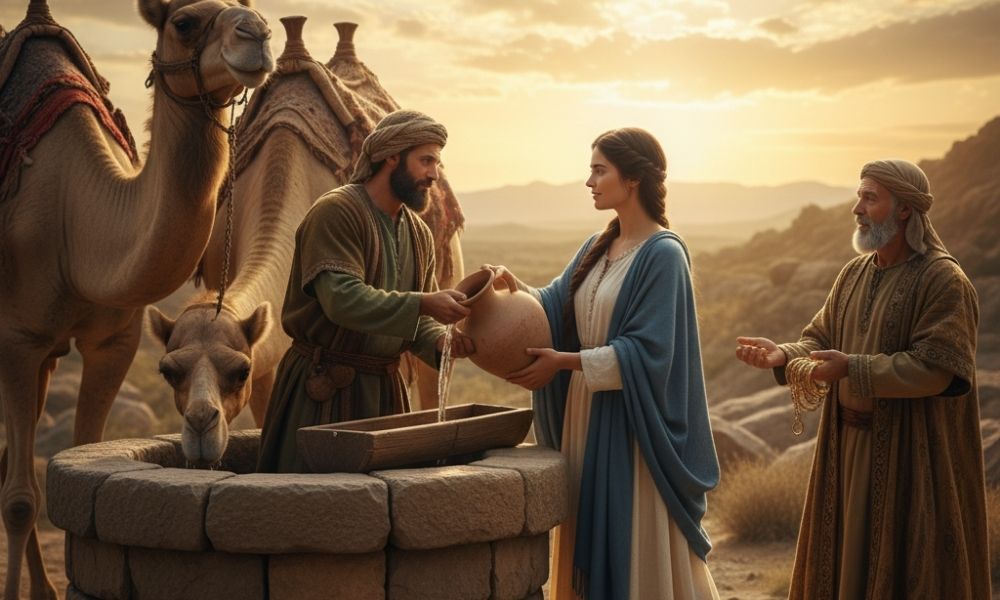
Rebekah was a woman of beauty, courage, and faith — chosen by God to be the wife of Isaac and the mother of Jacob and Esau. Her story in Genesis 24–27 reveals themes of divine guidance, family devotion, and the complexity of human choice within God’s sovereign plan.
Name: Rebekah (Hebrew: Rivqah, meaning “to tie” or “to bind”)
Tribe/Nation: Aramean (from Paddan-Aram, in Mesopotamia)
Era: Patriarchal period (~1900 BCE)
Father: Bethuel
Brother: Laban
Husband: Isaac
Children: Esau and Jacob (twins)
Home: Haran → Canaan
Book: Genesis (Chapters 24–27)
Key Virtues: Faith, kindness, decisiveness
Legacy: Matriarch of Israel; mother of two nations
Symbol: The well — symbolizing divine appointment and life-giving faith
Name Meaning
Rebekah means “to tie” or “bind,” symbolizing her role in uniting families and generations within God’s covenant plan.
Lineage / Family Background
Rebekah was the daughter of Bethuel and sister of Laban, from Nahor’s family, Abraham’s kin. She was discovered by Abraham’s servant in Mesopotamia when seeking a wife for Isaac — an answer to prayer and a sign of God’s providence.
Major Roles / Identity
- Chosen wife for Isaac by divine guidance
- Mother of twin sons, Esau and Jacob
- Matriarch who shaped Israel’s covenant line
- Example of active faith and bold decision-making
Key Character Traits
- Faith: Willingly left her home to marry Isaac, trusting God’s plan (Genesis 24:58).
- Kindness: Offered water not only to Abraham’s servant but also to his camels — a sign of generous hospitality.
- Discernment: Recognized God’s prophecy about her sons’ destinies.
- Protectiveness: Intervened to ensure Jacob received Isaac’s blessing, fulfilling God’s promise.
Main Life Events
- Called by God: Found at the well by Abraham’s servant through prayer and divine signs (Genesis 24:12–27).
- Marriage to Isaac: Met Isaac in Canaan; they loved each other deeply (Genesis 24:63–67).
- Barrenness and Prayer: After twenty years of waiting, she conceived through Isaac’s prayers (Genesis 25:21).
- Birth of Twins: God revealed that two nations were in her womb — Jacob and Esau (Genesis 25:22–23).
- Guiding Jacob: Helped Jacob receive Isaac’s blessing, ensuring God’s chosen line continued (Genesis 27).
Major Relationships
- Isaac: Her loving husband and covenant partner.
- Jacob: The son she favored and helped secure God’s blessing.
- Esau: Her firstborn, whose impulsive nature grieved her heart.
- God: Guided her decisions and revealed His will directly to her.
Notable Passages
- Genesis 24:12–27: The servant’s prayer and Rebekah’s faithful response.
- Genesis 24:58: Her decision — “I will go.”
- Genesis 25:22–23: God’s revelation of the two nations in her womb.
- Genesis 27: Her decisive role in fulfilling the covenant blessing.
Legacy & Impact
- A model of faithful obedience and divine purpose.
- Her life shows that God’s plan prevails, even through human imperfection.
- Remembered as a matriarch of Israel, alongside Sarah, Rachel, and Leah.
Symbolism / Typology
- The Well: A place of divine meeting — representing faith, provision, and calling.
- Rebekah’s Journey: Symbolizes the believer’s willing response to God’s invitation.
- Mother of Nations: Prefigures the spiritual division between faith (Jacob/Israel) and worldliness (Esau/Edom).







Leave a Reply