
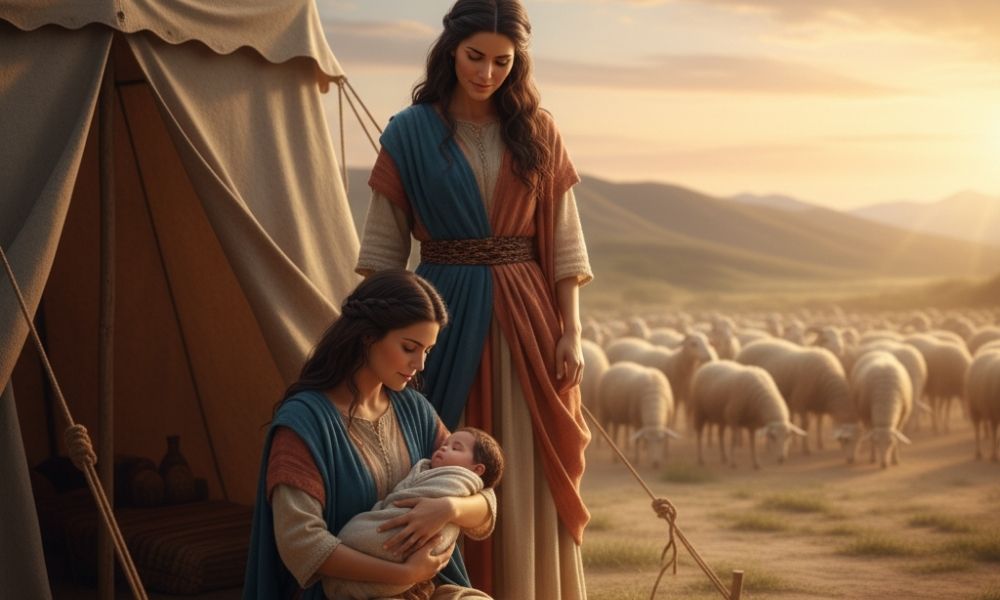
Bilhah was Rachel’s handmaid and one of Jacob’s concubines. Though she lived in the shadow of her mistress, Bilhah played a key role in the formation of the twelve tribes of Israel. Through her, Rachel sought to share in the blessing of motherhood, and Bilhah became the mother of two of Jacob’s sons — Dan and Naphtali. Her story reflects themes of obedience, humility, and how God’s covenant purposes extended through all members of Jacob’s household, not just the prominent ones.
Name: Bilhah (Hebrew: Bilhah, meaning “Timid,” “Tender,” or “Troubled”)
Tribe/Nation: Aramean (from Haran, servant in Laban’s household)
Era: Patriarchal Period (~19th century BCE)
Master/Mistress: Rachel (daughter of Laban)
Husband (by concubinage): Jacob
Children: Dan and Naphtali
Home: Haran → Canaan
Book: Genesis (Chapters 29–35)
Key Virtues: Humility, service, obedience
Legacy: Mother of two tribes of Israel — Dan and Naphtali
Symbol: Dove — representing gentleness and quiet obedience
Name Meaning
The name Bilhah is often interpreted to mean “timid,” “modest,” or “troubled.” It reflects the quiet and humble position she held in Jacob’s household — a servant chosen for a significant role in God’s unfolding plan, yet without the status or voice of her mistresses.
Lineage / Family Background
Bilhah was likely given to Rachel by her father Laban as a personal handmaid when Rachel married Jacob. Her origins were in Haran, making her of Aramean background, like Laban and his family.
- Master: Rachel
- Husband: Jacob (as a concubine)
- Children: Dan and Naphtali
- Sister-handmaid: Zilpah (Leah’s maid)
Major Roles / Identity
- Servant of Rachel
- Concubine to Jacob
- Mother of two patriarchs among the twelve tribes of Israel
- A humble participant in God’s covenant plan
Key Character Traits
- Obedient: Submitted to Rachel’s decision and Jacob’s authority.
- Quiet Strength: Lived faithfully despite her lowly status.
- Instrument of Blessing: Through her, Rachel’s longing for children was partially fulfilled.
- Faithful Presence: Remained part of Jacob’s household and heritage.
Main Life Events
- Given to Rachel: Laban gave Bilhah to his daughter Rachel as a maidservant when Rachel married Jacob (Genesis 29:29).
- Rachel’s Barrenness: When Rachel could not conceive, she offered Bilhah to Jacob as a surrogate, saying, “Here is my maid Bilhah; go in to her, that she may bear upon my knees” (Genesis 30:3).
- Birth of Dan: Bilhah’s first son was named Dan (“He judged”), as Rachel said, “God has judged me, and has also heard my voice.”
- Birth of Naphtali: Bilhah’s second son was Naphtali (“My struggle”), as Rachel declared, “I have had a great struggle with my sister, and I have prevailed” (Genesis 30:8).
- Later Years: Bilhah remained within Jacob’s family; in later years, Reuben, Leah’s eldest son, committed sin with her (Genesis 35:22), causing great grief in Jacob’s household.
Major Relationships
- Rachel: Her mistress and the one who offered her to Jacob; Bilhah bore children on Rachel’s behalf.
- Jacob: Patriarch and father of her two sons; she became one of his concubines.
- Dan and Naphtali: Her sons, founders of two tribes of Israel.
- Leah and Zilpah: Part of the same complex family rivalry that surrounded Jacob’s marriages.
Notable Passages
- Genesis 30:3–5: Rachel said, “Here is my maid Bilhah… and she bore Jacob a son.”
- Genesis 30:6: Rachel said, “God has vindicated me; he has listened to my plea and given me a son. So she named him Dan.”
- Genesis 30:8: “Then Rachel said, ‘With mighty wrestlings I have wrestled with my sister, and I have prevailed.’ So she called his name Naphtali.”
Legacy & Impact
Though Bilhah lived as a servant, God honored her through the birth of Dan and Naphtali, both of whom became founding tribes of Israel. Her quiet obedience contributed to the fulfillment of God’s promise to Abraham — that his descendants would be as numerous as the stars.
- Mother of two of the twelve tribes of Israel
- Example of humility used for divine purpose
- Her life shows that God’s covenant included even the lowly and unseen
Symbolism / Typology
- Bilhah’s Service: Represents the hidden faithfulness through which God often works His purposes.
- Her Children: Dan (“Judged”) and Naphtali (“Wrestling”) symbolize divine justice and perseverance amid struggle.
- Her Role as Surrogate: Foreshadows how God redeems human imperfection and brings blessing through complex circumstances.
Extra-Biblical References
- Jewish tradition views Bilhah as a loyal and righteous servant, honored for her role in building Israel’s house.
- In Midrashic writings, she is sometimes listed among the women of faith who upheld their households.
- Her inclusion among the mothers of Israel signifies that God values the humble and faithful, regardless of rank.







Leave a Reply