
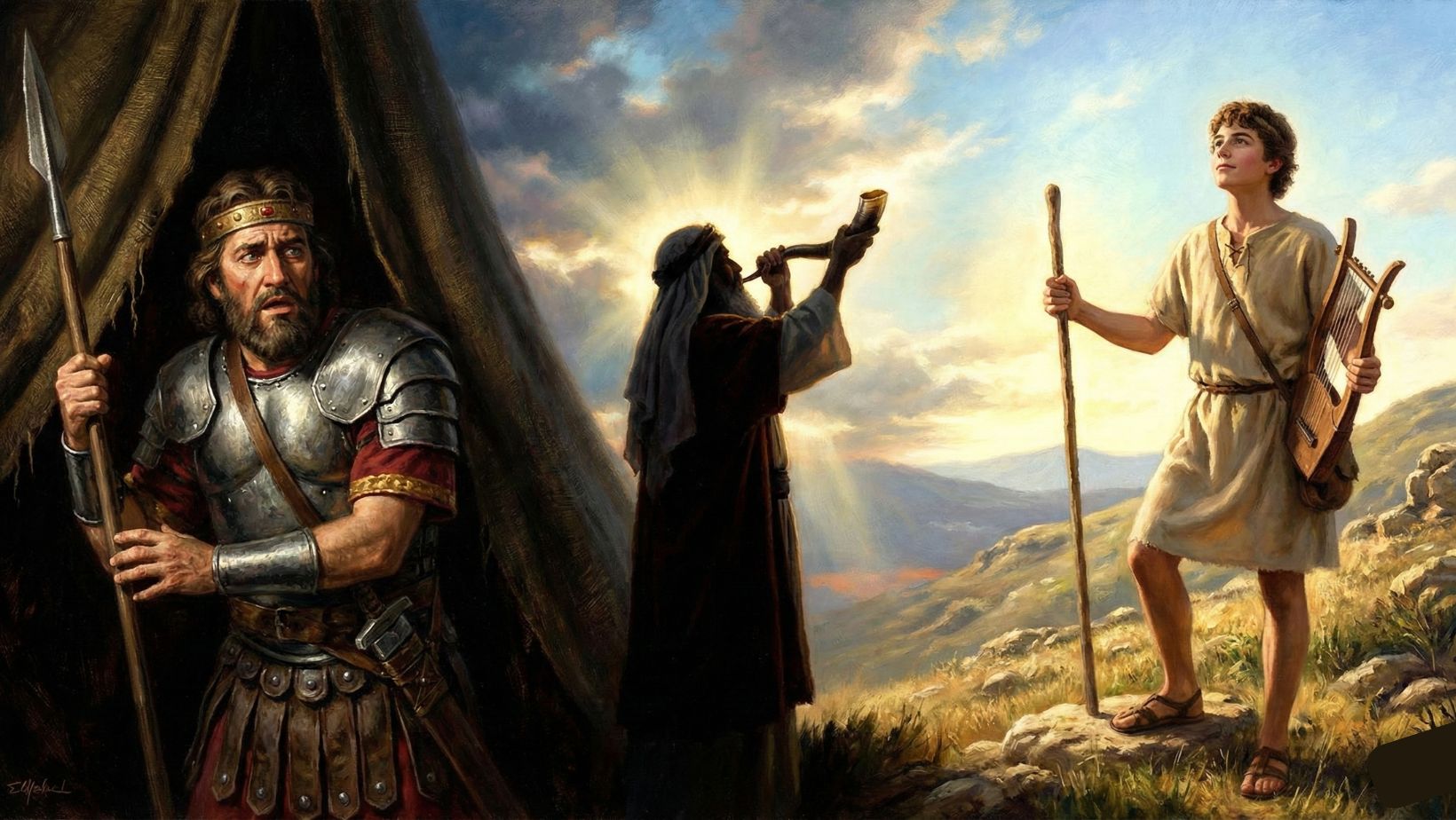
The Book of 1 Samuel is a pivotal historical narrative in the Old Testament that documents one of the most significant transitions in biblical history: Israel’s shift from a loose confederation of tribes ruled by Judges to a unified monarchy under a King. It is a story of political upheaval, spiritual crisis, and personal rivalry. The book centers on three key figures: Samuel (the last Judge and first major Prophet), Saul (the first King, who fails due to pride), and David (the shepherd-king chosen by God). It explores complex themes of power, obedience, and the tension between human demands and divine sovereignty.
Quick Facts
- Title: 1 Samuel (Originally one book with 2 Samuel in Hebrew: Sefer Shmuel)
- Author: Traditionally attributed to Samuel, with additions by prophets Gad and Nathan
- Date Written: Likely between 930–722 BCE (after the division of the kingdom)
- Time Period: Approx. 1100–1010 BCE
- Genre: Historical Narrative
- Key Figures: Samuel, Eli, Hannah, Saul, Jonathan, David
- Key Location: Shiloh, Ramah, Gibeah, Bethlehem, Wilderness of Judea
- Key Verse: “But the LORD said to Samuel, ‘Do not look on his appearance or on the height of his stature, because I have rejected him. For the LORD sees not as man sees: man looks on the outward appearance, but the LORD looks on the heart.’” (1 Samuel 16:7)
Structure & Outline
The book is naturally divided into three main sections based on the dominant leadership figure of the time:
1. The Ministry of Samuel (Chapters 1–7)
- The birth of Samuel to Hannah and his dedication to the Lord.
- The corruption of the priesthood under Eli’s sons.
- The loss of the Ark of the Covenant to the Philistines and its return.
- Samuel’s rise as Judge and the restoration of Israel’s faith.
2. The Rise and Reign of Saul (Chapters 8–15)
- Israel demands a king “like all the other nations.”
- Saul is anointed as the first King of Israel.
- Saul’s early military victories.
- Saul’s disobedience, unlawful sacrifice, and rejection by God.
3. The Rise of David and Decline of Saul (Chapters 16–31)
- David is anointed secretly by Samuel.
- David defeats Goliath and gains fame.
- The friendship between David and Jonathan.
- Saul’s jealousy and pursuit of David in the wilderness.
- The death of Saul and his sons on Mount Gilboa.
Major Themes
Kingship & Theocracy: The central tension of the book is Israel’s rejection of God as their King in favor of a human ruler. God grants their request but warns them of the consequences. The book contrasts the people’s choice (Saul: tall, impressive, but spiritually shallow) with God’s choice (David: humble, faithful, a man after God’s own heart).
Obedience over Ritual: A recurring lesson is that religious rituals cannot replace genuine obedience. Saul loses his kingdom not because he wasn’t religious, but because he tried to manipulate religious duties for personal gain. Samuel declares, “To obey is better than sacrifice” (1 Sam 15:22).
The Reversal of Fortunes: Introduced in Hannah’s Song (Chapter 2), this theme echoes throughout the book: God humbles the proud and exalts the humble. The barren woman has a child; the powerful King Saul is brought low; the shepherd boy David is raised up.
Friendship & Loyalty: The covenant bond between Jonathan (Saul’s heir) and David is one of the Bible’s profoundest examples of sacrificial love. Jonathan willingly gives up his claim to the throne because he recognizes God’s hand on David.
Key Characters
Samuel: The bridge between the era of Judges and Kings. He serves as priest, judge, and prophet. He is the moral compass of the nation, holding both the people and the king accountable to God’s law.
Saul: A tragic figure. He starts with promise—humble and physically impressive—but is consumed by insecurity, fear of man, and jealousy. He represents leadership in the flesh.
David: The youngest son of Jesse. Though flawed, he possesses a heart that is sensitive to God. He represents leadership by the Spirit. He refuses to kill Saul (“God’s anointed”) even when he has the chance, trusting God’s timing over his own ambition.
Eli: The High Priest who fails to restrain his wicked sons, serving as a warning against passive leadership and the neglect of family discipline.
Notable Passages
1 Samuel 2:1–10 (Hannah’s Prayer): A prophetic poem praising God’s sovereignty, serving as a theological framework for the whole book (and a precursor to Mary’s Magnificat in Luke).
1 Samuel 3:10 (Samuel’s Call): “Speak, for your servant is listening.” The model posture for approaching God’s Word.
1 Samuel 15:22 (The Rejection of Saul): “Has the LORD as great delight in burnt offerings and sacrifices, as in obeying the voice of the LORD? Behold, to obey is better than sacrifice, and to listen than the fat of rams.”
1 Samuel 17 (David and Goliath): The ultimate underdog story that is actually about faith in God’s power over human might. “The battle is the LORD’s.”
Analysis & Legacy
The Failure of Human Monarchy: 1 Samuel demonstrates that a change in political structure cannot solve a spiritual problem. Israel thought a king would save them from the Philistines, but their true safety lay only in covenant faithfulness to Yahweh.
Typology of Christ: David is the primary “type” of Christ in the Old Testament. He is the Anointed One (Messiah means “anointed”), born in Bethlehem, a shepherd who risks his life for the sheep, and a king who defeats the enemies of God’s people.
Psychological Depth: The book offers a raw look at human psychology, particularly in the character of Saul—his descent into paranoia, depression, and madness serves as a somber study on the corrosive effects of jealousy and sin.







Leave a Reply