
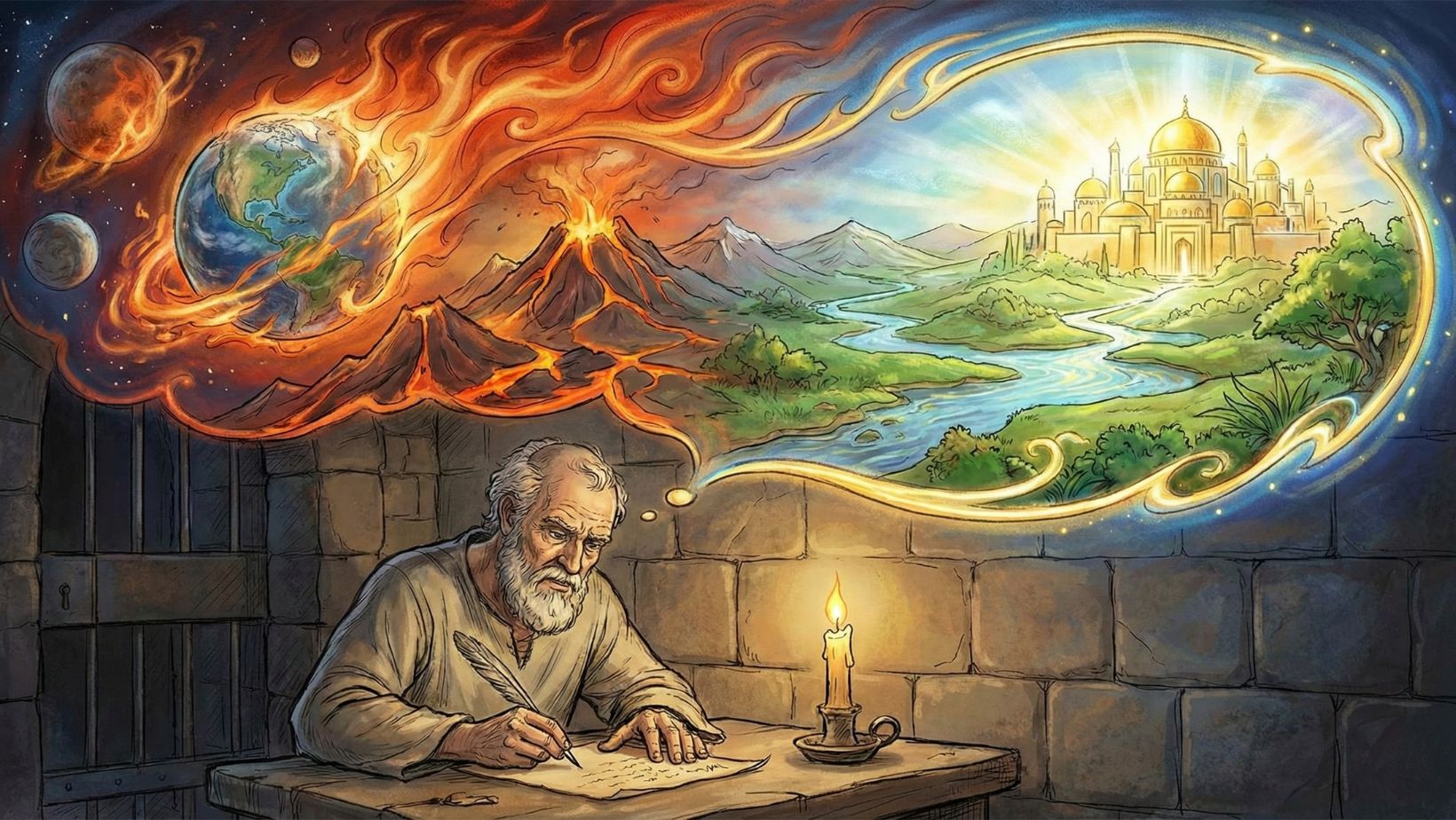
The Second Epistle of Peter is the Apostle Peter’s “last will and testament.” Written shortly before his execution in Rome (traditionally by upside-down crucifixion), it strikes a very different tone from his first letter. While 1 Peter comforted believers facing external persecution (attacks from the world), 2 Peter warns them against internal corruption (poison in the church). Peter sounds the alarm against false teachers who were twisting the concept of grace into a license for immorality and mocking the promise of Jesus’ return. It is an urgent, fiery call to hold fast to the “true knowledge” of God and to grow in spiritual maturity before the end comes.
Quick Facts
- Author: The Apostle Peter (Simon Peter)
- Date Written: ~65–67 AD (Shortly before his death under Nero)
- Audience: The same believers as the first letter (3:1)
- Theme: Warning against False Teachers / The Certainty of Judgment
- Key Word: “Knowledge” (epignosis — appearing roughly 16 times)
- Key Verse: 2 Peter 3:18 (“But grow in the grace and knowledge of our Lord and Savior Jesus Christ.”)
- Structure: True Virtue (1) → False Teachers (2) → Sure Return (3)
- Symbol: The Day Star (Morning Star) — rising in your hearts
Title / Purpose
Title: The Second Epistle of Peter.
Purpose:
- To Warn: To expose false teachers who were introducing destructive heresies and denying the Lord who bought them.
- To Remind: Peter knows his death is imminent (“I will soon put aside this tent,” 1:14), so he writes to ensure they remember the truth after he is gone.
- To Reassure: To affirm that the Second Coming is real, despite the scoffers who claimed, “Where is this ‘coming’ he promised?”
Authorship & Context
The Author: Peter identifies himself as “a servant and apostle of Jesus Christ.” He references his personal experience at the Transfiguration (1:16–18) and his friendship with “our dear brother Paul” (3:15).
The Connection to Jude: Chapter 2 of this letter bears a striking resemblance to the Epistle of Jude. Most scholars believe one borrowed from the other (or both drew from a common source) to combat the same rising heresy.
The Heresy: The false teachers were likely early Gnostics or antinomians (“lawless ones”) who believed that since the spirit is good and the body is evil/irrelevant, they could indulge in sexual immorality without spiritual consequence. They also ridiculed the idea of a literal judgment day.
Structure / Narrative Arc
The letter is a “sandwich” of truth—beginning and ending with true knowledge, with a filling of false teaching in the middle.
1. Cultivating Christian Character (Chapter 1):
- The Ladder of Faith: Faith is not static. Peter lists a progression: add to your faith goodness, knowledge, self-control, perseverance, godliness, brotherly kindness, and love.
- The Reliability of Scripture: We didn’t follow “cleverly devised stories.” We saw His majesty on the holy mountain. Prophecy never had its origin in the human will; men spoke from God as they were carried along by the Holy Spirit.
2. Condemning False Teachers (Chapter 2):
- Their Profile: They are bold, arrogant, and experts in greed. They promise freedom but are themselves slaves of depravity.
- Their Judgment: God knows how to rescue the godly (like Lot) and punish the unrighteous. Peter compares them to “springs without water” and “dogs returning to their vomit.”
3. Confidence in Christ’s Return (Chapter 3):
- The Scoffers: They say, “Everything goes on as it has since the beginning.” Peter argues they “deliberately forget” that God judged the world once by water (Noah) and will judge it again by fire.
- God’s Time: “With the Lord a day is like a thousand years.” His delay is not slowness; it is patience, waiting for people to repent.
- The New Heavens: Since everything will be destroyed by fire, “what kind of people ought you to be?” We look forward to a new heaven and a new earth.
Major Themes
True Knowledge vs. False Knowledge: The heretics claimed to have special, secret insight. Peter argues that true knowledge is open to all, found in the Scriptures, and produces a holy life.
The Nature of Scripture: This book contains one of the highest views of biblical inspiration in the New Testament (1:20–21), asserting that the Bible is the result of the Holy Spirit “carrying along” the human authors like a wind fills a sail.
Eschatology (The End Times): Peter provides a graphic description of the end of the world—the elements melting with intense heat—followed by a recreation of the cosmos.
Apostasy: Peter warns that it is possible to know the way of righteousness and then turn back, and that the latter state of such a person is worse than the first (2:20–21).
Key Characters
Peter: The dying apostle, urgent and protective. The False Teachers: Unnamed infiltrators characterized by sexual greed and arrogance. Lot: Used as an example of a righteous man tormented by the filthy lives of the wicked living around him (in Sodom). Balaam: The Old Testament prophet who loved the “wages of wickedness,” used to typify the greed of the false teachers. Paul: Peter affirms Paul’s letters as “Scripture” (3:16), a crucial moment in the formation of the New Testament canon.
Notable Passages
The Divine Nature (1:4): “…he has given us his very great and precious promises, so that through them you may participate in the divine nature…”
Origin of Scripture (1:21): “For prophecy never had its origin in the human will, but prophets, though human, spoke from God as they were carried along by the Holy Spirit.”
The Dog and the Vomit (2:22): “A dog returns to its vomit,” and, “A sow that is washed returns to her wallowing in the mud.”
God’s Time (3:8): “With the Lord a day is like a thousand years, and a thousand years are like a day.”
God’s Patience (3:9): “The Lord is not slow in keeping his promise… Instead he is patient with you, not wanting anyone to perish, but everyone to come to repentance.”
Twisting Scripture (3:16): Peter notes that Paul’s letters contain “some things that are hard to understand, which ignorant and unstable people distort, as they do the other Scriptures.”
Legacy & Impact
Canonization: 2 Peter 3:16 is historically significant because Peter classifies Paul’s writings as graphē (“Scripture”), putting them on the same level as the Old Testament prophets. This shows that the early church recognized the authority of the New Testament books very early on.
Theology of Judgment: It provides the definitive New Testament imagery of the “Day of the Lord” as a cleansing fire that makes way for a restored creation.
Symbolism / Typology
The Morning Star: Peter describes the awakening of spiritual understanding as the “morning star” rising in your hearts (1:19), a symbol of Christ and the dawn of the eternal day.
Noah’s Flood vs. The Coming Fire: The flood is used as a historical precedent to prove that God is willing to intervene in history to judge sin, refuting the scoffers who believed the world was immutable.







Leave a Reply