
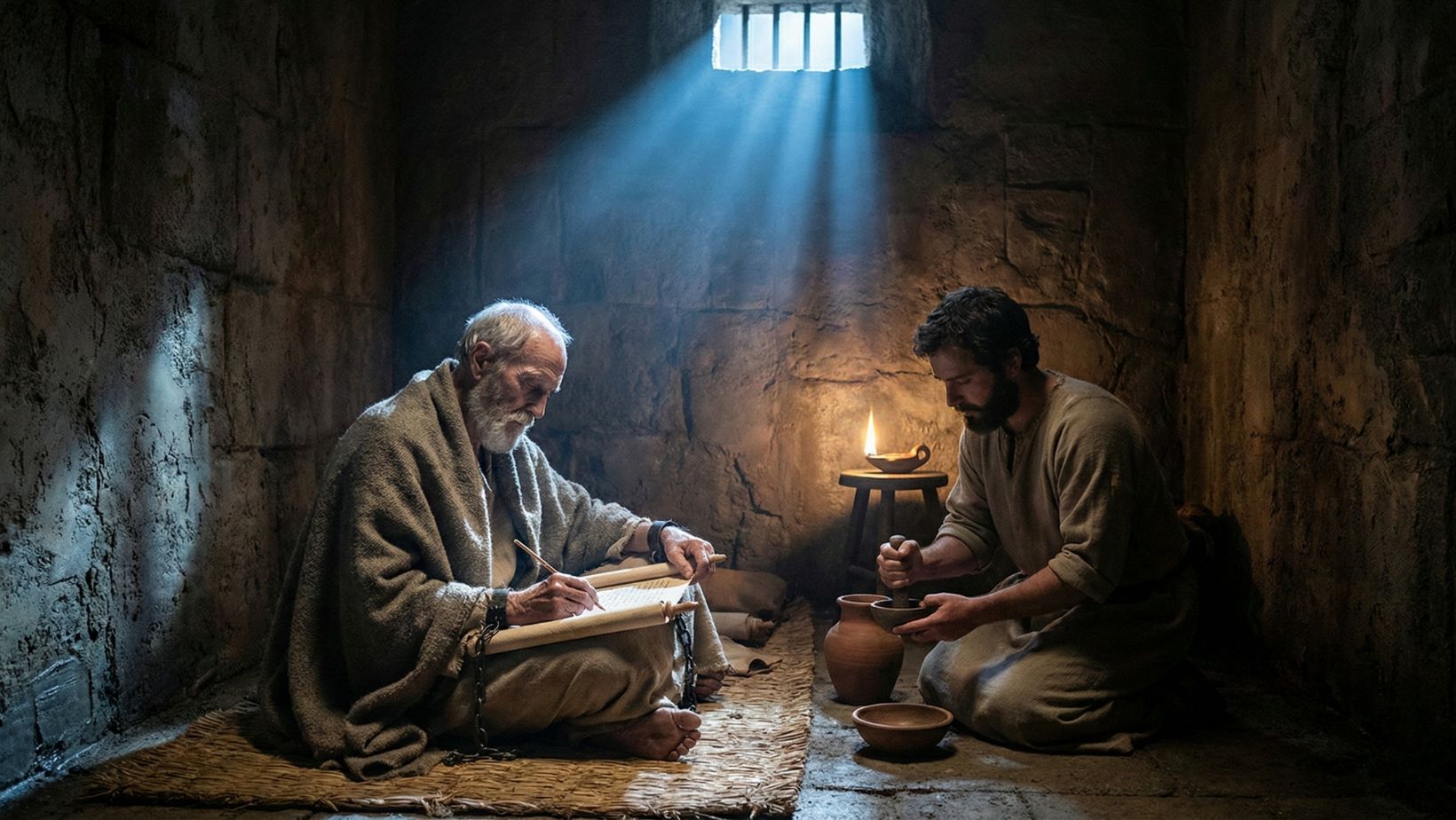
The Second Epistle to Timothy is the final, most poignant letter written by the Apostle Paul. It is his “swan song”—his last will and testament written from a cold, damp dungeon in Rome as he awaits execution under Emperor Nero. Unlike 1 Timothy, where Paul was free and organizing the church, here Paul is bound as a criminal, abandoned by many friends, and sensing that his departure is imminent. The letter is intensely personal, emotional, and urgent. He writes to summon his “beloved son” Timothy to his side one last time and to pass the baton of the Gospel ministry to the next generation. It is a stirring call to endure hardship, preach the Word, and finish the race with faithfulness.
Quick Facts
- Author: The Apostle Paul
- Date Written: ~67 AD (Shortly before his martyrdom)
- Location: Mamertine Prison, Rome (a hole in the ground)
- Audience: Timothy
- Theme: Endurance and Faithfulness
- Key Word: “Suffering” and “Word”
- Key Verse: 2 Timothy 4:7 (“I have fought the good fight, I have finished the race, I have kept the faith.”)
- Structure: The Call to Courage (1) → The Call to Endurance (2) → The Call to Truth (3–4)
- Symbol: The Baton — representing the transfer of the Gospel to the next generation
Title / Purpose
Title: The Second Epistle of Paul to Timothy.
Purpose:
- To Summon Timothy: Paul is lonely and cold; he asks Timothy to come quickly before winter and bring his cloak and scrolls.
- To Strengthen: Knowing he will soon be gone, Paul exhorts Timothy not to be ashamed of the Gospel or of Paul’s chains.
- To Warn: To prepare the church for the “difficult times” of the last days when people will reject truth.
Authorship & Context
The Author: This is Paul at the end of his life. He is not in house arrest (as in Acts 28); he is in a dungeon, likely the Mamertine Prison, treated as a dangerous criminal.
The Atmosphere: There is a sense of abandonment. “Everyone in the province of Asia has deserted me” (1:15). Demas, a former coworker, has left him because he “loved this world.” Only Luke remains.
The Stakes: The Neronian persecution is raging. Paul knows there is no release this time—only the sword.
Structure / Narrative Arc
The letter moves from looking back at their shared history to looking forward to the future of the church without Paul.
1. The Foundation of Faith (Chapter 1):
- Heritage: Paul recalls the sincere faith of Timothy’s grandmother Lois and mother Eunice.
- Courage: “For God has not given us a spirit of fear, but of power and of love and of a sound mind.”
- Loyalty: Paul praises Onesiphorus, who was not ashamed of Paul’s chains and searched for him in Rome.
2. The Metaphors of Ministry (Chapter 2):
- The Strategy: Entrust the message to faithful men who will teach others (spiritual multiplication).
- The Pictures: A Soldier (who doesn’t get entangled in civilian affairs), an Athlete (who competes according to the rules), and a Farmer (who works hard for the harvest).
3. The Prediction of Apostasy (Chapter 3):
- Perilous Times: In the last days, people will be “lovers of self, lovers of money… having a form of godliness but denying its power.”
- The Anchor: In a chaotic world, Timothy must cling to the Holy Scriptures, which are “God-breathed” (theopneustos).
4. The Final Charge (Chapter 4):
- The Command: “Preach the word; be prepared in season and out of season.”
- The Departure: Paul announces he is being “poured out like a drink offering.”
- The Request: “Do your best to come to me quickly.”
Major Themes
Discipleship (Succession): The Gospel is always one generation away from extinction. Paul commands Timothy to take what he heard and invest it in “faithful men.” This is the 4-generation chain: Paul → Timothy → Faithful Men → Others.
The Inspiration of Scripture: 2 Timothy 3:16 is the classic text on the nature of the Bible. It is not just good advice; it is breathed out by God and is profitable for equipping the man of God for every good work.
Ending Well: Paul does not look at death with fear but with anticipation. He sees the “crown of righteousness” waiting for him.
Suffering for the Gospel: Paul emphasizes that “everyone who wants to live a godly life in Christ Jesus will be persecuted” (3:12). Suffering is not a sign of failure; it is a mark of faithfulness.
Key Characters
Paul: The dying spiritual father. Timothy: The son and heir to the ministry. Lois and Eunice: The faithful women who taught Timothy the Scriptures from childhood. Demas: The tragic figure who deserted Paul for worldly comfort. Mark: Surprisingly, Paul asks for Mark (“he is helpful to me”), showing that the young man who once quit (Acts 13) has been fully restored and matured.
Notable Passages
Spirit of Power (1:7): “For the Spirit God gave us does not make us timid, but gives us power, love and self-discipline.”
Spiritual Multiplication (2:2): “And the things you have heard me say… entrust to reliable people who will also be qualified to teach others.”
God-Breathed Scripture (3:16–17): “All Scripture is God-breathed and is useful for teaching, rebuking, correcting and training in righteousness…”
Preach the Word (4:2): “Preach the word; be prepared in season and out of season; correct, rebuke and encourage—with great patience and careful instruction.”
The Epitaph (4:7): “I have fought the good fight, I have finished the race, I have kept the faith.”
Legacy & Impact
Pastoral Ministry: The “Final Charge” in Chapter 4 is often read at the ordination of pastors, reminding them that their primary job is not to be innovative or popular, but to herald the text of Scripture.
Bibliology: The doctrine of Sola Scriptura (Scripture Alone) relies heavily on Paul’s assertion in Chapter 3 that Scripture is sufficient to make the man of God “thoroughly equipped.”
Symbolism / Typology
The Drink Offering: Paul views his death not as an execution by Rome, but as a liturgical offering to God. The wine is being poured out on the altar; the sacrifice is complete.
The Lion’s Mouth: Paul says he was “delivered from the lion’s mouth” (4:17). This could refer to Satan, or literally to the lions in the Roman coliseum, or generally to the immediate threat of death.







Leave a Reply