
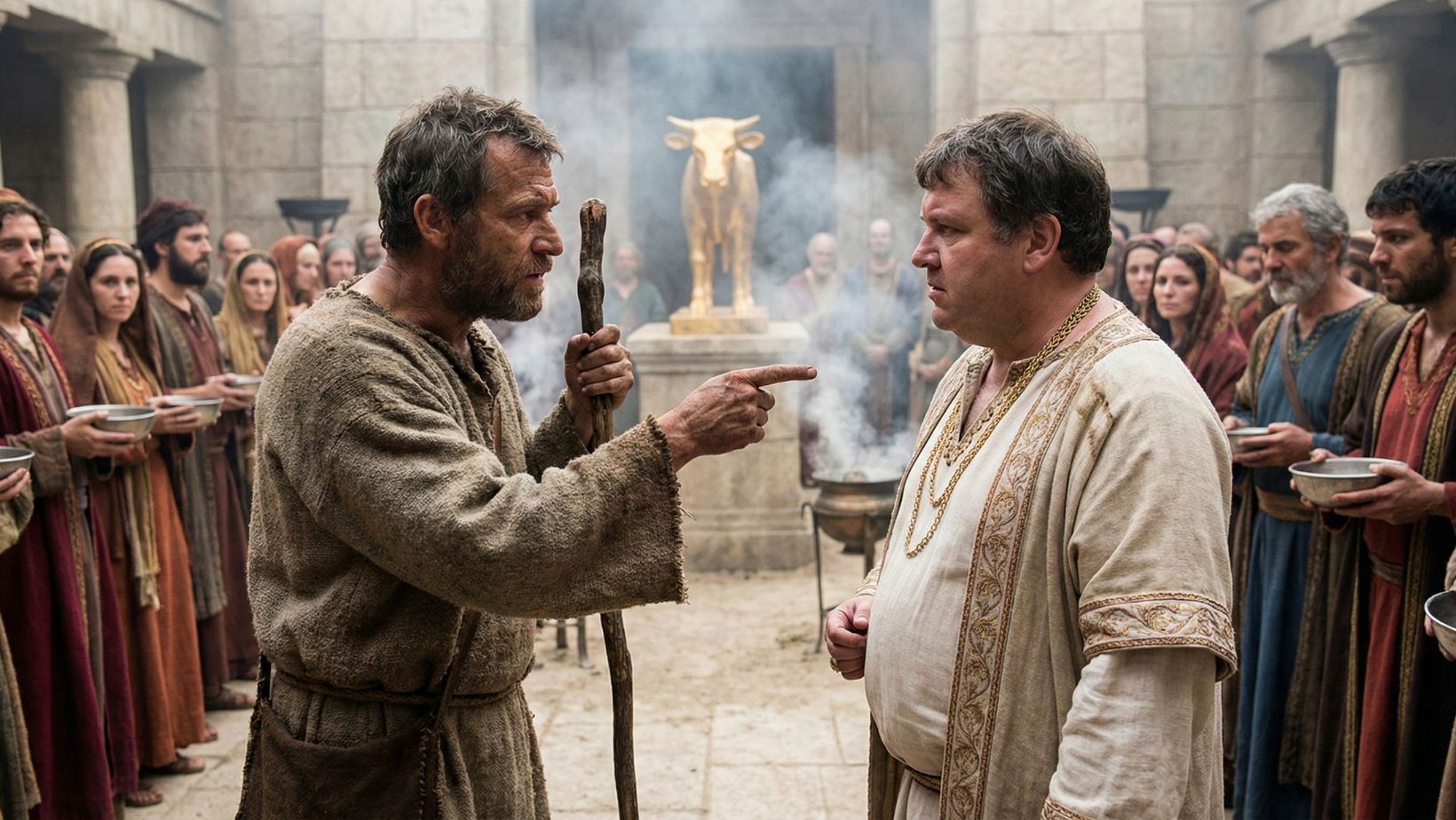
Amos is the great champion of social justice in the Old Testament. Unlike many other prophets who came from priestly or noble families, Amos was a layman—a shepherd and a grower of sycamore figs from the Southern Kingdom of Judah. God called him from his rural work to travel north to the wealthy, idolatrous Kingdom of Israel (the Northern Kingdom) during the reign of Jeroboam II. His message was blistering and unpopular: he condemned the wealthy elite for their extravagant lifestyles, their oppression of the poor, and their empty religious rituals. Amos famously declared that God hates worship that is not accompanied by justice.
Quick Facts
- Name: Amos (Hebrew: Amos)
- Tribe/Nation: Judah (Southern Kingdom), but prophesied to Israel (Northern Kingdom)
- Era: Divided Kingdom / Pre-Exilic (Mid-8th Century BCE)
- Kings Served: Uzziah (Judah); Jeroboam II (Israel)
- Home: Tekoa (a rural village south of Jerusalem)
- Occupation: Sheep breeder / Shepherd; tender of sycamore-fig trees
- Book: The Book of Amos (9 chapters)
- Key Virtues: Courage, blunt honesty, passion for justice
- Legacy: The “Prophet of Social Justice;” heavily quoted by Martin Luther King Jr.
- Symbol: The Plumb Line — representing God’s measuring standard of righteousness
Name Meaning
“Amos” means “Burden” or “Burden-bearer.” This fits his calling perfectly, as he carried a heavy message of judgment (“burdens” or oracles) against the nations and specifically against the corrupt leadership of Israel.
Lineage / Family Background
Origin: Tekoa, a rugged town in the hill country of Judah, about 10 miles south of Jerusalem.
Status: He explicitly states, “I was no prophet, nor was I a son of a prophet” (Amos 7:14). This means he did not belong to the professional “guild” or “school” of prophets. He was an outsider—a businessman and agriculturalist—independent of the royal payroll and religious establishment.
Biblical Era / Context
Time: Approx. 760–750 BCE.
Political Context: A time of temporary peace and great economic prosperity (“The Silver Age”) for both Israel and Judah. With enemies like Syria and Assyria temporarily weak, Jeroboam II expanded Israel’s borders.
Social Context: The wealth led to distinct social stratification. The rich lived in “houses of ivory,” feasted on choice meat, and drank wine by the bowlful, while exploiting the poor, selling the needy for “a pair of sandals,” and perverting justice in the courts.
Major Roles / Identity
The Outsider: A Southerner preaching in the North. This made him culturally and politically suspect to the Northern establishment.
Social Critic: He attacked the economic structures that allowed the rich to thrive at the expense of the poor.
** doom-sayer:** While the people expected the “Day of the LORD” to be a day of victory over their enemies, Amos shocked them by predicting it would be a day of darkness and judgment for them.
Key Character Traits
Fearlessness: He walked into the royal sanctuary at Bethel—the heart of the Northern Kingdom’s religious and political power—and told the King’s priest that the King would die and the people would go into exile.
Rustic Eloquence: Though not a “professional,” his writing is some of the finest in the Hebrew Bible. He used imagery from his life: lions, bears, bird traps, fishing hooks, and harvest baskets.
Uncompromising: He refused to soften his message for the sake of acceptance.
Observant: He saw the connection between spiritual apostasy (idolatry) and social decay (injustice).
Main Life Events
The Call: While following the flock in Tekoa, “The LORD took me” (Amos 7:15) and commanded him to prophesy to Israel.
The Pronouncement against the Nations: Amos begins by skillfully condemning Israel’s pagan neighbors (Damascus, Gaza, Tyre, Edom, Ammon, Moab) and even Judah. The crowd likely cheered until he turned the same formula (“For three sins… and for four”) onto Israel itself (Amos 1–2).
The Confrontation at Bethel: Amaziah, the high priest of the golden calf shrine at Bethel, accused Amos of treason and told him to flee back to Judah to earn his bread there.
Amos’s Defense: Amos clarified that he wasn’t prophesying for money (bread), but out of divine compulsion: “The lion has roared; who will not fear? The Lord GOD has spoken; who can but prophesy?” (Amos 3:8).
The Visions: He received five visions of judgment:
- Locust swarm (averted by prayer).
- Devouring fire (averted by prayer).
- The Plumb Line (judgment determined).
- Basket of Summer Fruit (the end is ripe).
- The Lord standing by the Altar (destruction of the temple).
Major Relationships
Amaziah: The Priest of Bethel. He represents the religious establishment that supports the state rather than obeying God. He tried to silence Amos.
Jeroboam II: The King of Israel. Though they likely never met face-to-face, Amos’s message was a direct indictment of his administration.
The “Cows of Bashan”: A sarcastic term Amos used for the wealthy, pampered women of Samaria who demanded luxury while urging their husbands to oppress the poor (Amos 4:1).
Notable Passages
Amos 5:24: “But let justice roll down like waters, and righteousness like an ever-flowing stream.” (Ideally describing the unstoppable force of God’s demand for equity).
Amos 4:1: “Hear this word, you cows of Bashan… who oppress the poor, who crush the needy…”
Amos 8:11: “Behold, the days are coming… when I will send a famine on the land—not a famine of bread, nor a thirst for water, but of hearing the words of the LORD.”
Amos 3:3: “Do two walk together, unless they have agreed to do so?”
Legacy & Impact
Martin Luther King Jr.: Dr. King frequently quoted Amos 5:24 in his “I Have a Dream” speech and “Letter from Birmingham Jail,” cementing Amos as a timeless voice for civil rights.
The Death of “Cheap Grace”: Amos taught that religious ritual (feasts, songs, sacrifices) is an abomination to God if it is not accompanied by ethical treatment of one’s neighbor.
Predicting the Exile: Amos accurately predicted the Assyrian exile of Israel, which occurred roughly 30-40 years after his ministry (722 BCE).
Symbolism / Typology
The Plumb Line: A construction tool used to ensure a wall is vertical. Amos sees God holding a plumb line against Israel. The wall (Israel) is crooked (corrupt) and cannot be fixed; it must be torn down.
The Basket of Summer Fruit: A pun in Hebrew. The word for “summer fruit” (qayits) sounds like the word for “end” (qets). The fruit is ripe, implying Israel is “ripe” for judgment.
Famine of the Word: A prophecy that a time would come when people would desperately seek God’s direction but find silence—a state of spiritual judgment.
Extra-Biblical References
Earthquake: Amos dates his book to “two years before the earthquake” (Amos 1:1). Archaeological evidence (at Hazor and other sites) confirms a massive earthquake in the region around 760 BCE, testifying to the historical precision of the account.







Leave a Reply