
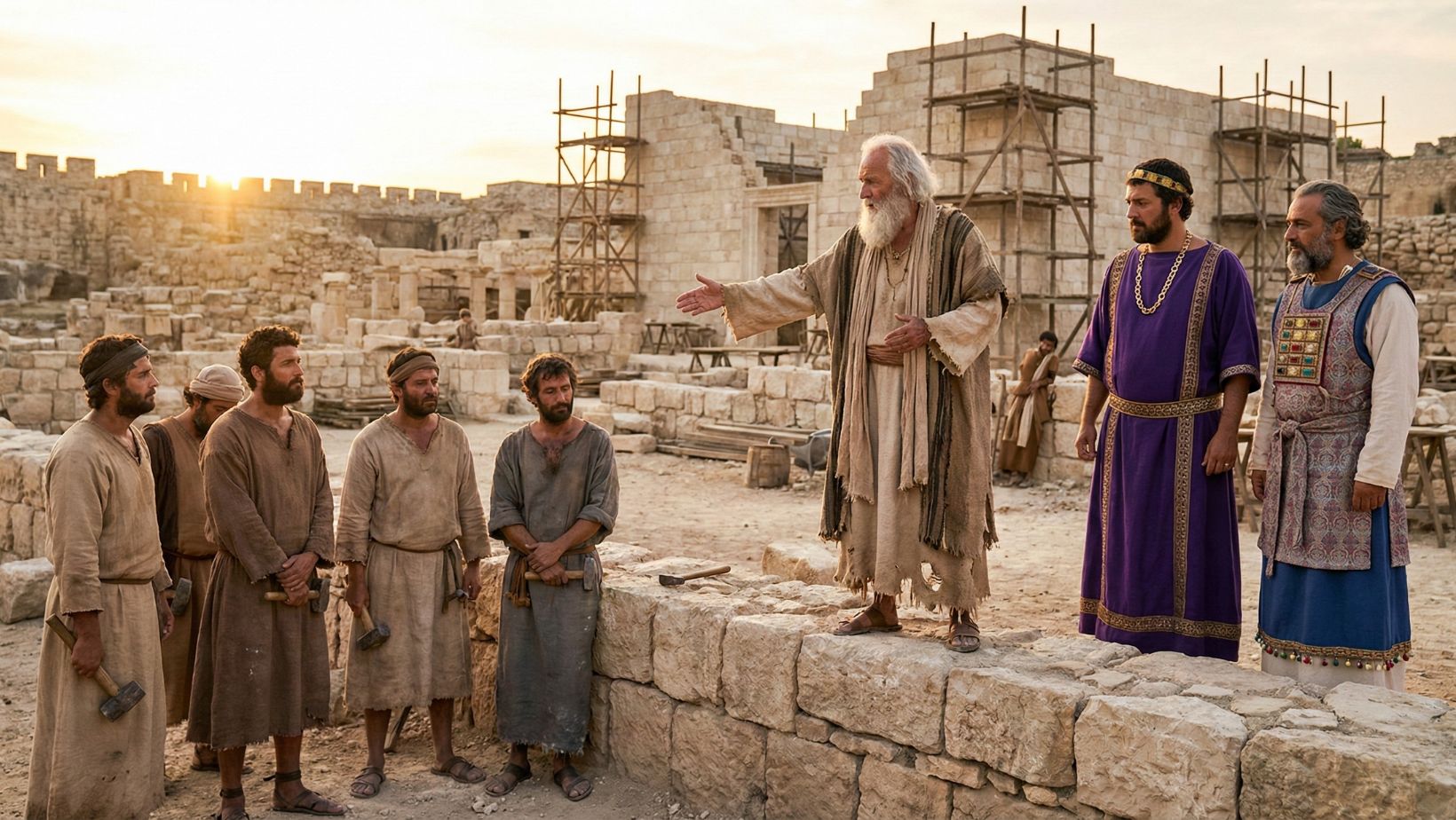
Haggai is the “Prophet of the Temple.” He appears on the scene in 520 BCE with a singular, laser-focused mission: to kickstart the stalled reconstruction of God’s house. The Jewish exiles had returned from Babylon nearly 20 years earlier with high hopes, but opposition and apathy had caused the work to grind to a halt. The people had become comfortable living in their own “paneled houses” while the Temple lay in ruins. Haggai shattered their complacency, arguing that their economic hardships—failed crops and empty purses—were direct consequences of their misplaced priorities. He is one of the most successful prophets in history; his preaching resulted in immediate action, and the Temple was completed within four years.
Quick Facts
- Name: Haggai (Hebrew: Chaggai)
- Tribe/Nation: Judah (Post-Exilic Community)
- Era: Persian Period (520 BCE)
- Contemporary: Zechariah
- Duration of Ministry: Only 4 months (August to December 520 BCE)
- Target Audience: Zerubbabel (Governor), Joshua (High Priest), and the returning exiles
- Book: The Book of Haggai (2 chapters)
- Key Virtues: Focus, prioritization, encouragement
- Legacy: Successfully mobilized the nation to rebuild the Second Temple
- Symbol: The Signet Ring — representing authority and God’s chosen leader
Name Meaning
“Haggai” is derived from the Hebrew word chag, meaning “Festival” or “Feast.” This suggests he may have been born on a feast day. His name implies celebration, fitting for a prophet whose work led to the restoration of Israel’s central place of worship and festivity.
Lineage / Family Background
Origin: Little is known about his family. He is simply called “the prophet.” Age: Jewish tradition suggests Haggai may have been very old—old enough to have seen the first Temple of Solomon before it was destroyed in 586 BCE. This would explain his emotional question in 2:3: “Who of you is left who saw this house in its former glory?” If true, he was a living bridge between the pre-exilic glory and the post-exilic struggle.
Biblical Era / Context
Time: The second year of King Darius I of Persia (520 BCE). Dates: The book is meticulously dated. Every sermon is time-stamped, covering a period of exactly 3 months and 24 days.
Historical Context:
- The Return: Cyrus the Great allowed the Jews to return in 538 BCE.
- The Stoppage: They laid the foundation, but Samaritan opposition and discouragement stopped the work for ~16 years.
- The Apathy: The people rationalized their inaction, saying, “The time has not yet come to rebuild the LORD’s house” (Haggai 1:2), while focusing on building their own luxury homes.
Major Roles / Identity
The Motivator: Haggai was a practical pragmatist. While Zechariah (his contemporary) used apocalyptic visions to encourage the people, Haggai used direct commands and logic: “Give careful thought to your ways.”
The Realist: He pointed out the direct correlation between their spiritual negligence and their economic recession.
The Encourager: Once the people started working, his message shifted immediately from rebuke to reassurance: “I am with you, declares the LORD” (Haggai 1:13).
Key Character Traits
Directness: He wasted no words. His sermons are short, punchy, and impossible to misunderstand.
Authority: He constantly used the phrase “This is what the LORD Almighty says” (used 26 times in 38 verses), emphasizing that the message was not his own.
Responsiveness: Unlike prophets like Jeremiah who preached for decades with little result, Haggai saw immediate obedience. The leaders and people “obeyed the voice of the LORD” (Haggai 1:12).
Main Life Events
The Rebuke (August 29, 520 BCE): Haggai challenges the people for living in “paneled houses” (luxury) while God’s house is a “ruin.” He explains their “holes in their pockets”—why they earn wages but never have enough (Haggai 1).
The Response: Zerubbabel (the Governor) and Joshua (the High Priest) are stirred by the Spirit. Within 23 days, the work on the Temple resumes.
The Encouragement (October 17, 520 BCE): As the builders look at the modest new foundation and compare it to Solomon’s glorious temple, they become discouraged. Haggai promises, “The glory of this present house will be greater than the glory of the former house” (Haggai 2:9).
The Promise to Zerubbabel (December 18, 520 BCE): Haggai concludes with a personal word to the governor, Zerubbabel, promising that God will shake the nations but make him like a “signet ring,” reversing the curse that had been placed on his grandfather, King Jehoiachin.
Major Relationships
Zerubbabel: The civil leader (Governor) of Judah and a descendant of David. Haggai affirms his leadership as God’s chosen instrument.
Joshua (Jeshua): The religious leader (High Priest). Haggai and Zechariah worked together to strengthen his hands for the spiritual work.
Zechariah: The younger prophet who worked alongside Haggai. Ezra 5:1 records that these two prophets together inspired the rebuilding efforts.
Notable Passages
Haggai 1:5–6: “Give careful thought to your ways. You have planted much, but harvested little. You eat, but never have enough… You earn wages, only to put them in a purse with holes in it.”
Haggai 2:9: “‘The glory of this present house will be greater than the glory of the former house,’ says the LORD Almighty. ‘And in this place I will grant peace.’”
Haggai 2:23: “‘On that day… I will take you, my servant Zerubbabel… and I will make you like my signet ring, for I have chosen you,’ declares the LORD Almighty.”
Legacy & Impact
The Second Temple: Without Haggai’s intervention, the Second Temple might not have been completed when it was. This Temple stood for nearly 500 years (later renovated by Herod), becoming the center of Jewish life and the place where Jesus himself would teach.
Messianic Lineage: The prophecy of the “signet ring” (Haggai 2:23) is crucial. God had previously “pulled off” the signet ring from Jehoiachin (Jeremiah 22:24), cutting off the line. Haggai declares that God is putting the ring back on Zerubbabel, officially restoring the Davidic line that leads to Christ (Matthew 1:12).
Symbolism / Typology
The Signet Ring: Represents royal authority, identity, and the guarantee of a promise. Zerubbabel becomes the “signature” of God’s renewed covenant.
The Shaking of Heaven and Earth: Haggai predicts God will “shake” all nations. The writer of Hebrews (12:26–28) quotes this to contrast the temporary nature of earthly kingdoms with the unshakeable Kingdom of God.







Leave a Reply