
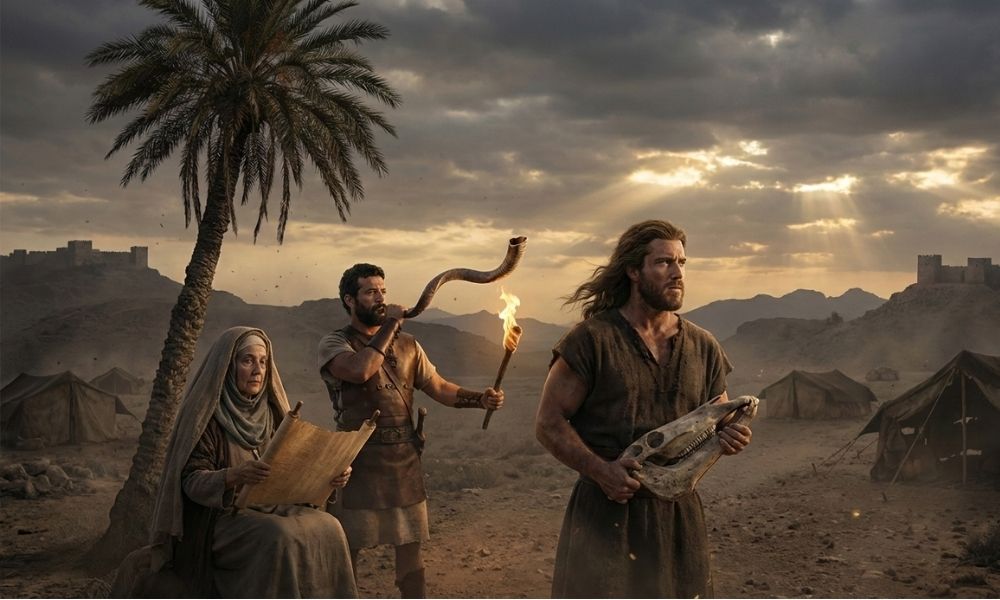
The Book of Judges is not merely a collection of hero stories; it is a tragedy in three parts. It serves as the dark bridge between the high hopes of the conquest under Joshua and the establishment of the monarchy under Samuel and Saul. It depicts a loose confederation of tribes descending into moral anarchy, political fragmentation, and spiritual syncretism (mixing true worship with idolatry).
While often called a “cycle,” scholars increasingly view the book as a downward spiral. With each successive judge, the quality of leadership creates a lower baseline, moving from the ideal Othniel to the chaotic Samson.
Quick Facts
Hebrew Name: Shophetim (Judges)
Placement: 7th book of the Old Testament
Author: Traditionally attributed to Samuel (not stated in the text)
Era: From Joshua’s death to Samuel’s lifetime (approx. 1200–1050 BCE)
Theme: Israel’s moral and spiritual decline; God’s mercy through deliverers
Key Figures: Deborah, Gideon, Samson, Ehud, Jephthah
Key Verse: Judges 21:25 — “In those days Israel had no king; everyone did what was right in his own eyes.”
1. The “S” Cycle: The Pattern of History
The narrative is driven by a recurring cyclical pattern of history, often described using keywords starting with “S.” This cycle repeats throughout the book:
- Sin (Apostasy): Israel abandons Yahweh to worship Canaanite idols (Baal and Ashtoreth).
- Servitude (Oppression): God removes His protection, allowing foreign nations to oppress and enslave Israel.
- Supplication (Cry for Help): In their suffering, Israel cries out to God (often out of misery rather than true repentance).
- Salvation (The Judge): God raises up a deliverer—a “Judge”—empowered by the Spirit to rescue the people.
- Silence (Rest): The land enjoys a period of peace as long as the judge lives.
2. The Twelve Judges Recorded in the Book of Judges
The central section of the book focuses on these deliverers. They are traditionally divided into “Major Judges” (those with extended narratives) and “Minor Judges” (those with brief descriptions).
1. Othniel (Major) The ideal judge and the younger brother/nephew of Caleb. He is the model of leadership in the book.
- Action: He led the Israelites to victory over the Mesopotamians (Cushan-Rishathaim).
- Result: The land had rest for 40 years.
2. Ehud (Major) A Benjaminite warrior noted for being left-handed, which he used to his advantage in a stealth operation.
- Action: He assassinated Eglon, the obese King of Moab, by hiding a sword on his right thigh. He then led the tribes to seize the fords of the Jordan.
- Result: Moab was subdued, and the land rested for 80 years.
3. Shamgar (Minor) A brief but impressive account of a warrior with limited resources.
- Action: Known for killing 600 Philistines with an ox goad (a farming tool).
- Result: He too delivered Israel.
4. Deborah (Major) A prophetess and the only female judge. She held court under a palm tree and commanded the military leader Barak.
- Action: She led the Israelites to victory against the Canaanites under King Jabin and his cruel general, Sisera.
- Note: The victory culminated in Jael, a Kenite woman, killing Sisera with a tent peg.
5. Gideon (Major) A complex figure who started with fear but was used mightily by God to prove that victory comes from the Lord, not human strength.
- Action: Led a successful campaign against the Midianites with a drastically reduced army of only 300 men (using trumpets and torches).
- Legacy: Later in life, he created a gold ephod that became a snare (idol) to his family and Israel.
6. Tola (Minor) From the tribe of Issachar.
- Action: He rose to save Israel and judged for 23 years. He lived and was buried in Shamir.
7. Jair (Minor) A Gileadite with significant wealth and influence (his 30 sons rode 30 donkeys).
- Action: He judged Israel for 22 years.
8. Jephthah (Major) A mighty warrior but a social outcast (son of a prostitute) who was called back by the elders of Gilead to lead them.
- Action: A leader who fought against the Ammonites. Before the battle, he made a rash vow to sacrifice whatever came out of his house first upon his return.
- Tragedy: This led to the sacrifice of his only daughter. He also led a brutal civil war against the tribe of Ephraim (using the famous “Shibboleth” test).
9. Ibzan (Minor) From Bethlehem. He had 30 sons and 30 daughters, indicating high social status and political alliances through marriage.
- Action: He judged Israel for 7 years.
10. Elon (Minor) A Zebulunite.
- Action: He judged Israel for 10 years and was buried in Aijalon.
11. Abdon (Minor) From Pirathon. Like Jair, his family (40 sons and 30 grandsons) is noted for riding donkeys, a sign of nobility.
- Action: He judged Israel for 8 years.
12. Samson (Major) The most famous and tragic figure. A Nazarite from birth (no wine, no haircuts), endowed with supernatural strength but plagued by moral weakness.
- Action: A judge known for his superhuman strength and his one-man war against the Philistines.
- Outcome: After being betrayed by Delilah and blinded, his story ends with a final act of defiance—collapsing the temple of Dagon upon himself and thousands of Philistines.
3. Structure of the Book
Part I: The Introduction (Chapters 1–2)
- Military Failure: The tribes fail to drive out the Canaanites completely.
- Religious Failure: A generation arises that “does not know the Lord.” The Angel of the Lord rebukes Israel for making covenants with the inhabitants of the land.
Part II: The Cycle of Judges (Chapters 3–16)
- This section contains the stories of the 12 judges listed above.
- The Trend: As the book progresses, the judges become more flawed. We move from Othniel (faithful) to Jephthah (rash) to Samson (impulsive and vengeful).
Part III: The Epilogue of Chaos (Chapters 17–21)
- There are no judges in this section. It serves to illustrate the total moral collapse of the people.
- Religious Corruption: The story of Micah’s idol and the tribe of Dan.
- Moral Depravity: The atrocity of the Levite’s concubine in Gibeah, leading to a near-genocidal civil war against the tribe of Benjamin.
4. Key Themes & Theology
The Leadership Vacuum The refrain of the epilogue is: “In those days Israel had no king; everyone did what was right in his own eyes” (Judges 21:25). The book illustrates that anarchy ensues without righteous leadership.
God’s Long-Suffering Mercy Despite Israel’s repeated “spiritual adultery,” God continues to rescue them. He uses flawed people (assassins, outcasts, doubters, and hedonists) to accomplish His purposes.
The Need for a True King The book sets the stage for the Books of Samuel. It demonstrates that the tribal confederacy is failing and prepares the reader for the establishment of the Davidic monarchy—and ultimately points toward the need for the Messianic King.







Leave a Reply