
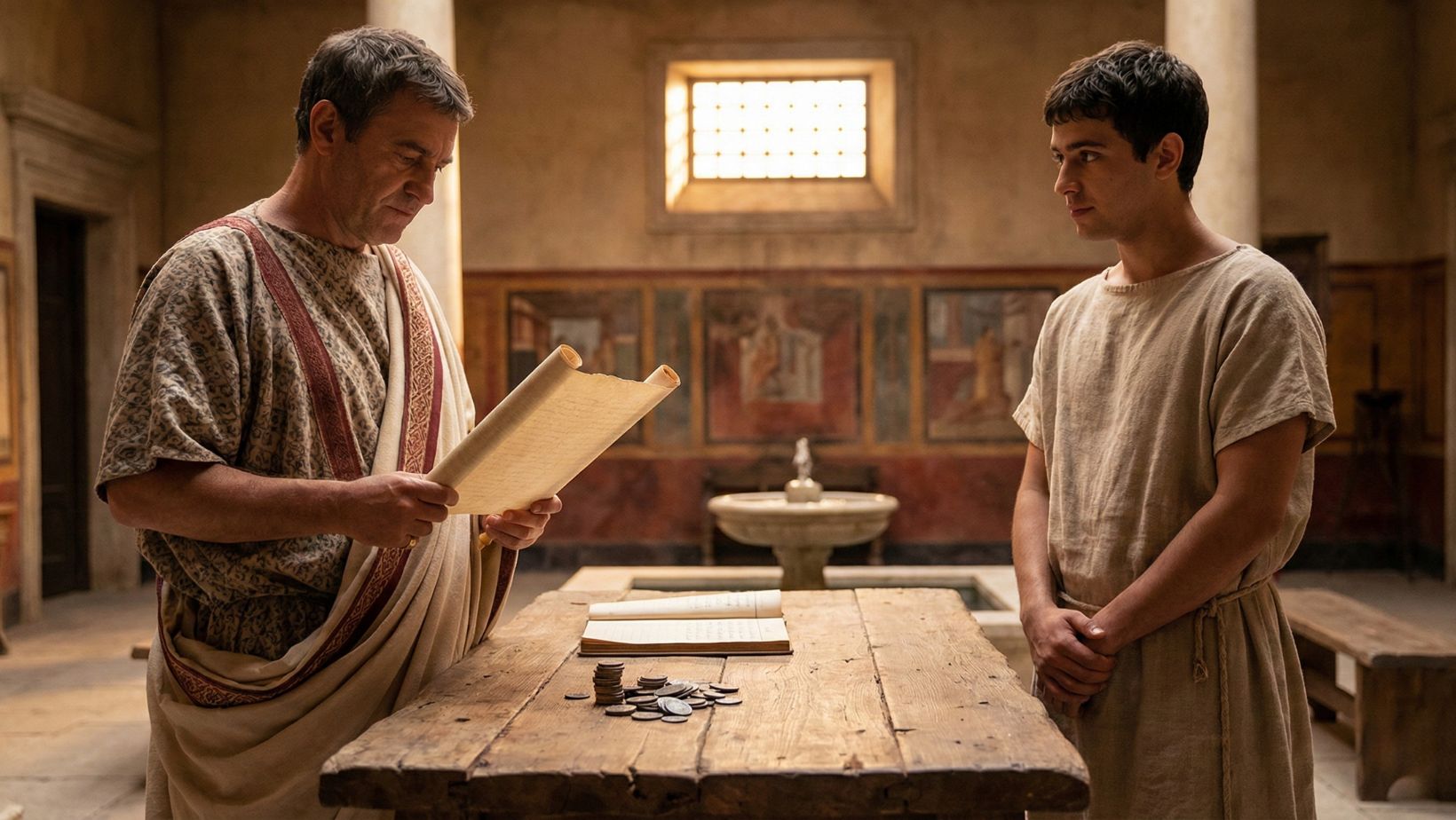
The Epistle to Philemon is the shortest and most personal of Paul’s letters. It is a masterpiece of diplomacy, tact, and Christian grace. Unlike his other letters which address churches about theology, this is a private note to a wealthy friend regarding a delicate domestic crisis. A slave named Onesimus had robbed his master, Philemon, and fled to Rome, where he met Paul and was converted to Christ. Paul is now sending the runaway slave back to his master—not to be punished, but to be welcomed as a beloved brother. It is a powerful real-life illustration of the Gospel: just as Paul asks Philemon to welcome Onesimus as he would welcome Paul, Christ asks the Father to welcome us sinners as He would welcome His own Son.
Quick Facts
- Author: The Apostle Paul (and Timothy)
- Date Written: ~60–62 AD (A “Prison Epistle”)
- Recipient: Philemon (a wealthy leader of the Colossian church)
- Subject: Onesimus (the runaway slave)
- Location: Written from house arrest in Rome to Colossae
- Theme: Reconciliation, Forgiveness, and Imputation
- Key Word: “Receive” (proslambano) and “Refresh”
- Key Verse: Philemon 1:17–18 (“So if you consider me a partner, welcome him as you would welcome me. If he has done you any wrong or owes you anything, charge it to me.”)
- Structure: Appreciation (1–7) → Appeal (8–21) → Assurance (22–25)
- Symbol: The Ledger / Bill of Debt — representing Paul taking on Onesimus’s cost
Title / Purpose
Title: The Epistle of Paul to Philemon.
Purpose:
- Reconciliation: To persuade Philemon to forgive his runaway slave, Onesimus, and receive him back without punishment (which, under Roman law, could have been death).
- Elevation: To shift the relationship from “Master-Slave” to “Brother-Brother” in the Lord.
- Restitution: Paul offers to personally pay any financial loss Philemon suffered because of the theft or flight.
Authorship & Context
The Author: Paul writes as “a prisoner of Christ Jesus,” appealing to pity and love rather than commanding with apostolic authority.
The Recipient: Philemon was a beloved fellow worker and likely a convert of Paul. His house was large enough to host the local church gathering in Colossae.
The Context: Slavery was ubiquitous in the Roman Empire. Runaway slaves (fugitivus) were often branded on the forehead or crucified. Paul sending Onesimus back was a test of Philemon’s faith and a radical challenge to the social hierarchy of the day.
Structure / Narrative Arc
The letter is a carefully constructed “chiastic” appeal, moving from praise to the difficult request.
1. The Prayer of Thanksgiving (Verses 1–7):
- Paul praises Philemon’s love and faith toward all the saints.
- He says Philemon has “refreshed the hearts of the Lord’s people.” By establishing Philemon’s reputation for generosity, Paul sets the stage: Will you be generous now?
2. The Petition for Onesimus (Verses 8–16):
- The Play on Words: The name Onesimus means “Useful.” Paul says he was formerly “useless” to you, but now he is truly “useful” (Onesimus) to both of us.
- The Relationship Change: Paul is sending him back “no longer as a slave, but better than a slave, as a dear brother.”
- The Spiritual Father: Paul calls Onesimus “my son,” whom he fathered in the faith while in chains.
3. The Pledge of Substitution (Verses 17–25):
- Imputation: “If he owes you anything, charge it to me.” Paul takes the debt on himself.
- The Subtle Nudge: Paul reminds Philemon, “You owe me your very self” (referring to Philemon’s salvation).
- The Guest Room: Paul expresses hope for release and asks Philemon to prepare a room for him—a gentle reminder that Paul will be coming to check on how the situation was handled!
Major Themes
Imputation (The Gospel in Miniature): Verses 17–18 are a perfect picture of what Jesus did for us.
- Philemon = God the Father (The one offended).
- Onesimus = The Sinner (The one who ran away and owes a debt).
- Paul = Jesus Christ (The Mediator who says, “Welcome him as you would welcome me,” and “Put his debt on my account”).
Christian Brotherhood: The Gospel transforms social structures from the inside out. While Paul does not explicitly outlaw slavery here, he plants a seed that destroys its root. You cannot treat someone as property if they are your beloved brother.
Providence: Paul suggests that perhaps the reason Onesimus was allowed to run away for a short time was so that Philemon could have him back forever—not just as a servant, but as a saved brother (Verse 15).
Key Characters
Paul: The mediator and guarantor. Philemon: The wealthy Christian master facing a test of grace. Onesimus: The runaway slave returning to face the music, now carrying a letter that holds his life in the balance. Apphia: Likely Philemon’s wife (addressed as “our sister”). Archippus: Likely their son or the local pastor (“our fellow soldier”).
Notable Passages
Useless to Useful (Verse 11): “Formerly he was useless to you, but now he has become useful both to you and to me.”
Welcome Him (Verse 17): “So if you consider me a partner, welcome him as you would welcome me.”
The Guarantee (Verse 18–19): “If he has done you any wrong or owes you anything, charge it to me. I, Paul, am writing this with my own hand. I will pay it back.”
Legacy & Impact
Abolition of Slavery: Though critics argue Paul should have condemned slavery outright, this letter provided the theological basis for the eventual abolition movement. It asserted the spiritual equality of master and slave, a concept alien to the ancient world.
Restorative Justice: It models a justice system based on restoration and relationship rather than mere punishment.
Historical Sequel: Church tradition (and a letter from Ignatius in ~110 AD) suggests that Onesimus may have later become the Bishop of Ephesus. If true, it means Philemon not only forgave him but freed him to lead the church—a stunning outcome.
Symbolism / Typology
The Debt: The stolen money or lost labor Onesimus owed represents the debt of sin every human owes to God.
The Hand: Paul writing “with my own hand” (v. 19) symbolizes a legal contract or promissory note, akin to Christ’s nail-pierced hands guaranteeing our debt is paid.







Leave a Reply