
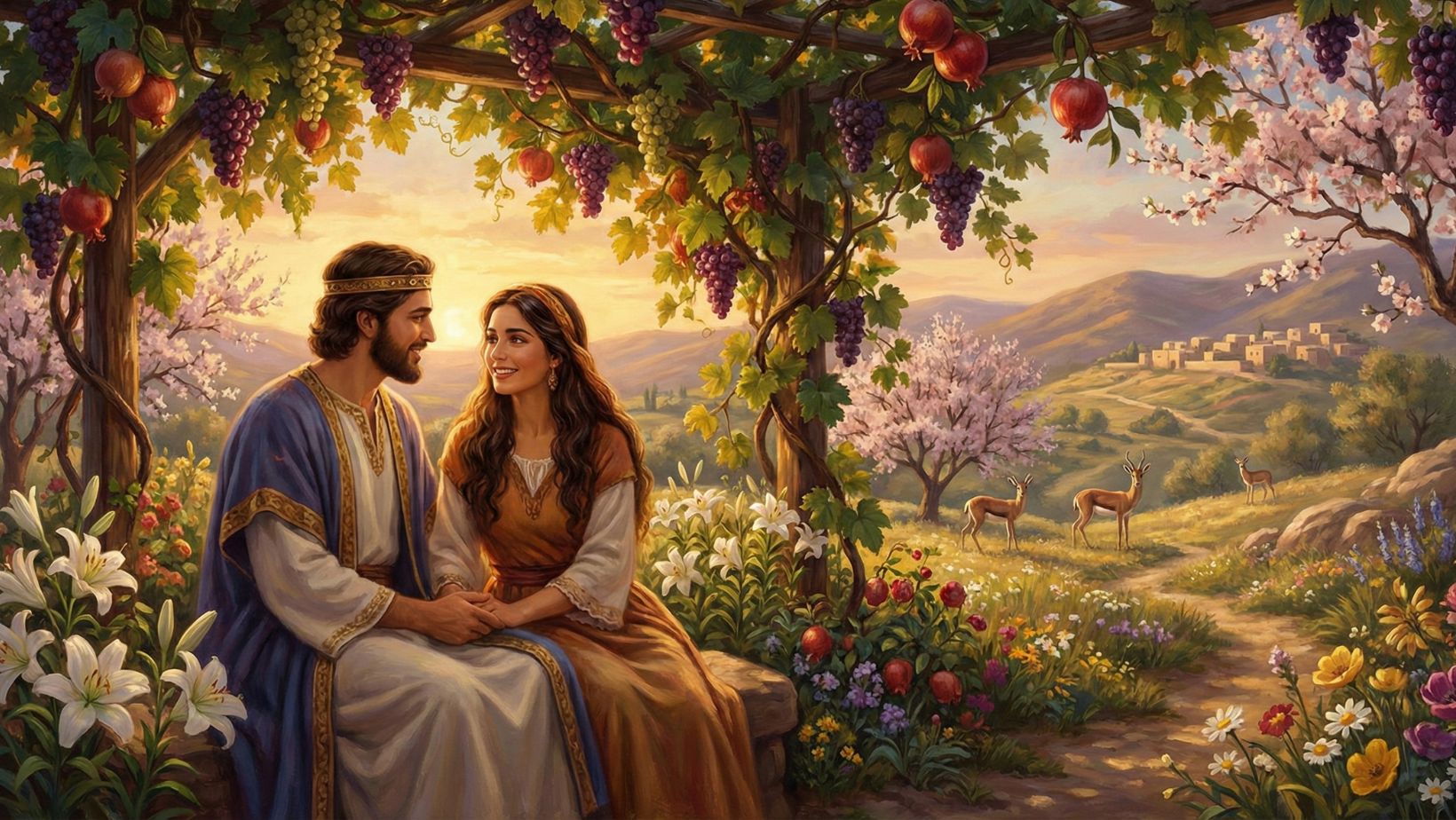
The Song of Songs (also known as the Song of Solomon) is perhaps the most surprising and debated book in the Bible. It is a passionate, explicit, and lyrical poem celebrating romantic love, sexual desire, and marriage. Unlike the legal or historical books, it contains no direct commands or prophecies. Instead, it presents a series of love poems between a young woman (the Shulammite) and her lover (Solomon or a shepherd king). Throughout history, it has been interpreted in two primary ways: literally, as a divine affirmation of the sanctity of physical love within marriage, and allegorically, as a picture of the intense love between God and Israel, or Christ and the Church.
Quick Facts
- Name: Song of Songs (Hebrew: Shir Hashirim – the superlative, meaning “The Best of Songs”)
- Author: King Solomon (traditionally), though some scholars suggest a later poet writing in his tradition.
- Date Written: ~960 BCE (early in Solomon’s reign)
- Main Characters: The Beloved (The Shulammite Woman), The Lover (King Solomon), The Chorus (Daughters of Jerusalem)
- Core Themes: The beauty of sex, the exclusivity of marriage, the intensity of desire, the permanence of love
- Literary Style: Lyric Poetry / Erotic Verse
- Key Symbol: The Garden — representing the private, sacred space of marital intimacy
Name Meaning
The title “Song of Songs” is a Hebrew idiom meaning the greatest or most beautiful song (similar to “King of Kings” or “Holy of Holies”). It implies that of the 1,005 songs Solomon wrote (1 Kings 4:32), this was his masterpiece.
Historical Context
Time: Written during the early years of the monarchy, likely before Solomon’s heart was turned away by his many foreign wives. Cultural Setting: The poem uses rich agricultural imagery—vineyards, flocks, gardens, spices, and fruits—reflecting the agrarian society of ancient Israel. Interpretation History: For centuries, Jewish rabbis forbade men under 30 from reading it due to its graphic nature. The early Church Fathers almost exclusively read it as an allegory for Christ’s love for the soul.
Major Roles / Identity
The Beloved (The Shulammite): A young country woman, likely working in vineyards, who is dark-skinned from the sun (“I am dark but lovely”). She is the primary speaker, voicing female desire and initiative. The Lover (The King): He praises her beauty in elaborate detail and eagerly anticipates their union. The Daughters of Jerusalem: A chorus of friends to whom the Shulammite speaks, often asking them for advice or help in finding her lover.
Key Character Traits
Mutuality: Unlike many ancient texts where women were property, the woman here is an equal partner—she seeks, she initiates, and she proclaims, “My beloved is mine and I am his.” Desire: The book is unashamedly erotic, describing the physical bodies of both the man and woman with admiration and delight. Exclusivity: The refrain “Do not arouse or awaken love until it so desires” suggests that sexual love is powerful and must be handled with care and right timing. Vulnerability: The lovers experience moments of insecurity and separation, highlighting that true intimacy requires overcoming barriers.
Structure
The Courtship (1:1 – 3:5): The lovers express their longing and praise one another, culminating in a dream of separation. The Wedding Procession (3:6 – 5:1): Solomon arrives in a carriage; the marriage is consummated (“Eat, friends, and drink; drink your fill of love”). Conflict and Restoration (5:2 – 8:4): A dream sequence where the woman hesitates to open the door, leading to a frantic search for her lover and eventual reunion. Conclusion (8:5 – 8:14): A final affirmation of the strength of love (“Strong as death”).
Major Metaphors
The Garden: The woman describes herself as a “garden locked up,” meaning her sexuality is reserved for her husband. The man is invited to “come into his garden and taste its choice fruits.” The Gazelle/Stag: The lover is compared to a swift, graceful animal leaping over mountains, symbolizing masculine vitality and excitement. Spices and Perfumes: Myrrh, frankincense, and nard are used constantly to evoke the intoxicating power of attraction.
Notable Passages
Song of Solomon 2:16: The declaration of mutual possession: “My beloved is mine and I am his; he browses among the lilies.” Song of Solomon 4:7: The affirmation of beauty: “You are altogether beautiful, my darling; there is no flaw in you.” Song of Solomon 8:6: The seal of love: “Place me like a seal over your heart, like a seal on your arm; for love is as strong as death.” Song of Solomon 8:7: The value of love: “Many waters cannot quench love; rivers cannot sweep it away.”
Legacy & Impact
The Song of Songs provides the biblical theology of sexuality, refuting the idea that the physical body is evil or that sex is merely for procreation. It celebrates sex as a gift for mutual pleasure within the covenant of marriage. Allegorically, it has inspired countless hymns (e.g., “Jesus, Lover of My Soul”) and mystical writings about the depth of God’s passion for His people.
Symbolism / Typology
The Banner of Love: “His banner over me is love” suggests public protection and identity. The Search: The woman seeking her lover in the streets symbolizes the soul’s desperate pursuit of God. The Wedding: Foreshadows the ultimate “Marriage Supper of the Lamb” described in Revelation, where Christ is united with His Bride, the Church.
SHORT SENTENCE:
The Song of Songs is a poetic celebration of the intense beauty and sanctity of sexual love within marriage, serving as both a literal affirmation of human romance and an allegorical picture of God’s passionate love for His people.







Leave a Reply