
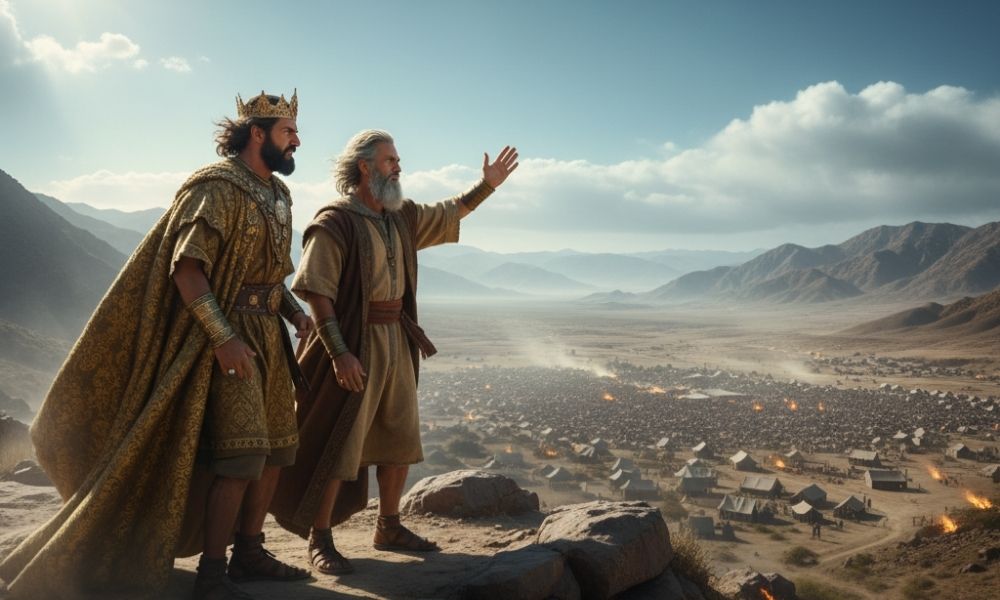
Balak was the king of Moab during Israel’s wilderness journey, best known for his attempt to curse Israel through the prophet Balaam. His fear of Israel’s growing strength led him to seek supernatural help rather than submit to the God of Israel. Though he tried to manipulate divine power for his own protection, God overruled his plans, turning intended curses into blessings.
Quick Facts
Name: Balak (Hebrew: Bālaq, meaning “devastator” or “destroyer”)
Title: King of Moab
Father: Zippor (Numbers 22:2)
Tribe/Nation: Moab (descendants of Lot, Abraham’s nephew)
Contemporaries: Balaam, Moses, the Israelites in the wilderness
Time Period: c. 13th century BCE
Main Setting: Plains of Moab, near the Jordan River opposite Jericho
Key Scriptures: Numbers 22–24; Joshua 24:9; Micah 6:5
Symbol: The mountain overlooking Israel — symbol of human fear against God’s sovereign blessing
Name Meaning
“Balak” means “devastator” or “destroyer.” Ironically, though his name suggests strength and conquest, he was powerless against the will of God.
Lineage / Background
Balak was the son of Zippor, a Moabite ruler. The Moabites descended from Lot, Abraham’s nephew (Genesis 19:37). Balak ruled Moab during the time when Israel, after defeating neighboring nations like the Amorites, camped near his territory on their journey to Canaan (Numbers 22:1–4).
Biblical Era / Timeline
Era: During Israel’s wilderness wanderings, before they crossed the Jordan River into Canaan.
Context: After Israel’s victories over Sihon and Og, the kings of Moab and Midian feared the Israelites would conquer them next. Balak sought to resist them through spiritual means — by hiring Balaam to curse Israel.
Major Roles / Identity
- King of Moab: Ruler of a nation descended from Lot.
- Instigator of spiritual conflict: Attempted to use Balaam’s prophetic power against Israel.
- Opponent of God’s people: Represented human fear and rebellion against God’s purpose.
Key Character Traits
Strengths:
- Strategic — recognized Israel’s growing power and sought a non-military solution.
- Persistent — made multiple attempts to persuade Balaam.
Weaknesses:
- Fearful and faithless — lacked trust in God and acted out of panic.
- Spiritually blind — sought to manipulate divine will rather than submit to it.
- Resistant to truth — saw God’s power displayed yet refused to repent.
Main Life Events
- Fear of Israel: Balak saw Israel’s victories and trembled for Moab’s safety (Numbers 22:3–4).
- Sending for Balaam: He sent messengers to the prophet Balaam at Pethor, offering rewards to curse Israel (Numbers 22:5–6).
- Negotiations: When Balaam initially refused, Balak sent more honorable princes and greater rewards, showing his desperation (Numbers 22:15–17).
- Meeting Balaam: Balak welcomed Balaam with honor and took him to various high places to view Israel and attempt curses (Numbers 22:36–41).
- Failed Curses: Three times Balaam opened his mouth to curse Israel, but each time God turned the words into blessings (Numbers 23–24).
- Anger and Dismissal: Frustrated, Balak said to Balaam, “I called you to curse my enemies, and behold, you have altogether blessed them these three times!” (Numbers 24:10).
- Aftermath: Despite witnessing God’s power, Balak did not repent. Later, through Balaam’s counsel, Moabite women led Israel into sin and idolatry (Numbers 31:16; Revelation 2:14).
Notable Stories / Passages
- Balak and Balaam on the High Places: Balak takes Balaam to different vantage points (Bamoth-baal, Pisgah, and Peor) to curse Israel, but Balaam blesses them instead, declaring, “God is not a man, that He should lie” (Numbers 23:19).
- Balaam’s Final Oracle: Balaam prophesies the rise of a “Star out of Jacob” (Numbers 24:17), foretelling Israel’s future greatness — a message Balak could not stop.
Legacy & Impact
- Symbol of Opposition: Balak represents those who oppose God’s people out of fear rather than faith.
- Historical Memory: Mentioned later in Scripture as a warning —
- Moral Lesson: Human efforts to resist God’s blessing are futile. God’s purposes prevail regardless of human intent or power.
Symbolism / Typology
- Balak as a type of worldly fear: Represents leaders who act out of fear of God’s power rather than reverence for it.
- Mountaintop altars: Symbolize humanity’s attempt to control spiritual outcomes apart from true submission to God.
- Contrast with Moses: While Moses interceded for Israel in faith, Balak sought their destruction through manipulation.
Legacy in Faith and Teaching
Balak’s story reminds believers that no curse or opposition can stand against those whom God blesses (Numbers 23:8; Romans 8:31). His failure underscores that God’s sovereignty cannot be bought, bargained, or resisted. Though he stood on the mountains of Moab seeking destruction, God revealed His unstoppable plan of redemption and blessing for His people.







Leave a Reply