
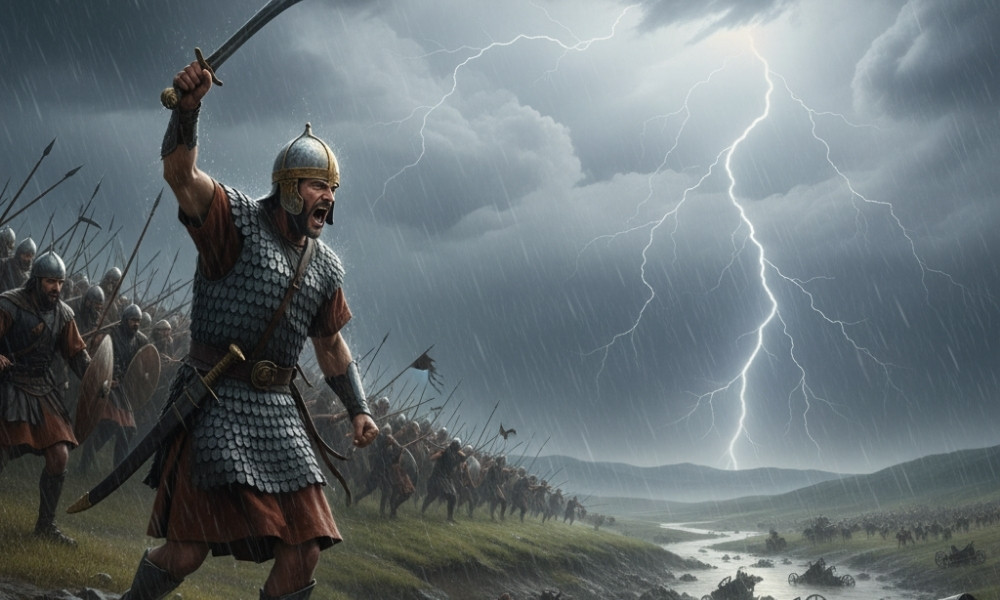
Barak is a complex and pivotal figure in the Book of Judges, best known as the military commander who worked in tandem with the prophetess Deborah to overthrow the Canaanite oppression. Unlike the solitary heroes of the book (like Samson or Ehud), Barak represents the necessity of shared leadership and the interdependence of spiritual authority and military action. While often critiqued for his initial hesitation to go to battle without Deborah, he is ultimately honored in the New Testament as a hero of faith who “quenched the power of fire” and “became mighty in war.”
- Name: Barak (Hebrew: Baraq)
- Meaning: “Lightning” or “Flash”
- Role: Military General, Deliverer
- Tribe: Naphtali
- Father: Abinoam
- Home: Kedesh-Naphtali
- Era: Period of the Judges (~12th–11th Century BCE)
- Adversary: Jabin (King of Canaan) and Sisera (General)
- Scripture: Judges 4–5; Hebrews 11:32
- Key Battle: Mount Tabor / River Kishon
- Legacy: Defeated Sisera’s chariots; secured 40 years of peace
Name Meaning
“Lightning”: The name Baraq means “Lightning.” This suggests a nature that is sudden, striking, and powerful. However, lightning usually requires a storm to manifest; in this narrative, Deborah (the storm/voice) directs the lightning (Barak) where to strike.
Contrast with Lappidoth: Deborah’s husband’s name, Lappidoth, means “Torches.” Some Jewish traditions playfully suggest Barak and Lappidoth are the same person, contrasting the steady light of a torch with the sudden flash of lightning.
Lineage / Family Background
Tribe of Naphtali: Barak hailed from Kedesh in the territory of Naphtali. This northern tribe was hit hardest by the Canaanite oppression because it was closest to King Jabin’s capital, Hazor.
Son of Abinoam: He is repeatedly identified as the “son of Abinoam,” establishing his legitimate standing within his clan.
Biblical Era / Context
The Iron Age Disadvantage: The Canaanites possessed 900 chariots of iron—the “tanks” of the ancient world. Israel, dwelling in the hill country, had no technology to match this on the plains.
The Call to Muster: Israel had been oppressed for twenty years. The people were disheartened and disarmed until the call came to assemble at Mount Tabor, a strategic high ground rising above the Jezreel Valley.
Major Roles / Identity
The Reluctant Warrior: Barak is famous for his condition: “If you go with me, I will go.” While some view this as cowardice, others view it as a recognition that military might is useless without God’s presence (represented by the prophetess).
The Executor: Deborah provided the Word (strategy), but Barak provided the Sword. He was the one who had to inspire 10,000 men to leave the safety of the high ground and charge into the valley against chariots.
The Singer: Alongside Deborah, he is a co-author of the Victory Song in Judges 5 (“Then sang Deborah and Barak…”), showing he was also a man of praise and history.
Key Character Traits
Humility: He accepted a secondary role to a woman in a patriarchal society. He did not argue when Deborah prophesied that the ultimate glory (killing Sisera) would go to another woman (Jael).
Faith: Despite his initial hesitation, he is listed in the “Hall of Faith” (Hebrews 11). Once he committed, he did not waver, leading a charge on foot against iron chariots.
Responsiveness: When Deborah gave the command “Up! For this is the day,” Barak immediately marched down the mountain, trusting that God had already moved.
Main Life Events
The Summons: Deborah summoned him from the north to the hill country of Ephraim to receive his commission.
The Condition: Barak refused to march unless the Prophetess accompanied the army, valuing spiritual cover over tactical advantage.
The Muster: He successfully rallied 10,000 men from the tribes of Naphtali and Zebulun to Mount Tabor.
The Charge: At Deborah’s signal, he led his men down the slopes. God caused a flash flood (implied in Judges 5:21) in the River Kishon, bogging down the enemy chariots.
The Pursuit: Barak pursued the fleeing army to Harosheth Haggoyim, ensuring the destruction of the entire Canaanite force.
The Aftermath: Upon arriving at Jael’s tent, he found the enemy general, Sisera, already dead by her hand, fulfilling Deborah’s prophecy.
Major Relationships
Deborah: The primary dynamic of his life. They functioned as “Word and Deed.” Their relationship was cooperative, not competitive.
Sisera: The foil to Barak. Sisera relied on iron and technology; Barak relied on a word from God.
Jael: The Kenite woman who finished what Barak started. Her role served as a check on Barak’s ego—he won the war, but she won the “trophy” (Sisera).
Notable Passages
Judges 4:8: “Barak said to her, ‘If you go with me, I will go; but if you do not go with me, I will not go.’”
Judges 4:14: “And Deborah said to Barak, ‘Up! For this is the day in which the Lord has given Sisera into your hand. Does not the Lord go out before you?’ So Barak went down from Mount Tabor with 10,000 men following him.”
Hebrews 11:32: “And what more shall I say? For time would fail me to tell of Gideon, Barak, Samson, Jephthah…”
Legacy & Impact
Hero of Faith: His inclusion in Hebrews 11 vindicates his character. It serves as a reminder that faith does not mean the absence of fear or hesitation, but the willingness to act continuously on God’s word.
Liberation of the North: His victory broke the back of Canaanite power in the Galilee region, allowing the northern tribes to settle securely.
Model of Partnership: The Deborah-Barak alliance remains a biblical model for male-female partnership in leadership, where different gifts are honored to achieve a common goal.
Symbolism / Typology
Lightning: Barak represents the power of God that remains latent until triggered by the Spirit (Deborah).
The Storm: The battle at Kishon involved a divinely appointed storm. Barak acts as the lightning strike within that storm, executing God’s judgment on the enemies of His people.
Extra-Biblical References
Rabbinic Tradition: As noted, the Talmud (Megillah 14a) identifies Barak with Lappidoth, Deborah’s husband. The rationale is linguistic: Barak (lightning) and Lappidoth (torches) both relate to light/fire. If true, this adds a layer of intimacy to their partnership—husband and wife delivering Israel together.
Josephus: The historian describes Barak as a man of the tribe of Naphtali who was “held in esteem for his military skill,” emphasizing his generalship more than his hesitation.







Leave a Reply