
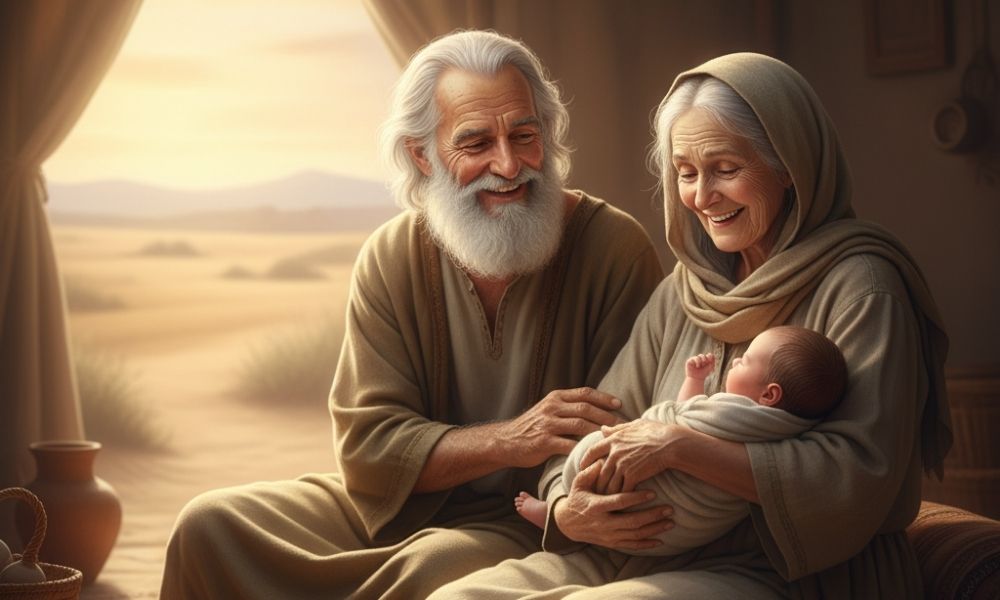
Birth of Isaac

Isaac was the miraculous son of Abraham and Sarah, born in fulfillment of God’s promise, symbolizing joy, faith, and divine faithfulness.


Isaac’s birth marks the fulfillment of God’s promise to Abraham and Sarah — a miraculous event that demonstrated God’s faithfulness and power. Though both were advanced in age, God’s covenant was fulfilled through Isaac, the long-awaited son who would carry forward the divine promise to bless all nations through Abraham’s descendants. His birth represents joy, faith, and the assurance that nothing is impossible for God.


Name: Isaac (Hebrew: Yitzḥaq, meaning “He laughs” or “Laughter”)
Parents: Abraham and Sarah
Tribe/Nation: Hebrew (patriarchal line of Israel)
Era: Middle Bronze Age (~2000 BCE)
Birthplace: Canaan
Scriptural Reference: Genesis 17–21
Key Themes: Faith, fulfillment of promise, divine power, joy
Symbol: Laughter — representing joy after long waiting


Divine Promise and Waiting

God promised Abraham that he would be the father of many nations, even though Sarah was barren and both were elderly. This covenant promise was reiterated multiple times (Genesis 12, 15, 17), emphasizing God’s faithfulness despite human impossibility.


Miraculous Birth

In Genesis 21:1–7, Sarah conceives and gives birth to Isaac in her old age, when Abraham is 100 years old. The event is seen as a direct act of divine intervention — proof that God’s word never fails. Sarah laughs in joy and amazement, saying, “God has brought me laughter, and everyone who hears about this will laugh with me.”


Covenant Fulfillment

Isaac’s birth signifies the continuation of God’s covenant promise — that Abraham’s descendants would become a great nation and inherit the land of Canaan. Through Isaac, the line of promise continues to Jacob and eventually to the nation of Israel.


Family and Significance

Isaac grows to be the chosen heir, and God confirms His covenant with him (Genesis 26:2–5). His life bridges the patriarchal generations — linking Abraham’s faith with Jacob’s destiny.


Symbolism and Legacy

  • Faith Rewarded: Abraham and Sarah’s long wait shows that God’s timing is perfect.
  • Laughter Restored: Isaac’s name embodies the joy of fulfilled promises.
  • Covenant Continuity: The line through Isaac leads to the eventual coming of Christ (Matthew 1:2).

Notable Passages

  • Genesis 17:19: “Your wife Sarah will bear you a son, and you will call him Isaac. I will establish my covenant with him.”
  • Genesis 18:14: “Is anything too hard for the LORD?”
  • Genesis 21:6: “God has brought me laughter, and everyone who hears about this will laugh with me.”

Legacy

Isaac’s birth stands as a testimony of divine faithfulness. It reminds believers that God’s promises may seem delayed but are always fulfilled in His perfect time — turning doubt into laughter and faith into joy.


Leave a Reply

Your email address will not be published. Required fields are marked *

Bible Characters

  • Mark (John Mark)
  • Mark (John Mark)

    John Mark was a young disciple who overcame early failure to become a trusted companion of Paul and Peter, ultimately authoring the dynamic Gospel that bears his name.


  • Matthew

    Matthew was a despised tax collector transformed by grace into a devoted apostle, whose Gospel bridges the Old and New Testaments by proclaiming Jesus as the promised Messiah and King.


  • Nabal

    Nabal was a wealthy but foolish landowner whose arrogance and refusal to show hospitality to David led to divine judgment and his sudden death.


Biblical Events

  • David lies to Ahimelech
  • Mark (John Mark)

    John Mark was a young disciple who overcame early failure to become a trusted companion of Paul and Peter, ultimately authoring the dynamic Gospel that bears his name.


  • Matthew

    Matthew was a despised tax collector transformed by grace into a devoted apostle, whose Gospel bridges the Old and New Testaments by proclaiming Jesus as the promised Messiah and King.


  • Nabal

    Nabal was a wealthy but foolish landowner whose arrogance and refusal to show hospitality to David led to divine judgment and his sudden death.


Bible Locations

  • Jezreel
  • Jezreel

    Jezreel was the fertile royal seat of King Ahab and Queen Jezebel, famous for the murder of Naboth and the site where divine judgment eventually wiped out their entire dynasty.


  • Aphek

    Aphek was a strategic military stronghold and staging ground on the Sharon Plain where the Philistines gathered to capture the Ark and where David was providentially released from the Philistine army.


  • Lachish

    Lachish was the second most powerful city in ancient Judah, a mighty fortress whose dramatic fall to Assyria and Babylon serves as a pivotal moment in biblical history and archaeology.


You May Also Like:

  • The Twelve Tribes of Israel were the tribal divisions descended from the sons of Jacob that formed the foundation of the Israelite nation and the prophetic lineage of the Messiah.

  • After burying Jacob in Canaan with great honor, Joseph reassures his fearful brothers that their past evil was overruled by God for good, and he dies in Egypt with a prophetic command that his bones be carried to the Promised Land.

  • On his deathbed, Jacob gathers his twelve sons to prophesy their destinies, disqualifying the firstborns for their sins and appointing Judah as the royal line and Joseph as the fruitful recipient of the double portion.

  • On his deathbed, Jacob adopts Joseph’s two sons as his own, deliberately crossing his hands to give the greater blessing to the younger Ephraim, declaring God as his Shepherd and Redeemer.

Bibliva

FREE
VIEW




