
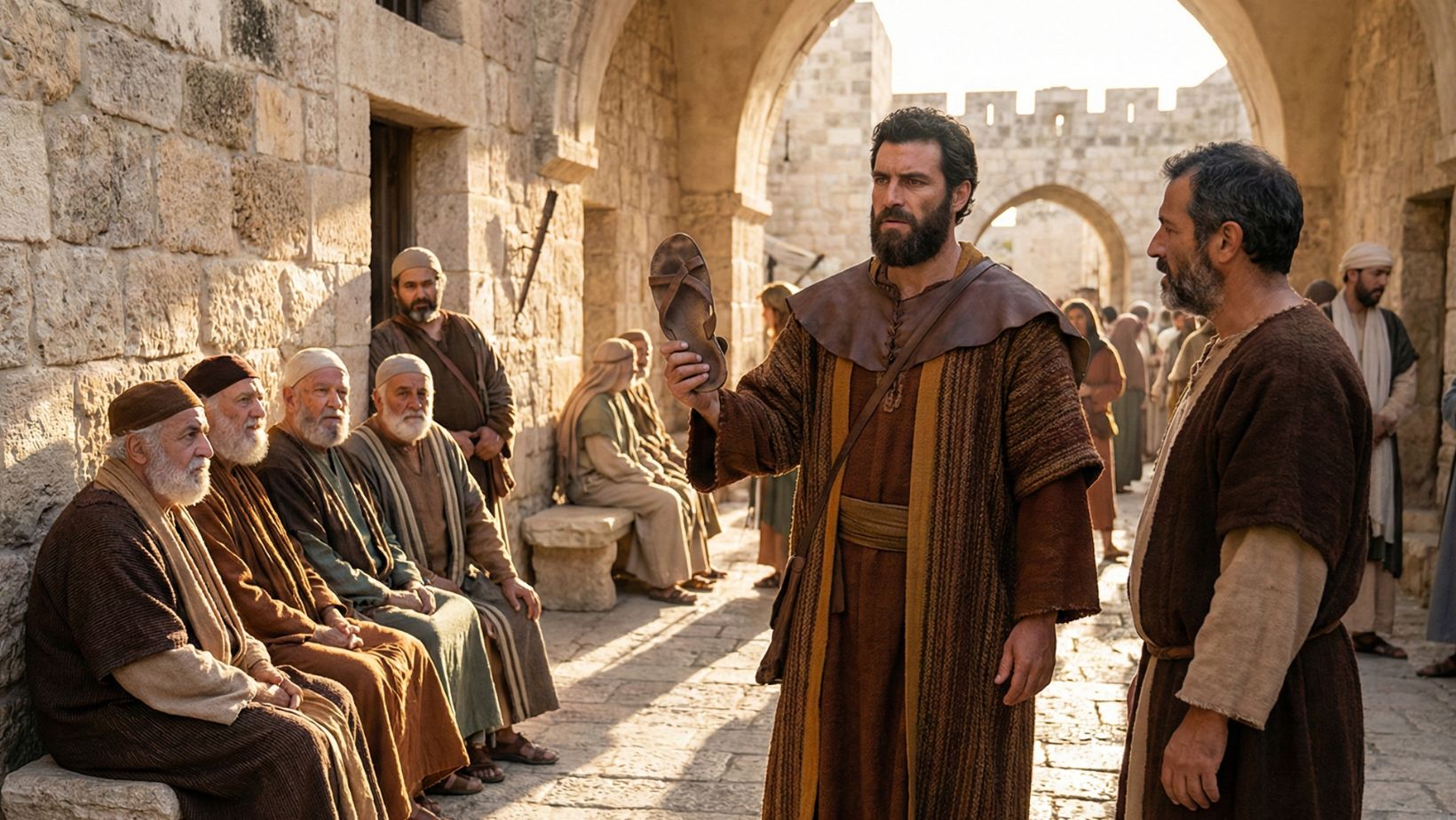
Boaz is a prominent figure in the Old Testament, celebrated as a man of great wealth, integrity, and generosity. Appearing in the Book of Ruth, he serves as the “Kinsman-Redeemer” (Goel) who rescues Naomi and Ruth from poverty and hopelessness. In a time of moral chaos during the period of the Judges, Boaz stands out as a beacon of righteousness, strictly observing God’s law regarding the poor and the widow. His marriage to Ruth, a Moabite woman, not only restored a broken family line but also secured his place as the great-grandfather of King David and an ancestor of Jesus Christ.
Quick Facts
- Name: Boaz (Hebrew: Bo`az)
- Meaning: “In him is strength” or “Swiftness”
- Tribe: Judah
- Era: Time of the Judges (~12th century BCE)
- Home: Bethlehem, Judah
- Occupation: Wealthy Landowner / Farmer
- Wife: Ruth
- Parents: Salmon and Rahab (Matthew 1:5)
- Son: Obed
- Key Role: Kinsman-Redeemer (Goel)
- Legacy: Great-grandfather of King David; ancestor of Jesus Christ
Name Meaning
Boaz: The name is widely understood to mean “In him is strength.” This meaning is highly symbolic of his role in the narrative: he provides the strength, stability, and legal standing necessary to redeem Naomi’s family line and protect Ruth. It may also relate to one of the two pillars in Solomon’s Temple (Jachin and Boaz), symbolizing God’s strength.
Lineage / Family Background
Tribe of Judah: Boaz belonged to the prominent tribe of Judah, the tribe from which the Messiah would eventually come.
Parents: according to the genealogy in Matthew 1:5, Boaz was the son of Salmon and Rahab (the former prostitute of Jericho). This background is significant; having a non-Israelite mother who was grafted into the covenant may have predisposed Boaz to show kindness to Ruth, a foreigner.
Relation to Elimelech: He was a close relative (kinsman) to Elimelech, Naomi’s deceased husband, which gave him the legal right to redeem their land.
Biblical Era / Context
Time: The era of the Judges, generally characterized by the phrase “everyone did what was right in his own eyes” (Judges 21:25).
Setting: Bethlehem (“House of Bread”) during the barley and wheat harvests.
Social Context: The Law of Moses included provisions for the poor and foreigners (gleaning laws, Leviticus 19:9-10) and for widows without heirs (Levirate marriage, Deuteronomy 25:5-10). Boaz is depicted as a man who faithfully upheld these social safety nets.
Major Roles / Identity
The Kinsman-Redeemer (Goel): His primary theological role. He steps in to pay off debts, buy back lost land, and marry the widow to ensure the family name continues.
Provider and Protector: He ensures Ruth is safe from harassment in his fields and provides food for her and Naomi.
Man of Standing: He is respected at the city gate, indicating he was an elder or judge within the community.
Key Character Traits
Integrity: He follows the letter and spirit of the law, ensuring the nearer kinsman has the first right of refusal before he acts (Ruth 4).
Generosity: He goes beyond the legal requirement, telling his workers to pull out stalks of grain from the bundles for Ruth to find (Ruth 2:16).
Godliness: His first recorded words are a blessing to his workers: “The LORD be with you” (Ruth 2:4).
Respectful: He treats Ruth, a foreign widow, with high honor, calling her “my daughter” and praising her reputation.
Main Life Events
Meeting Ruth: Boaz notices Ruth gleaning in his field and inquires about her. He immediately offers her protection and water (Ruth 2).
The Threshing Floor: When Ruth approaches him at night to request redemption (symbolized by spreading his garment over her), Boaz responds with purity and honor, promising to settle the matter legally the next morning (Ruth 3).
The Legal Proceeding: Boaz gathers the elders at the city gate and confronts the closer kinsman. When the other man refuses to marry Ruth (fearing it would impair his own inheritance), Boaz publicly buys the land and takes Ruth as his wife (Ruth 4).
Fatherhood: Boaz and Ruth have a son, Obed. The women of Bethlehem declare that Naomi has been “restored” through this birth.
Major Relationships
Ruth: A relationship defined by mutual respect, honor, and redemption. It is one of the Bible’s great love stories.
Naomi: Boaz acts as the restorer of her life, turning her bitterness into joy by redeeming her husband’s land and giving her a grandson.
The Reapers: Boaz has a benevolent relationship with his employees, treating them with dignity and invoking God’s blessing upon them.
Notable Passages
Ruth 2:12: Boaz blessing Ruth: “May the LORD repay you for what you have done. May you be richly rewarded by the LORD, the God of Israel, under whose wings you have come to take refuge.”
Ruth 3:11: His affirmation of Ruth: “And now, my daughter, don’t be afraid. I will do for you all you ask. All the people of my town know that you are a woman of noble character.”
Ruth 4:9-10: The legal declaration: “Today you are witnesses that I have bought from Naomi all the property of Elimelech… I have also acquired Ruth the Moabite… as my wife.”
Legacy & Impact
Genealogical Link: Boaz is the father of Obed, who was the father of Jesse, the father of David. This places him directly in the royal line of Israel.
Messianic Line: He is listed in the genealogy of Jesus (Matthew 1:5; Luke 3:32), proving that Christ’s lineage includes men of noble character who honored the law.
Model of Manhood: Boaz remains a biblical standard for a godly husband and a responsible community leader.
Symbolism / Typology
Type of Christ: Boaz is widely seen as a “Type” of Christ. Just as Boaz (the rich kinsman) redeemed Ruth (the destitute foreigner) by paying a price she could not pay, Jesus redeems the Church (His bride) from sin and spiritual poverty.
The Guardian: His name and actions symbolize God as the ultimate guardian and provider for the vulnerable.
The Spreading of the Garment: When Boaz spreads his garment over Ruth (Ruth 3:9), it symbolizes marriage and protection, mirroring God spreading His covenant over Israel (Ezekiel 16:8).
Extra-Biblical References
Jewish Tradition: The Talmud (Bava Batra 91a) suggests that Boaz may be identified with the Judge Ibzan (Judges 12:8–10), though this is debated.
Rabbinic Literature: Tradition holds that Boaz was a scholar and a righteous judge who died shortly after his marriage to Ruth, having fulfilled his purpose of preserving the messianic line.







Leave a Reply