
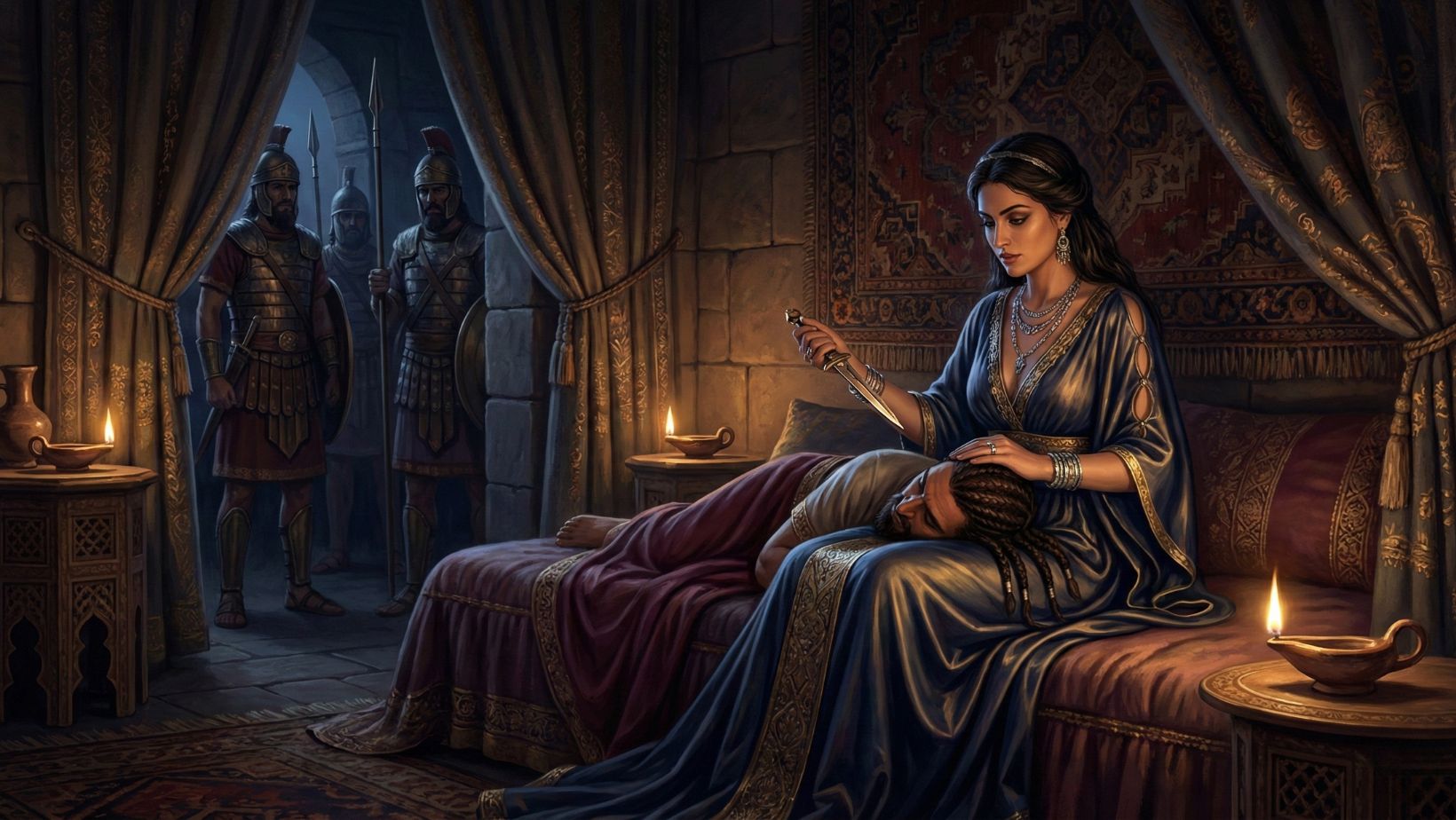
Delilah is one of the most infamous figures in biblical history, the archetype of the femme fatale—a seductive woman who uses her beauty and charm to entrap a man. Unlike Jael, who used deception to save Israel, Delilah used deception to destroy Israel’s judge for personal gain. She is the only woman in the Samson narrative who is named, highlighting her significance. Her story is not one of romance, but of cold, calculated espionage and a transaction where the strongest man in the world was sold for silver.
- Name: Delilah (Hebrew: Delilah)
- Meaning: “Delicate,” “Dainty,” or possibly “Of the Night”
- Role: Seductress, Spy, Collaborator
- Home: The Valley of Sorek
- Nationality: Likely Philistine or Canaanite (living in Philistine-controlled territory)
- Lover/Victim: Samson
- Employers: The five Lords of the Philistines
- Bribe: 1,100 shekels of silver from each lord (5,500 total)
- Scripture: Judges 16
- Key Virtue (Vice): Manipulation and Persistence
- Legacy: The woman who shore the Nazirite of his strength
Name Meaning
“Of the Night”: The Hebrew root lilah means “Night.” This creates a profound literary contrast with Samson (Shimshon), whose name means “Sun.” Culturally and symbolically, Delilah represents the darkness that extinguishes the light of the “Sun-man.”
“Delicate”: Alternatively, the name can mean “dangling” or “delicate,” suggesting a soft, fragile beauty that disguised her dangerous intent.
Lineage / Family Background
The Valley of Sorek: Delilah lived in the Valley of Sorek, a buffer zone between the hill country of Israel (Zorah) and the coastal plains of Philistia. This was a place where Israelites and Philistines mixed.
Ethnicity Debate: The Bible does not explicitly call her a Philistine, only a “woman in the Valley of Sorek.” However, her loyalty to the Philistine lords and her worship of their political interests strongly suggest she was either Philistine or a mercenary Canaanite fully integrated into their society.
Biblical Era / Context
The High Stakes: The Philistines could not defeat Samson militarily (he had already killed 1,000 of them). Therefore, they resorted to psychological warfare and espionage.
The Lords of the Philistines: The five rulers (Seren) of the Philistine pentapolis (Gaza, Ashdod, Ashkelon, Gath, Ekron) personally came to her. This shows the high priority of the mission.
The Bribe: 5,500 shekels of silver was an astronomical sum. For context, later in the book of Judges, a priest is hired for 10 shekels a year (Judges 17:10). Delilah was paid a fortune to betray her lover.
Major Roles / Identity
The Mercenary: Unlike other biblical villains who act out of national pride or religious zeal, Delilah appears entirely motivated by greed. She negotiated a price before agreeing to the betrayal.
The Manipulator: She is a master of emotional blackmail. She weaponized Samson’s affection against him, equating his refusal to share secrets with a lack of love.
Key Character Traits
Persistence: She did not give up after the first, second, or third failure. She “pestered him daily with her words and pressed him, so that his soul was vexed to death” (Judges 16:16).
Cunning: She understood that Samson’s strength had a source. She didn’t just want to kill him; she needed to know how to afflict or humble him (Judges 16:5).
Treachery: She lulled him to sleep on her lap—a place of intimacy and safety—to execute his destruction.
Main Life Events
The Proposition: The Philistine lords approached her with the offer of 1,100 shekels each to find the source of Samson’s strength.
The Three Lies:
- Fresh Bowstrings: Samson lied that fresh bowstrings would bind him. She bound him; he snapped them.
- New Ropes: He lied that new ropes would work. He snapped them like thread.
- The Loom: He lied that weaving his hair into her web/loom would work. He pulled the loom out of the ground.
The Ultimatum: Delilah questioned his love and nagged him until he broke.
The Truth: Samson revealed his Nazirite vow: “A razor has never come upon my head.”
The Betrayal: She put him to sleep on her knees and called for a man to shave off the seven locks of his hair. She then began to torment him as his strength left.
The Handover: She shouted, “The Philistines are upon you, Samson!” When he rose, powerless, the Philistines gouged out his eyes. Delilah collected her silver and disappeared from the narrative.
Major Relationships
Samson: A relationship defined by lust on his side and commerce on hers. Samson seemingly ignored the red flags (her trying to bind him three times) because of his infatuation.
The Philistine Lords: Her true partners. They treated her as a business contractor, and she delivered the goods.
Notable Passages
Judges 16:5: “And the lords of the Philistines came up to her and said to her, ‘Seduce him, and see where his great strength lies… and we will each give you 1,100 pieces of silver.’”
Judges 16:15: “How can you say, ‘I love you,’ when your heart is not with me? You have mocked me these three times.”
Judges 16:19: “She made him sleep on her knees. And she called a man and had him shave off the seven locks of his head. Then she began to torment him, and his strength left him.”
Legacy & Impact
Cultural Icon: Delilah has become a metaphor for treacherous beauty. Her name is used to describe any woman who betrays a man’s trust.
The Danger of Unequal Yoking: Her story is often used as a cautionary tale against forming romantic attachments with those who do not share one’s faith or values (2 Corinthians 6:14).
The Fall of the Mighty: She proved that the man who could defeat a lion and an army could not defeat his own lack of self-control.
Symbolism / Typology
The World/Flesh: In allegorical readings, Delilah represents the pleasures of the world that seduce the believer. She offers comfort (sleep on her knees) but delivers bondage and blindness.
Sleep: Spiritual lethargy. Samson sleeping on Delilah’s lap symbolizes the believer becoming comfortable with sin, unaware that their spiritual power is being severed.
Extra-Biblical References
Milton’s Samson Agonistes: In John Milton’s epic poem, Delilah visits the blinded Samson in prison to ask for forgiveness, claiming she did it for her country. Samson rejects her apologies as false, solidifying her role as a deceiver.
Art History: The scene of “Samson and Delilah” was a favorite of Baroque painters (like Rubens and Rembrandt) because of its dramatic lighting and the contrast between the soft, beautiful woman and the rugged, vulnerable hero.







Leave a Reply