
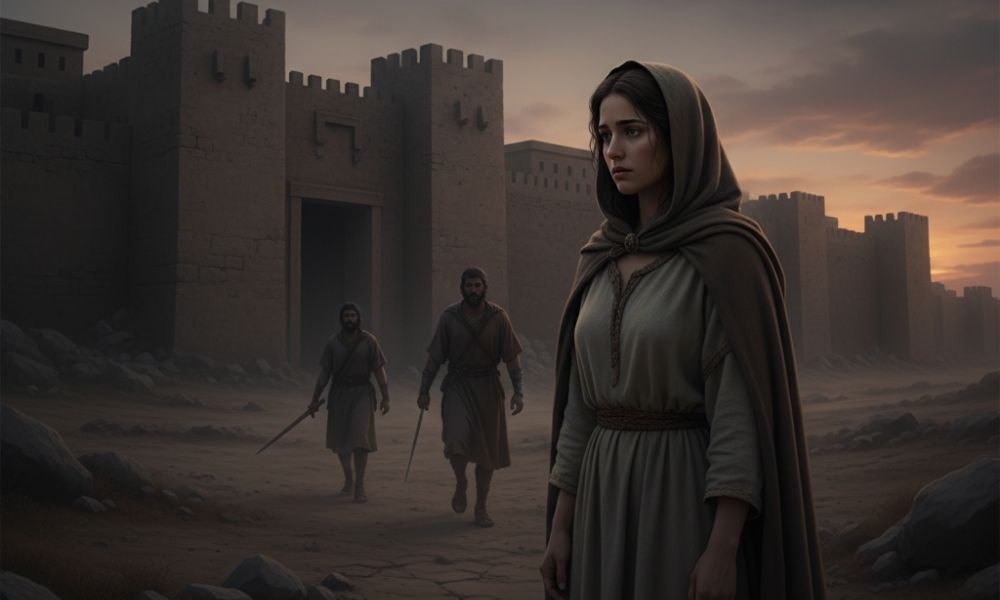
Dinah was the only daughter of Jacob and Leah mentioned by name in Scripture. Her life story, though brief and tragic, highlights deep themes of family honor, justice, and the danger of uncontrolled vengeance. Dinah’s experience led to one of the most violent episodes in Genesis — the attack on Shechem by her brothers Simeon and Levi. Through her story, we see both the pain of injustice and the consequences of human anger when not guided by divine wisdom.
Name: Dinah (Hebrew: Dînāh, meaning “Judged” or “Vindicated”)
Tribe/Nation: Israel (daughter of Jacob and Leah)
Era: Patriarchal Period (~19th century BCE)
Father: Jacob (Israel)
Mother: Leah
Brothers: Reuben, Simeon, Levi, Judah, Issachar, Zebulun, and six half-brothers
Home: Canaan
Book: Genesis (Chapter 34; mentioned again in Genesis 46:15)
Key Virtues: Innocence, purity, dignity
Legacy: Her story stands as a lesson in justice, restraint, and the value of protecting honor with wisdom
Symbol: Scales — representing judgment and justice
Name Meaning
Dinah means “judged” or “vindicated,” derived from the Hebrew root din, meaning “to judge” or “to govern.” The name likely reflects Leah’s hope for justice and recognition within her family, and it becomes hauntingly prophetic given the conflict that follows Dinah’s violation.
Lineage / Family Background
Dinah was the daughter of Jacob and Leah, born during the years Jacob lived in Haran. As the sister of six sons (and half-sister to others), she was the only named daughter among Jacob’s twelve sons — a symbol of Leah’s enduring legacy and God’s blessing upon her.
- Father: Jacob, patriarch of Israel
- Mother: Leah, Jacob’s first wife
- Brothers: Reuben, Simeon, Levi, Judah, Issachar, Zebulun (and six half-brothers)
- Tribe Connection: Tribe of Leah’s lineage — Judah and Levi’s lines
Major Roles / Identity
- Only named daughter of Jacob
- Victim of Shechem’s violation
- Catalyst of Simeon and Levi’s vengeance
- A figure representing both innocence and suffering
Key Character Traits
- Innocent: Wronged through no fault of her own.
- Curious: Went out “to visit the women of the land,” showing openness and independence (Genesis 34:1).
- Symbolic: Her experience became the moral center of a national and familial conflict.
- Silent Sufferer: Her voice is absent from the text, emphasizing the tragedy of her story.
Main Life Events
- Visit to Shechem: Dinah went out to meet the women of the land (Genesis 34:1).
- Violation by Shechem: Shechem, son of Hamor the Hivite, “took her and lay with her by force” (Genesis 34:2).
- Marriage Proposal: Shechem loved Dinah afterward and asked his father Hamor to arrange marriage with her (Genesis 34:3–4).
- Brothers’ Deception: Simeon and Levi deceitfully agreed on condition that the men of Shechem be circumcised.
- Massacre of Shechem: While the men were weakened, Simeon and Levi attacked the city, killing all the males (Genesis 34:25–26).
- Jacob’s Displeasure: Jacob rebuked them, saying, “You have brought trouble on me by making me obnoxious to the inhabitants of the land” (Genesis 34:30).
- Aftermath: Dinah was brought back from Shechem’s house (Genesis 34:26). Her life after this event is not recorded, though she is listed among those who went with Jacob to Egypt (Genesis 46:15).
Major Relationships
- Jacob: Her father, who sought peace but struggled with the violent consequences of his sons’ actions.
- Leah: Her mother, whose desire for honor and justice echoed in Dinah’s name and fate.
- Simeon and Levi: Her brothers and avengers, whose zeal for family honor led to violence.
- Shechem: The prince who violated her yet professed affection afterward.
- God: Though His name is not mentioned in Genesis 34, divine justice and moral reflection are central to Dinah’s story.
Notable Passages
- Genesis 34:1–2: “Now Dinah, the daughter Leah had borne to Jacob, went out to visit the women of the land. When Shechem… saw her, he took her and violated her.”
- Genesis 34:25–26: “Simeon and Levi, Dinah’s brothers, took their swords and attacked the unsuspecting city, killing every male.”
- Genesis 34:30: “Then Jacob said to Simeon and Levi, ‘You have brought trouble on me…’”
- Genesis 46:15: “These were the children born to Jacob by Leah in Paddan-Aram, besides his daughter Dinah.”
Legacy & Impact
Dinah’s story serves as a sobering reflection on justice, purity, and restraint. Though she endured great suffering, her story shaped Israel’s moral consciousness about justice and family honor. Her brothers’ zeal revealed both courage and recklessness — and their actions led Jacob to prophesy their dispersion (Genesis 49:5–7).
- Symbol of purity violated and honor defended
- Catalyst for Simeon and Levi’s discipline and dispersal
- A lesson in the dangers of human vengeance versus divine justice
- Included among Jacob’s household that entered Egypt — proof that she remained part of God’s covenant family
Symbolism / Typology
- Dinah’s Silence: Symbolizes the suffering of the innocent and voiceless, awaiting divine vindication.
- Her Brothers’ Vengeance: Represents misguided zeal — justice distorted by wrath.
- Jacob’s Response: Symbolizes the need for wisdom and restraint in leadership.
- Her Name (“Judged”): Points to God’s ultimate role as the righteous Judge who sees every wrong.
Extra-Biblical References
- Jewish tradition remembers Dinah as a woman of purity and dignity, tragically caught in the tensions between covenant and culture.
- Midrashic accounts sometimes portray her as later redeemed through her descendants, emphasizing God’s mercy beyond tragedy.
- In Christian interpretation, Dinah often represents the believer’s vulnerability in a corrupt world and the need for divine justice rather than human vengeance.







Leave a Reply