
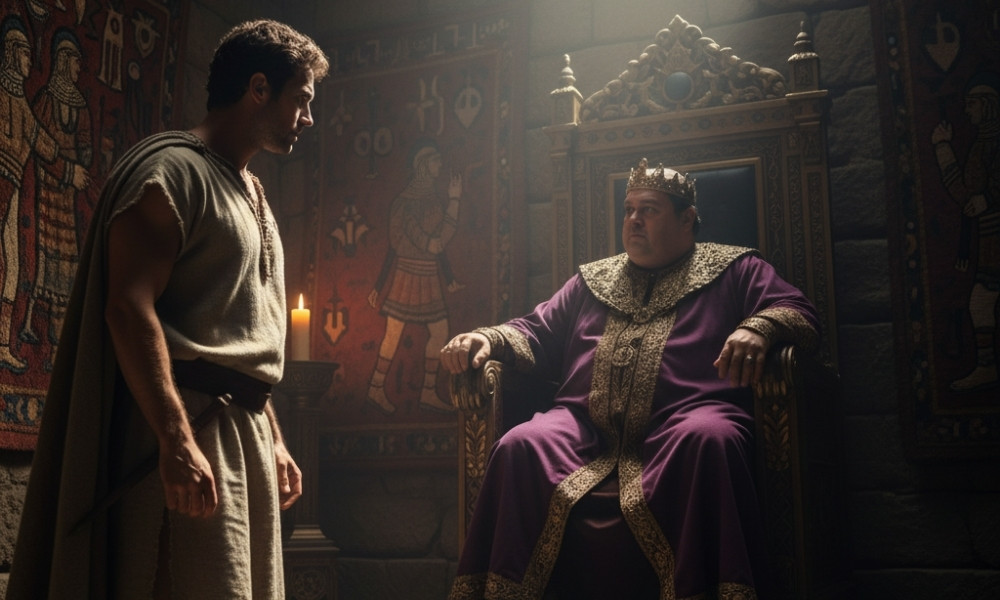
Ehud is the second Judge of Israel, famous for one of the most graphic and tactically brilliant narratives in the Bible. A Benjamite characterized by his left-handedness, Ehud utilized this unique physical trait to deceive and assassinate Eglon, the oppressive King of Moab. His story is not one of open battlefield confrontation initially, but of espionage, stealth, and decisive surgical action. Ehud’s bravery broke an 18-year oppression and ushered in the longest period of peace recorded in the Book of Judges—eighty years.
- Name: Ehud (Hebrew: Ehud)
- Meaning: “United,” “Union,” or “One”
- Role: Judge, Assassin, Military Commander
- Tribe: Benjamin
- Father: Gera
- Distinguishing Feature: Left-handed
- Weapon: A handmade, double-edged sword (1 cubit/18 inches long)
- Adversary: Eglon (King of Moab)
- Era: Period of the Judges (~1300 BCE)
- Key Location: The “City of Palms” (Jericho) and the Fords of the Jordan
- Scripture: Judges 3:12–30
- Legacy: Secured 80 years of peace (longest in the book)
Name Meaning
“United” / “Strong”: The etymology is slightly debated, but it is often linked to the concept of unity or oneness.
The Irony of Benjamin: Ehud was a Benjamite. The name Benjamin means “Son of my right hand.” Yet, Ehud is explicitly described as ish itter yad-yemino—literally “a man restricted in his right hand” (left-handed). This irony highlights that God often uses the unexpected or the “exception” to bring about deliverance.
Lineage / Family Background
Tribe of Benjamin: A tribe known for its fierce warriors and later for its skilled left-handed slingers (Judges 20:16).
Son of Gera: Identified as the son of Gera, a prominent family line within Benjamin.
Biblical Era / Context
Moabite Alliance: Because of Israel’s idolatry, God strengthened Eglon, King of Moab. Eglon formed a coalition with the Ammonites and Amalekites.
Occupation of Jericho: The coalition crossed the Jordan River and occupied the “City of Palms” (Jericho), forcing Israel to pay heavy tribute for 18 years.
Major Roles / Identity
The Deliverer: Like Othniel before him, Ehud was raised up by Yahweh in response to the people’s cries.
The Assassin: Ehud is unique among the judges as a lone operative. He did not initially raise an army; he executed a covert mission to decapitate the enemy leadership.
The General: Following the assassination, he seamlessly transitioned into a military commander, rallying the troops of Ephraim to secure a strategic victory.
Key Character Traits
Cunning: He constructed a specific weapon for a specific task and hid it on his right thigh (unexpected for a weapon check) because he was left-handed.
Deception: He used the pretext of a “secret message from God” to isolate the king.
Cool-headedness: After the assassination, Ehud did not panic. He calmly locked the doors, walked out past the guards, and escaped while the king’s servants waited, assuming the king was relieving himself.
Decisiveness: His call to arms was immediate and authoritative: “Follow me, for the Lord has given your enemies the Moabites into your hand.”
Main Life Events
The Tribute Mission: Ehud was selected to lead a delegation to present tribute (taxes) to King Eglon.
The Weapon: He made a double-edged sword, a cubit in length, and strapped it under his clothes on his right thigh.
The “Secret Message”: After delivering the tribute, he dismissed his team but returned alone to Eglon, claiming to have a secret word. Eglon dismissed his guards.
The Assassination: In the cool roof chamber, Ehud approached Eglon (who stood up out of reverence for a “message from God”). Ehud drew the sword with his left hand and thrust it into the obese king’s belly. The handle sank in after the blade, and the fat closed over it.
The Escape: Ehud locked the doors of the roof chamber and escaped toward Seirah while the servants delayed entering, thinking the king was using the toilet.
The Battle at the Fords: Ehud blew the trumpet in the hill country of Ephraim. He led the Israelites to capture the fords of the Jordan River, cutting off the Moabite retreat. They killed 10,000 robust Moabite soldiers; not one escaped.
Major Relationships
Eglon: The antagonist. Described as “a very fat man,” his physical gluttony mirrored his consumption of Israel’s resources. Ehud’s interaction with him is intimate and violent.
The Warriors of Ephraim: Though Ehud was a Benjamite, he rallied the hill country of Ephraim (the neighboring powerful tribe) to finish the job.
Notable Passages
Judges 3:15: “…a man left-handed. And by him the people of Israel sent tribute to Eglon the king of Moab.”
Judges 3:20: “And Ehud said, ‘I have a message from God for you.’ And he arose from his seat.”
Judges 3:21–22: “And Ehud reached with his left hand, took the sword from his right thigh, and thrust it into his belly. And the hilt also went in after the blade… and the dung came out.”
Judges 3:28: “Follow me, for the Lord has given your enemies the Moabites into your hand.”
Legacy & Impact
Eighty Years of Rest: Ehud’s decisive action led to the longest period of peace recorded in the Book of Judges (Judges 3:30).
Tactical Innovation: He taught Israel that victory didn’t always require a massive army initially; sometimes, it required strategic elimination of the enemy’s head.
Strategic Warfare: By seizing the fords of the Jordan, he prevented the Moabites from fleeing back home and prevented reinforcements from arriving, ensuring a total victory.
Symbolism / Typology
The Two-Edged Sword: In Christian theology, Ehud’s sword is often compared to the “Sword of the Spirit” or the Word of God, which is described as “sharper than any two-edged sword” (Hebrews 4:12), capable of piercing the heart.
Left-Handedness: Represents God’s use of what is considered “weak” or “unconventional” by human standards to confound the mighty.
Extra-Biblical References
Josephus: The historian Josephus expands on the narrative, suggesting Ehud became familiar with Eglon and his court during the tribute delivery, ingratiating himself to lower their guard before he struck.







Leave a Reply