
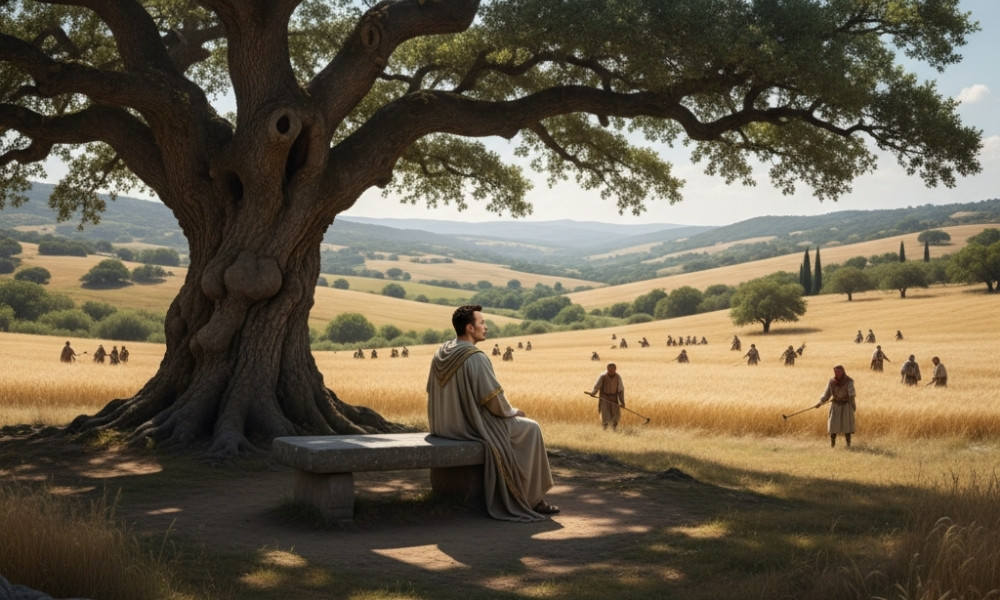
Elon is perhaps the most enigmatic of all the Judges, possessing the briefest record in the entire book—a mere two verses. Sandwiched between the prolific family of Ibzan and the wealthy dynasty of Abdon, Elon stands as a pillar of silent strength. His ten-year reign is unmarked by war, scandal, or internal strife, suggesting a decade of tranquility and effective administration for the northern tribes.
Name Meaning
“Oak” / “Terebinth”: The name Elon means “Oak” or “Terebinth” tree. In the ancient Near East, these trees were symbols of endurance, strength, and permanence. They were often used as landmarks or meeting places for judgment (e.g., Deborah’s palm, Abraham’s oak). His name suggests he was a man of solid, unmoving character.
Lineage / Family Background
Tribe of Zebulun: Elon is the only Judge explicitly stated to be from the tribe of Zebulun. This northern tribe, located in the Galilee region, was praised in the Song of Deborah for risking their lives on the heights of the field (Judges 5:18). Elon’s rise continues the shift of leadership to the north.
Connection to Aijalon: He was buried in Aijalon. The Hebrew spelling of Aijalon (Ayalon) is strikingly similar to Elon. This might indicate a clan territory named after him or his family. Note: This is a different Aijalon than the famous “Valley of Aijalon” where the sun stood still (which is in Dan/Benjamin); this is a northern location.
Biblical Era / Context
The Quiet Decade: Elon ruled for ten years. The complete absence of narrative—no battles, no foreign oppressors, no civil disputes—is arguably his greatest achievement. In the chaotic times of the Judges, “no news is good news.” It implies the deterrence of enemies and the effective maintenance of internal order.
Major Roles / Identity
The Silent Guardian: While other judges are known for their words (Deborah/Jephthah) or their feats of strength (Samson), Elon is known simply for his presence. He fulfilled the role of the “Judge” as a civil magistrate, likely maintaining the law of Moses in the north.
Key Character Traits
Stability: Like the tree he is named after, Elon represents a period of rootedness for Israel, a pause between the social maneuvering of Ibzan and the wealthy display of Abdon.
Main Life Events
Succession: Rose to judge Israel after the death of Ibzan.
Governance: Judged Israel for ten years.
Death: Died and was buried in Aijalon in the land of Zebulun.
Notable Passages
Judges 12:11–12: “After him Elon the Zebulunite judged Israel, and he judged Israel ten years. Then Elon the Zebulunite died and was buried at Aijalon in the land of Zebulun.”
Legacy & Impact
The Blessing of Obscurity: Elon’s story reminds readers that faithful service to God does not always result in fame or dramatic stories. Sometimes, the greatest blessing a leader can provide is a boring, peaceful life for their people.
Tribal Dignity: He provided representation for the tribe of Zebulun, ensuring that the northern tribes remained integrated into the leadership of the confederacy.
Symbolism / Typology
The Tree of Life: As his name means “Oak,” he can be seen as a type of the righteous man described in Psalm 1: “He is like a tree planted by streams of water.”
Rest: His ten years represent a complete cycle of testing (10 is often a number of testing or completeness in the Bible) passed in peace.







Leave a Reply