
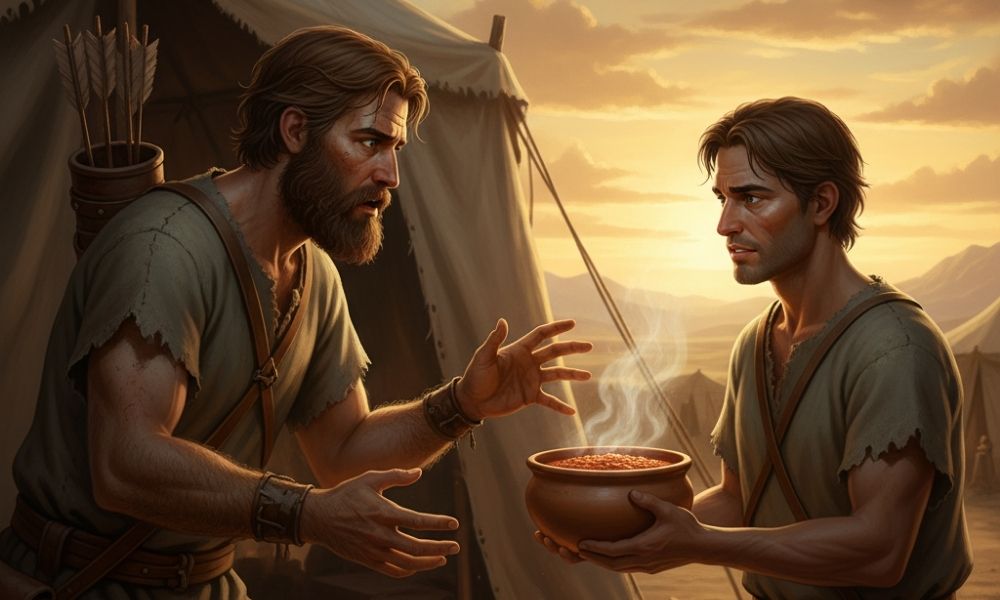
Esau was the firstborn son of Isaac and Rebekah, known for his strength, skill as a hunter, and impulsive nature. His story, found in Genesis 25–36, contrasts human desire with divine purpose — showing how God’s covenant would continue through Jacob, not by birthright but by God’s sovereign choice.
Name: Esau (Hebrew: ʿĒsaw, meaning “hairy”)
Tribe/Nation: Edomite — ancestor of the nation of Edom
Era: Patriarchal period (~1900 BCE)
Father: Isaac
Mother: Rebekah
Twin Brother: Jacob
Wives: Judith, Basemath, Mahalath
Home: Canaan → Mount Seir (Edom)
Book: Genesis (Chapters 25–36)
Key Traits: Strength, passion, impulsiveness, forgiveness
Legacy: Father of the Edomites
Symbol: A bowl of stew — representing traded birthright and fleeting desire
Name Meaning
Esau means “hairy,” describing his appearance at birth. He was also called Edom, meaning “red,” after the red stew for which he traded his birthright (Genesis 25:30).
Lineage / Family Background
Esau was the firstborn twin of Isaac and Rebekah, and grandson of Abraham. Though destined by culture to inherit the family blessing, God had foretold that “the older will serve the younger” (Genesis 25:23).
Major Roles / Identity
- Firstborn of Isaac
- Skilled hunter and outdoorsman
- Ancestor of the Edomites
- Man of passion rather than patience
- Symbol of worldly desire over spiritual inheritance
Key Character Traits
- Impulsive: Sold his birthright for a single meal (Genesis 25:29–34).
- Emotional: Acted from immediate hunger and anger.
- Forgiving: Later reconciled with Jacob despite betrayal (Genesis 33:4).
- Independent: Built his own household and became a great nation apart from Jacob.
Main Life Events
- Birth and Struggle: Born red and hairy, grasped by Jacob’s hand at birth — a sign of lifelong rivalry (Genesis 25:25–26).
- Birthright Sold: Traded his inheritance for lentil stew, showing disregard for spiritual blessing (Genesis 25:29–34).
- Loss of the Blessing: Jacob, guided by Rebekah, deceived Isaac and received Esau’s blessing (Genesis 27:1–40).
- Anger and Separation: Swore vengeance and caused Jacob to flee to Haran (Genesis 27:41–45).
- Marriage to Canaanite Women: Grieved his parents by marrying foreign wives (Genesis 26:34–35).
- Reconciliation: Forgave Jacob upon his return, embracing him in peace (Genesis 33:1–4).
- Settlement in Seir: Became the father of the Edomite nation (Genesis 36).
Major Relationships
- Isaac: His father, who favored him for his hunting and provision.
- Rebekah: His mother, who favored Jacob and set events in motion against him.
- Jacob: His twin brother, rival, and eventual reconciled friend.
- God: Chose Jacob for the covenant, yet still blessed Esau with prosperity.
Notable Passages
- Genesis 25:29–34: The selling of the birthright.
- Genesis 27:38: Esau’s sorrow — “Have you only one blessing, my father?”
- Genesis 33:4: Esau’s embrace of Jacob — a powerful act of forgiveness.
- Hebrews 12:16–17: A warning against despising spiritual gifts for temporary desires.
Legacy & Impact
- Ancestor of the Edomites, who later became Israel’s neighbors and occasional rivals.
- A lasting symbol of worldly priorities over spiritual inheritance.
- His reconciliation with Jacob demonstrates forgiveness and restoration within God’s plan.
- His story warns believers to value spiritual blessings above fleeting satisfaction.
Symbolism / Typology
- The Stew: Symbol of short-sighted choices and physical desire over faith.
- Esau vs. Jacob: Represents the contrast between the flesh and the spirit, or human will versus divine election.
- Reconciliation: Foreshadows the healing of broken relationships through grace.







Leave a Reply