
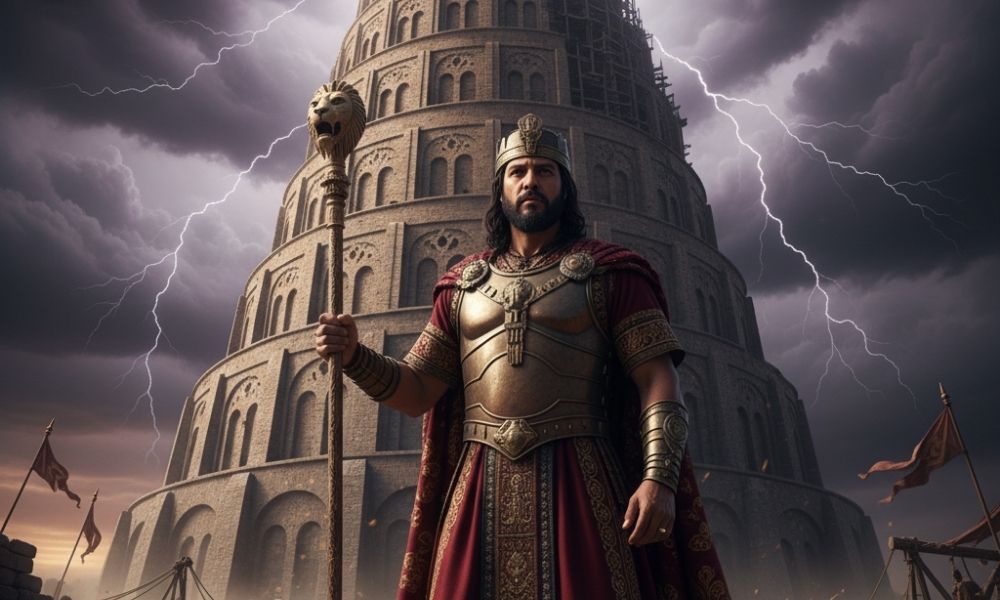
Nimrod was a powerful ruler and hunter in the generations after the Flood, known as the first mighty man and the founder of some of the earliest kingdoms on earth — including Babel (Babylon). Though renowned for his strength and leadership, Nimrod became a symbol of human pride and rebellion against God, leading efforts that defied divine authority, most notably at the Tower of Babel.
Quick Facts
Name: Nimrod (Hebrew: Nimrōd, meaning “we shall rebel” or “rebel”)
Father: Cush (son of Ham, grandson of Noah)
Era: Postdiluvian (after the Flood)
Occupation: Mighty hunter, warrior, and king
Known For: Founding Babel and other ancient cities; leading human rebellion against God
Kingdoms Founded: Babel, Erech, Akkad, and Calneh in Shinar; later Nineveh (Genesis 10:10–12)
Scriptural References: Genesis 10:8–12; 1 Chronicles 1:10; Micah 5:6
Symbol: Tower or bow — representing power, ambition, and rebellion
Name Meaning
The name Nimrod likely derives from the Hebrew root m-r-d, meaning “to rebel.”
This meaning aligns with his character and legacy as a man who defied God’s authority and led others into collective rebellion, both politically and spiritually.
Lineage and Family Background
Nimrod was the great-grandson of Noah, descended through Ham and Cush (Genesis 10:6–8). From this line came some of the earliest and most influential civilizations of the ancient world. Unlike the godly descendants of Shem, Nimrod’s lineage was marked by earthly power and human ambition, setting the stage for kingdoms that opposed God’s purposes.
Biblical Context
Nimrod appears in Genesis 10:8–12, within the “Table of Nations.” The passage describes him as:
“A mighty hunter before the LORD.”
This phrase likely means not that he hunted animals, but that he conquered and dominated people, establishing kingdoms by force. He is credited with founding Babel, Erech (Uruk), Akkad, and Calneh in the land of Shinar — the core of Mesopotamia.
Nimrod is traditionally associated with the Tower of Babel (Genesis 11:1–9), a project that represented humanity’s collective defiance of God’s command to “fill the earth.” His leadership thus became synonymous with rebellion, idolatry, and pride.
Key Character Traits
- Ambitious: Sought to build powerful kingdoms and exalt his name.
- Defiant: Rebelled against God’s command and authority.
- Dominant: Established the world’s first centralized governments.
- Charismatic: Led others in a united, yet godless cause.
Main Life Events
- Rise to Power: Became a “mighty one” on the earth (Genesis 10:8).
- Founder of Babel: Established cities in Shinar, including Babel, the root of Babylonian civilization.
- Expansion into Assyria: Built Nineveh and other cities, forming an early empire.
- Symbol of Rebellion: Traditionally linked to leading the Tower of Babel rebellion against God.
Major Relationships
- Cush (Father): Son of Ham; founder of a powerful lineage.
- Noah (Great-grandfather): His ancestor, whose righteous legacy Nimrod rejected through pride and violence.
- People of Babel: United under his rule in rebellion against God’s authority.
Notable Passages
- Genesis 10:8–9: “Cush begot Nimrod; he began to be a mighty one on the earth. He was a mighty hunter before the LORD.”
- Genesis 10:10: “The beginning of his kingdom was Babel, Erech, Akkad, and Calneh, in the land of Shinar.”
- Micah 5:6: References “the land of Nimrod,” equating it with Assyria — a symbol of human pride and power.
Legacy & Impact
Nimrod’s legacy endures as a warning against pride and self-exaltation. His empire-building and defiance illustrate humanity’s tendency to seek unity and greatness apart from God.
Spiritually, he represents worldly kingdoms that oppose divine rule — a theme that recurs throughout Scripture, culminating in Babylon as the archetype of rebellion in Revelation.
Nimrod’s story teaches that true greatness comes from submission to God, not from human ambition or earthly power.
Symbolism / Typology
- Nimrod: Symbol of rebellion, humanism, and worldly power.
- Babel: Represents mankind’s attempt to reach heaven through pride and self-effort.
- Contrast with Abraham: Nimrod’s rebellion foreshadows Abraham’s obedience — two opposing paths of human destiny.
Extra-Biblical Tradition
Jewish and Christian traditions often portray Nimrod as the builder of the Tower of Babel and the prototype of pagan kings. Some writings describe him as the first to promote idolatry after the Flood.
The Book of Jubilees and Josephus’ Antiquities identify him as a tyrant who sought to exalt humanity above God, leading to the divine scattering at Babel.







Leave a Reply