
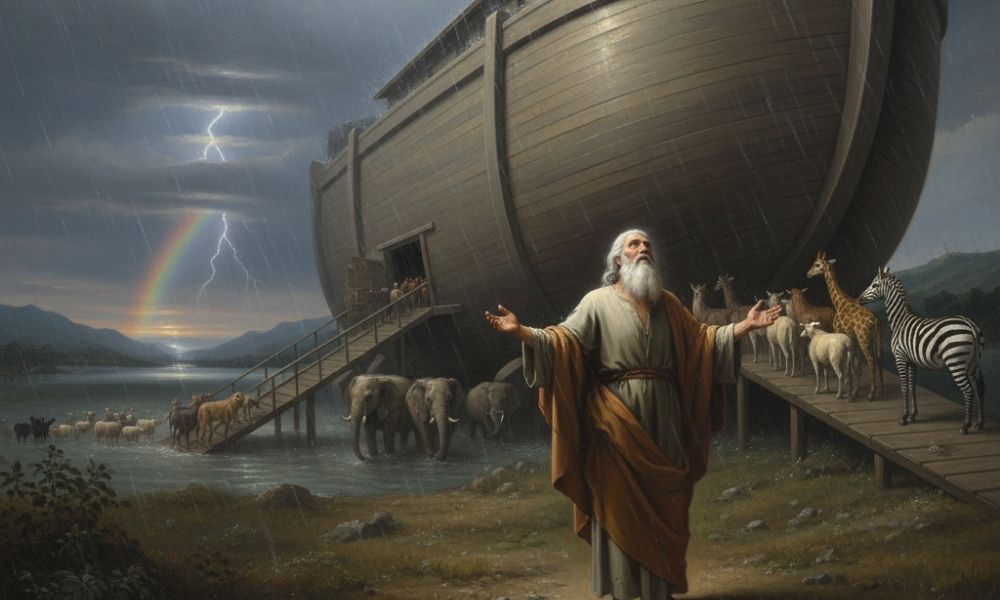
Noah is one of the most pivotal figures in the Bible — a righteous man chosen by God to preserve humanity and all living creatures from destruction through the Great Flood. His faith and obedience in building the Ark made him a symbol of salvation, covenant, and renewal. Noah’s story bridges the fallen world of Adam’s descendants with the new beginning of humanity under God’s covenant grace.
Quick Facts
Name: Noah (Hebrew: Noach, meaning “rest” or “comfort”)
Father: Lamech
Grandfather: Methuselah
Lineage: Descendant of Seth (10th generation from Adam)
Sons: Shem, Ham, and Japheth
Era: Antediluvian and Postdiluvian (before and after the Flood)
Age: 950 years (Genesis 9:29)
Occupation: Farmer, shipbuilder, and preacher of righteousness
Key Virtues: Faith, obedience, perseverance, righteousness
Scriptural References: Genesis 5–9; Hebrews 11:7; 1 Peter 3:20; Matthew 24:37–39
Symbol: The Ark or the rainbow — representing salvation, covenant, and divine faithfulness
Name Meaning
Noah means “rest” or “comfort.” His father Lamech prophesied at his birth:
“He will comfort us in the labor and painful toil of our hands caused by the ground the LORD has cursed.” (Genesis 5:29)
The name proved true, for through Noah, God brought rest from the corruption of the world and renewed His covenant with humanity.
Lineage and Family Background
Noah descended from the righteous line of Seth, through Methuselah and Lamech. Unlike the world around him, which had become filled with violence and sin, Noah remained faithful to God. He married and fathered three sons — Shem, Ham, and Japheth — who would repopulate the earth after the Flood.
Biblical Context
The story of Noah unfolds in Genesis 6–9, during a time when “the earth was corrupt and full of violence.” Humanity’s wickedness provoked divine judgment, but Noah found favor in the eyes of the LORD (Genesis 6:8).
God instructed Noah to build an Ark — a massive vessel of wood — to preserve his family and pairs of every living creature from the coming Flood. After 120 years of preparation and warning, the rains came, covering the whole earth. Only Noah, his family, and the animals aboard the Ark survived.
After the waters receded, Noah offered sacrifices of thanksgiving, and God established the Rainbow Covenant, promising never again to destroy the world by flood.
Key Character Traits
- Righteousness: “Noah was a righteous man, blameless among the people of his time” (Genesis 6:9).
- Faith: Obeyed God’s command to build the Ark despite human ridicule (Hebrews 11:7).
- Obedience: Followed God’s instructions precisely.
- Endurance: Worked faithfully for over a century while warning a corrupt world.
- Worship: Offered gratitude and sacrifice after deliverance, showing reverence to God.
Main Life Events
- Birth and Early Life: Born into the godly line of Seth (Genesis 5:28–29).
- Divine Command: God reveals His plan to flood the earth and save Noah (Genesis 6:13–22).
- Building the Ark: Constructed a massive vessel according to divine specifications (approx. 120 years).
- The Flood: Waters covered the earth for 40 days; Noah, his family, and the animals were preserved (Genesis 7).
- The Covenant: God promises never again to destroy all life by water, sealing it with the rainbow (Genesis 9:8–17).
- Final Years: Lived 350 years after the Flood, dying at 950 years old (Genesis 9:29).
Major Relationships
- Lamech (Father): Prophesied Noah’s comforting role in God’s plan.
- Methuselah (Grandfather): Died the same year the Flood began.
- Shem, Ham, Japheth (Sons): Survived the Flood; forefathers of post-Flood nations.
- God: Noah’s defining relationship — one of faith, obedience, and covenant grace.
Notable Passages
- Genesis 6:8–9: “But Noah found favor in the eyes of the LORD. Noah was a righteous man, blameless among the people of his time, and he walked faithfully with God.”
- Genesis 8:20–21: Noah builds an altar; God promises never again to curse the ground because of humans.
- Genesis 9:13: “I have set my rainbow in the clouds, and it will be the sign of the covenant between me and the earth.”
- Hebrews 11:7: “By faith Noah… became heir of the righteousness that comes by faith.”
Legacy & Impact
Noah’s faith preserved humanity and creation through divine judgment. He stands as a type of Christ — a savior figure through whom God provided deliverance from destruction. The Ark represents salvation and refuge in God, while the rainbow stands as an eternal reminder of His mercy and covenant faithfulness.
Noah’s descendants repopulated the world, and through his son Shem came the lineage of Abraham, David, and ultimately Jesus Christ.
Symbolism / Typology
- The Ark: Symbol of salvation and refuge — foreshadowing Christ as the true ark of safety.
- The Flood: Represents divine judgment against sin.
- The Rainbow: Sign of God’s everlasting covenant of mercy.
- Noah: A type of Christ — obedient, righteous, and the instrument of humanity’s preservation.
Extra-Biblical Tradition
In Jewish tradition, Noah is revered as a preacher of righteousness, warning the people of judgment.
In Christian theology, he is a symbol of faith and perseverance. The Quran also honors him (Nuh) as a prophet who called his people to repentance.
Ancient writings, such as the Book of Jubilees and 1 Enoch, expand on his wisdom and role as a guardian of divine law.







Leave a Reply