
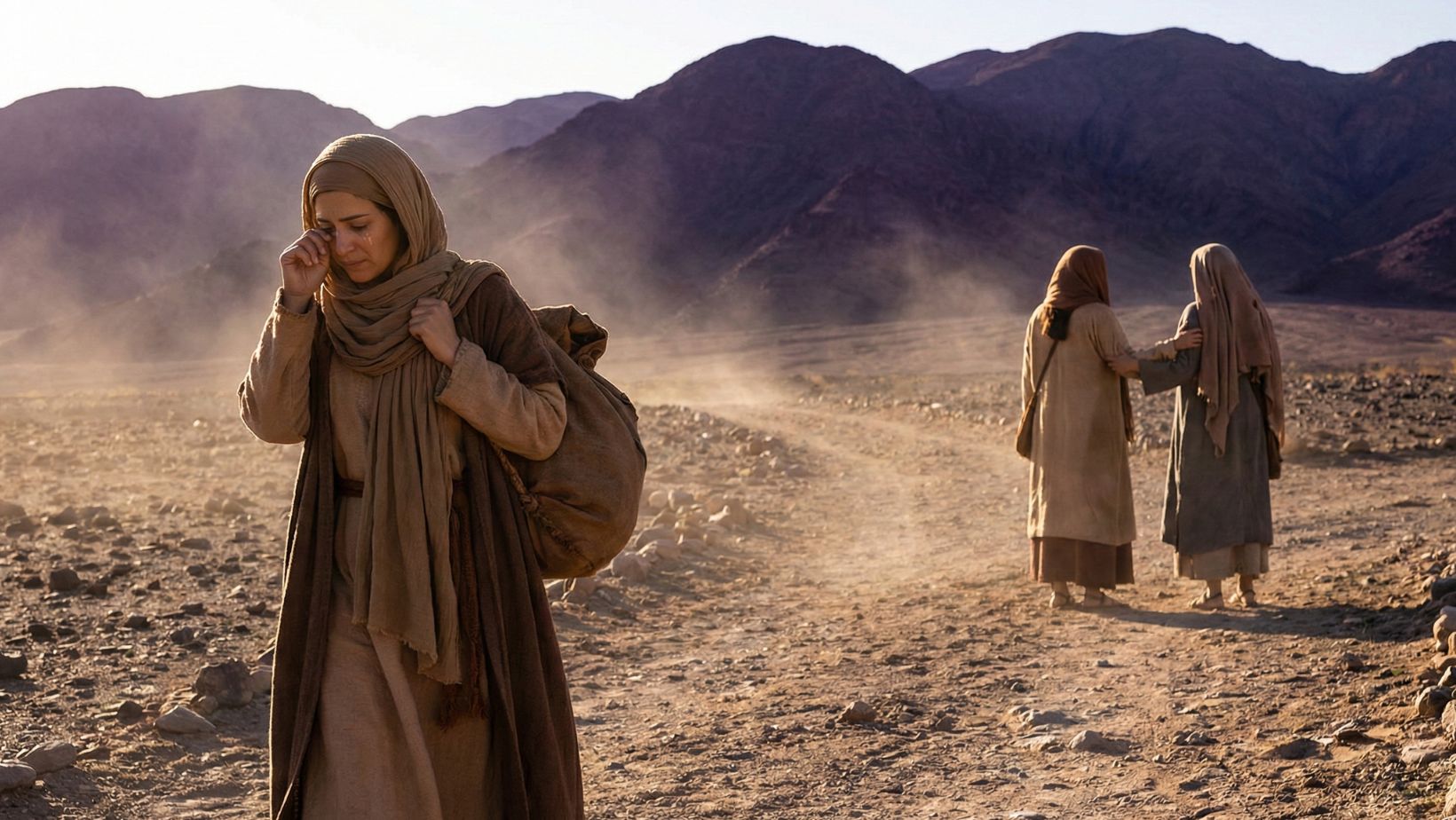
Orpah is the “other” daughter-in-law in the Book of Ruth, serving as a crucial literary foil to the protagonist. A Moabite woman who married into Naomi’s family, Orpah shares the same initial tragedy as Ruth—widowhood and childlessness. However, her story diverges at the border of Judah. While she loved Naomi and initially intended to go with her, Orpah ultimately chooses to return to her family and her gods in Moab. Her decision highlights the extraordinary nature of Ruth’s faith; Orpah represents the sensible, logical, and socially expected choice, making Ruth’s radical devotion shine even brighter by comparison.
Quick Facts
- Name: Orpah (Hebrew:
Orpah)- Meaning: “Back of the neck,” “Mane,” or “Fawn”
- Nation: Moabite
- Era: Time of the Judges (~12th century BCE)
- Husband: Chilion (traditionally associated, though not explicitly named as his specific wife in the text)
- Mother-in-law: Naomi
- Sister-in-law: Ruth
- Key Action: Returning to Moab
- Key Role: Literary foil to Ruth
- Fate: Returned to her people and her gods
Name Meaning
Orpah: The name is derived from the Hebrew root oreph, meaning “neck” or “back of the neck.” Symbolism: Many commentators view her name as prophetic of her action: she “turned her back” on Naomi and the God of Israel. Alternatively, it can mean “stiff-necked,” implying stubbornness in sticking to her own culture, or “fawn,” suggesting a gentle but timid nature.
Lineage / Family Background
Moabite Origin: Like Ruth, Orpah was from Moab, a nation descended from Lot (Abraham’s nephew). The Moabites were historical enemies of Israel, though during this famine, there was a temporary truce.
Marriage: She married one of Elimelech and Naomi’s sons (traditionally Chilion) during the family’s ten-year sojourn in Moab.
Biblical Era / Context
The Crisis: Orpah faced the “widow’s dilemma.” In the ancient Near East, a young childless widow had two choices: rely on the Levirate marriage custom (marrying a brother-in-law) or return to her father’s house to hope for a new marriage.
The Cultural Norm: Since Naomi had no other sons to offer, the culturally “correct” and safe decision for Orpah was to return to her Moabite family. Her decision to leave was not an act of malice, but of social survival.
Major Roles / Identity
The Foil: In literature, a foil is a character who contrasts with another to highlight particular qualities. Orpah’s decision to leave emphasizes that Ruth’s decision to stay was not inevitable—it was a difficult, radical choice.
The Pragmatist: Orpah represents human logic and natural affection. She loved Naomi, but she also loved her own security and future prospects.
The Representative of the Nations: By returning to “her people and her gods,” she represents the nations that turn away from the covenant of Yahweh to remain in their own traditions.
Key Character Traits
Affectionate: She is not cold-hearted. The text records that she wept aloud and kissed Naomi goodbye (Ruth 1:14). Her love for her mother-in-law was genuine.
Sensible: She listened to Naomi’s logical arguments (Ruth 1:11–13) regarding the lack of husbands and future in Judah. She allowed reason to dictate her actions.
Conventional: She followed the path of least resistance and social expectation, contrasting with Ruth’s unconventional faith.
Main Life Events
Marriage and Loss: She married into an Israelite family but became a widow after a decade, leaving her with no children.
The Journey Begins: She initially set out with Naomi and Ruth to return to the land of Judah (Ruth 1:7).
The Decision at the Crossroads: When Naomi urged the young women to return, Orpah initially refused (“We will go back with you”). However, after Naomi insisted and explained the hopelessness of their situation, Orpah kissed her mother-in-law and turned back.
Major Relationships
Naomi: A relationship marked by mutual sorrow and respect. Naomi blesses Orpah, praying that the Lord would show her kindness (hesed) just as Orpah had shown kindness to the dead and to Naomi.
Ruth: They shared a parallel life—same marriage date, same tragedy, same journey—until the moment of separation.
Chilion: Her husband, whose early death defined the trajectory of her young life.
Notable Passages
Ruth 1:8: Naomi’s release: “Go back, each of you, to your mother’s home. May the LORD show you kindness, as you have shown kindness to your dead husbands and to me.”
Ruth 1:14: The departure: “At this they wept aloud again. Then Orpah kissed her mother-in-law goodbye, but Ruth clung to her.”
Ruth 1:15: The spiritual distinction: “Look,” said Naomi, “your sister-in-law is going back to her people and her gods. Go back with her.”
Legacy & Impact
The Limit of Natural Love: Orpah demonstrates that human affection has limits when faced with a hopeless future. It highlights that true covenant faithfulness (like Ruth’s) goes beyond emotion.
A Warning: In Christian typology, Orpah is sometimes seen as a picture of those who start the journey of faith or show interest in God but turn back when the cost becomes too high (similar to the seed sown on rocky ground).
Symbolism / Typology
The Back vs. The Face: Orpah turned her back (neck) to go to Moab; Ruth set her face toward Bethlehem.
Logic vs. Faith: Orpah walked by sight (seeing no husband in Judah); Ruth walked by faith (trusting God despite the lack of prospects).
Extra-Biblical References
Rabbinic Tradition (Midrash): Jewish tradition presents a fascinating “what if” scenario regarding Orpah. The Midrash (Sotah 42b) identifies Orpah as the mother (or grandmother) of Goliath, the Philistine giant.
- The Contrast: This tradition sets up a cosmic conflict: Ruth (the ancestor of David) vs. Orpah (the ancestor of Goliath).
- The Lesson: Because Orpah turned her back on God, her lineage produced Israel’s great enemy. Because Ruth clung to God, her lineage produced Israel’s great King. The battle between David and Goliath is thus seen as the final confrontation between the choices made by these two women.







Leave a Reply