
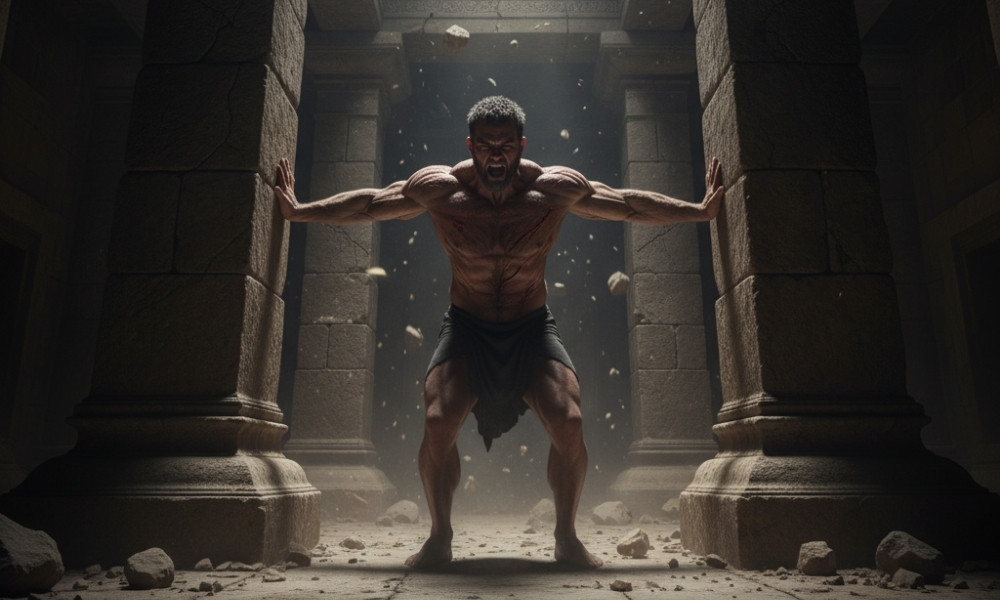
Samson is the final, most famous, and most complex of the Judges. He is a figure of immense contradictions: a man of supernatural strength but weak will, a Nazirite dedicated to God who constantly broke his vows, and a hero who saved Israel not by leading an army, but through acts of personal vengeance. Unlike previous judges who liberated Israel to bring peace, Samson began the conflict with the Philistines that would only be finished by King David. His life is a tragic epic of wasted potential and ultimate redemption.
- Name: Samson (Hebrew: Shimshon)
- Meaning: “Sun,” “Little Sun,” or “Sun-man”
- Role: Judge, Nazirite, One-Man Army
- Tribe: Dan
- Father: Manoah
- Home: Zorah (on the border of Philistine territory)
- Adversary: The Philistines
- Key Strength: Supernatural physical power via the Holy Spirit
- Key Weakness: Unbridled lust and lack of self-control
- Lover: Delilah (and others)
- Scripture: Judges 13–16
- Legacy: Killed more Philistines in his death than in his life
Name Meaning
“Little Sun”: The name Shimshon is derived from Shemesh (Sun). This is ironic for two reasons:
- The Proximity to Beth-Shemesh: He lived near Beth-Shemesh (“House of the Sun”), a center of sun worship, hinting at the syncretistic culture of his time.
- The Darkness: The “Sun-man” ends his life in total darkness, having his eyes gouged out by the enemy.
Lineage / Family Background
The Danite: Samson belonged to the tribe of Dan. At this time, Dan was a small, squeezed tribe caught between the aggressive Philistines on the coast and the mountains of Judah.
The Miraculous Birth: He is one of the few biblical characters (along with Isaac, Samuel, and John the Baptist) whose birth was announced by an angel to a barren woman. This signaled that his mission was divinely ordained from conception.
Biblical Era / Context
The Philistine Dominance: The Philistines were technologically superior (Iron Age technology) and militarily organized. Unlike previous oppressors who raided, the Philistines had settled and were assimilating Israel. Apathy: Uniquely in the book of Judges, the Israelites did not cry out to God for deliverance in Samson’s time. They were content to submit to the Philistines (Judges 15:11). Samson was sent to disrupt this comfortable status quo.
Major Roles / Identity
The Nazirite: From the womb, Samson was a Nazirite (Numbers 6). He was forbidden three things:
- Touching dead bodies.
- Drinking alcohol/products of the vine.
- Cutting his hair. Samson systematically violated the first two throughout his life, with the cutting of his hair being the final straw that broke his covenant.
The Lone Wolf: Samson never gathered an army. He never fought alongside other Israelites. In fact, the men of Judah actually tied him up and handed him over to the Philistines to avoid trouble. He fought entirely alone, empowered by the Spirit.
Key Character Traits
Impulsiveness: Samson was ruled by his appetites—whether for food (honey from a lion), sex (Philistine women), or revenge. He saw, he wanted, he took.
Physical Might vs. Spiritual Blindness: He could tear a lion apart with his bare hands, yet he could not see the obvious trap Delilah set for him three times.
Wit: He spoke in riddles and poetry. Even in battle, he was a taunter (e.g., the “heap on heaps” poem after the jawbone slaughter).
Main Life Events
The Lion and the Honey: On the way to court a Philistine woman, he killed a lion. Later, he ate honey from its carcass (violating the dead body vow) and created a riddle about it.
The Wedding & The Foxes: When his Philistine in-laws cheated to solve his riddle, he killed 30 men to pay the wager. When his wife was given to another, he caught 300 foxes, tied torches to their tails, and burned the Philistine grain fields.
The Jawbone: After the Philistines attacked, he picked up a fresh jawbone of a donkey and killed 1,000 men.
The Gates of Gaza: In a show of strength and mockery, he ripped the heavy city gates of Gaza from their hinges and carried them roughly 40 miles uphill to Hebron.
Delilah and the Betrayal: He fell in love with Delilah in the Valley of Sorek. She pestered him to reveal the secret of his strength. After three lies, he revealed his Nazirite vow. She cut his hair, and the Lord left him.
The Death: Blinded and enslaved, he was brought to the Temple of Dagon to entertain the crowds. He prayed one final time for strength, pushed the two central pillars apart, and collapsed the temple, killing himself and thousands of Philistine rulers.
Major Relationships
The Spirit of the Lord: The most important relationship. The Spirit would “rush upon” him to enable his feats. His tragedy was assuming the Spirit would always be there, regardless of his disobedience.
Delilah: His downfall. Unlike his first wife (who was threatened with fire), Delilah betrayed him for silver. She represents the fatal allure of compromise.
Manoah: His father, who tried to guide him but often seemed bewildered by his son’s desire for foreign women.
Notable Passages
Judges 13:5: “For behold, you shall conceive and bear a son. No razor shall come upon his head, for the child shall be a Nazirite to God from the womb, and he shall begin to save Israel from the hand of the Philistines.”
Judges 15:16: “With the jawbone of a donkey, heaps upon heaps, with the jawbone of a donkey I have struck down a thousand men.”
Judges 16:20: “And he awoke from his sleep and said, ‘I will go out as at other times and shake myself free.’ But he did not know that the Lord had left him.”
Judges 16:28: “O Lord God, please remember me and please strengthen me only this once, O God, that I may be avenged on the Philistines for my two eyes.”
Legacy & Impact
The Catalyst: Samson did not fully deliver Israel; the text says he began the deliverance. He stirred up the conflict that forced Israel to fight, eventually leading to the rise of Samuel and David.
Warning: His life is the ultimate biblical example of the difference between gifting (strength) and character. He had the gift but lacked the discipline, leading to destruction.
Hall of Faith: Despite his flaws, Hebrews 11:32 lists him as a hero of faith, validating that his final act was one of reliance on God.
Symbolism / Typology
Israel Incarnate: Samson is Israel. Like Israel, he was chosen by God, set apart (Nazirite), blessed with strength, but constantly chased after foreign loves (idolatry) until he was blinded and bound. His cry to God at the end mirrors Israel’s cry in captivity.
Christ-Type (Antitype): Samson offers a contrast to Jesus.
- Samson sacrificed his life to kill his enemies.
- Jesus sacrificed His life to save His enemies.
- Samson was betrayed for silver (like Jesus), but he fought back with violence, whereas Jesus fought with sacrificial love.
Extra-Biblical References
Archaeology: A seal found at Beth-Shemesh depicts a man fighting a lion, dating to roughly the 12th century BCE, suggesting the story was well-known in the region.
Literature: John Milton’s epic poem Samson Agonistes portrays Samson not just as a brute, but as a psychologically tortured soul wrestling with his failure before his final act.







Leave a Reply