
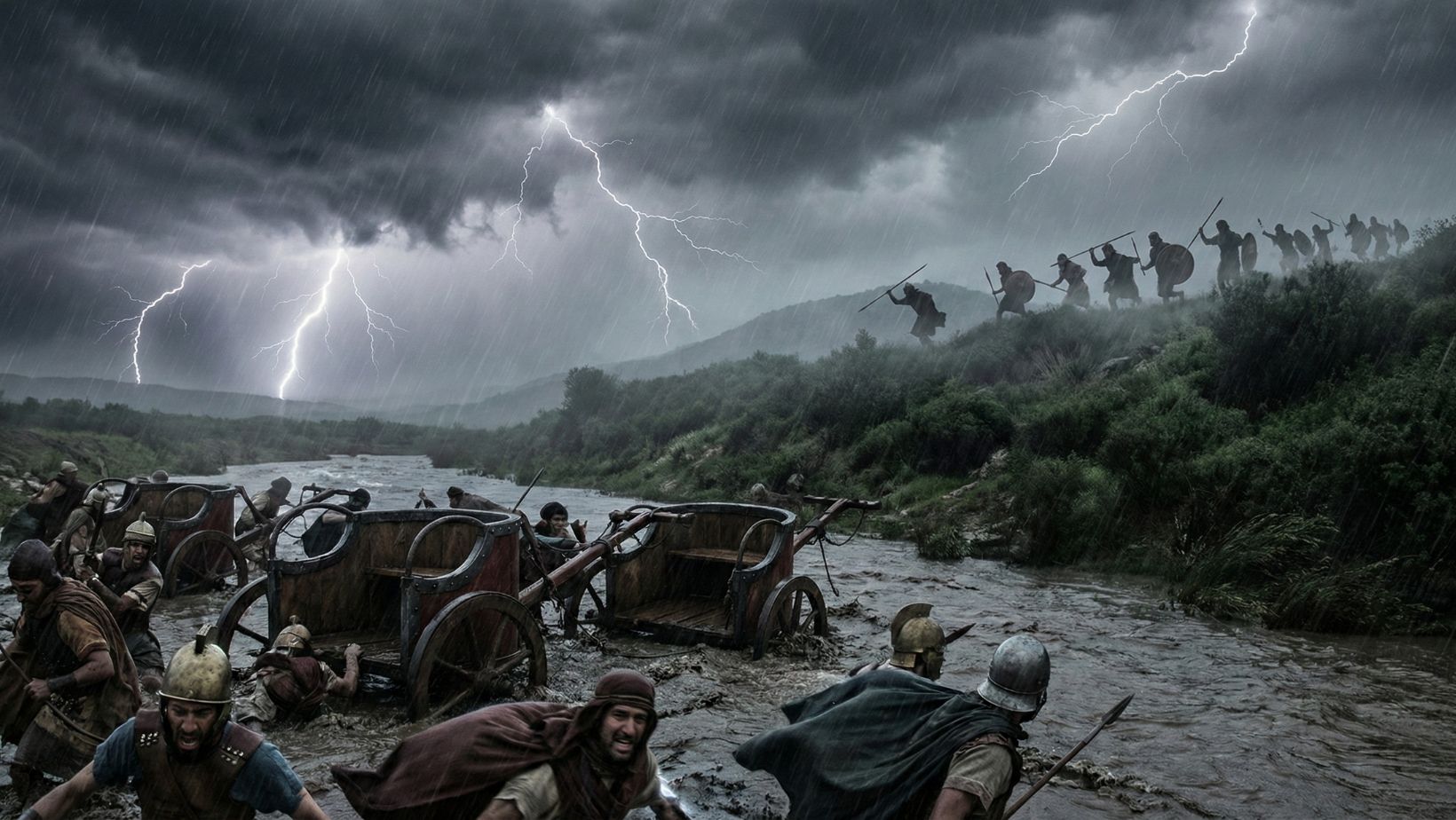
Sisera is one of the most formidable antagonists in the Book of Judges, serving as the commander of the Canaanite army under King Jabin of Hazor. Renowned for his terrifying military might—specifically his fleet of 900 iron chariots—he ruthlessly oppressed the Israelites for twenty years. His story culminates in a dramatic reversal of fortune: the mighty general is defeated not by a fellow warrior, but by the elements of nature and the hand of a woman, Jael, fulfilling the prophecy of the judge Deborah.
- Name: Sisera (Etymology uncertain; possibly Philistine, Hittite, or “Servant of Ra”)
- Role: Commander of the Canaanite Army
- Allegiance: King Jabin of Hazor (Canaanite)
- Era: Period of the Judges (~12th century BCE)
- Adversaries: Deborah (Prophetess/Judge) and Barak (General)
- Key Weaponry: 900 Iron Chariots
- Place of Defeat: River Kishon / Mount Tabor
- Place of Death: The tent of Jael, wife of Heber the Kenite
- Cause of Death: Tent peg driven through the temple
- Legacy: A symbol of worldly power brought low by God’s unexpected instruments
Name Meaning
Uncertain Origin: The name “Sisera” does not appear to be Semitic (Hebrew or Canaanite). Scholars suggest it may be of Philistine, Hittite, or Egyptian origin (potentially meaning “Servant of Ra”). In Jewish tradition, the name is sometimes associated with the rattling of his iron chariots or the concept of “battle array,” though these are interpretive rather than etymological.
Lineage / Family Background
National Origin: He was a leader of the Canaanite forces, specifically serving the Kingdom of Hazor, a major city-state in northern Canaan.
King: He served Jabin, the King of Canaan, who reigned in Hazor.
Mother: Though not named, Sisera’s mother appears in a poignant scene in the “Song of Deborah” (Judges 5), anxiously waiting at her window for her son who will never return.
Biblical Era / Context
Time: The Era of the Judges, a volatile time when Israel had no king and cycled through periods of apostasy, oppression, and deliverance.
Technological Context: The mention of “900 chariots of iron” highlights a significant technological gap. At this time, Israel was largely an agrarian society with bronze weapons, while the Canaanites possessed superior iron technology and cavalry, making Sisera’s army seemingly invincible on the plains.
Geographic Setting: The conflict centers around Northern Israel, specifically the Jezreel Valley, Mount Tabor, and the torrent of the River Kishon.
Major Roles / Identity
The Oppressor: For two decades, he was the instrument of cruelty against Israel, enforcing Canaanite dominance.
The Military Commander: He represents the pinnacle of military strategy and hardware of his time.
The Fugitive: Following his army’s destruction, he is reduced to a desperate man fleeing on foot.
The Unsuspecting Victim: He becomes the object of a stealthy assassination by Jael, a woman he believed was an ally.
Key Character Traits
Ruthless: Described as having “cruelly oppressed” the Israelites (Judges 4:3).
Confident/Arrogant: He mustered his entire force, assuming his technological superiority would easily crush the Israelite rebellion.
Desperate: When the tide of battle turned, he abandoned his troops and his chariot to save his own life.
Exhausted: His deep sleep in Jael’s tent indicates the sheer physical exhaustion of the battle and flight.
Main Life Events
The Gathering: Upon hearing that Barak had assembled troops at Mount Tabor, Sisera gathered all his chariots and troops at the Kishon River to crush the rebellion.
The Battle of Kishon: As Barak charged down the mountain, God threw Sisera’s army into confusion. Many scholars believe a sudden torrential rain caused the River Kishon to flood, rendering the iron chariots useless in the mud (implied in Judges 5:21).
The Flight: Panic ensued. Sisera abandoned his chariot and fled on foot, escaping the slaughter that claimed his entire army.
The Refuge: He arrived at the tent of Heber the Kenite. Heber’s family was at peace with King Jabin, so Sisera expected sanctuary. Heber’s wife, Jael, invited him in.
The Assassination: Sisera asked for water; Jael gave him milk and covered him with a rug. Once he fell into a deep sleep from exhaustion, Jael took a tent peg and a hammer and drove the peg through his temple into the ground, killing him instantly (Judges 4:21).
Major Relationships
King Jabin: His master and the King of Hazor. Sisera was the “strong arm” of Jabin’s rule.
Deborah & Barak: His primary antagonists. Deborah prophesied his defeat, and Barak led the army against him.
Jael: The wife of Heber the Kenite. Sisera viewed her as a safe harbor, but she became his executioner.
His Mother: Featured in the poetic recounting of the battle, she represents the tragic reality of war—a mother wondering why her son’s chariot is delayed, comforting herself with the thought that he is dividing the spoils.
Notable Passages
Judges 4:3: “Because he had nine hundred chariots fitted with iron and had cruelly oppressed the Israelites for twenty years, they cried to the LORD for help.”
Judges 4:9: Deborah’s prophecy — “…the LORD will deliver Sisera into the hands of a woman.”
Judges 4:21: The graphic description of his death — “But Jael, Heber’s wife, picked up a tent peg and a hammer and went quietly to him while he lay fast asleep, exhausted. She drove the peg through his temple into the ground, and he died.”
Judges 5:28: The Song of Deborah — “Through the window peered Sisera’s mother; behind the lattice she cried out, ‘Why is his chariot so long in coming?’”
Legacy & Impact
Fulfillment of Prophecy: His death verified Deborah’s role as a prophetess and humiliated the patriarchal military culture of the time—the greatest warrior fell not to a soldier, but to a woman with a household tool.
Peace for Israel: His defeat broke the power of Jabin and led to 40 years of peace for the land (Judges 5:31).
Divine Intervention: His defeat is a classic biblical example of God fighting for His people, using the weather (the stars and the river) to neutralize superior human technology.
Symbolism / Typology
Iron Chariots: Symbolize human strength, technological pride, and insurmountable obstacles that are nothing before God.
The Tent Peg: Represents the use of the mundane and “weak” things of the world to shame the strong.
Sisera: A type of the enemies of God’s people—imposing and terrifying in appearance, but ultimately vulnerable to God’s judgment.
Extra-Biblical References
Jewish Tradition: The Talmud suggests that Sisera’s mother cried out 100 times while waiting for him, which is why the Shofar is blown 100 times on Rosh Hashanah (to counter the cries of the enemy’s mother with the cries of repentance).
Midrash: Some Midrashic texts describe Sisera as possessing supernatural strength, claiming his voice alone could shake walls or kill animals, emphasizing the miracle of his defeat.





Leave a Reply