
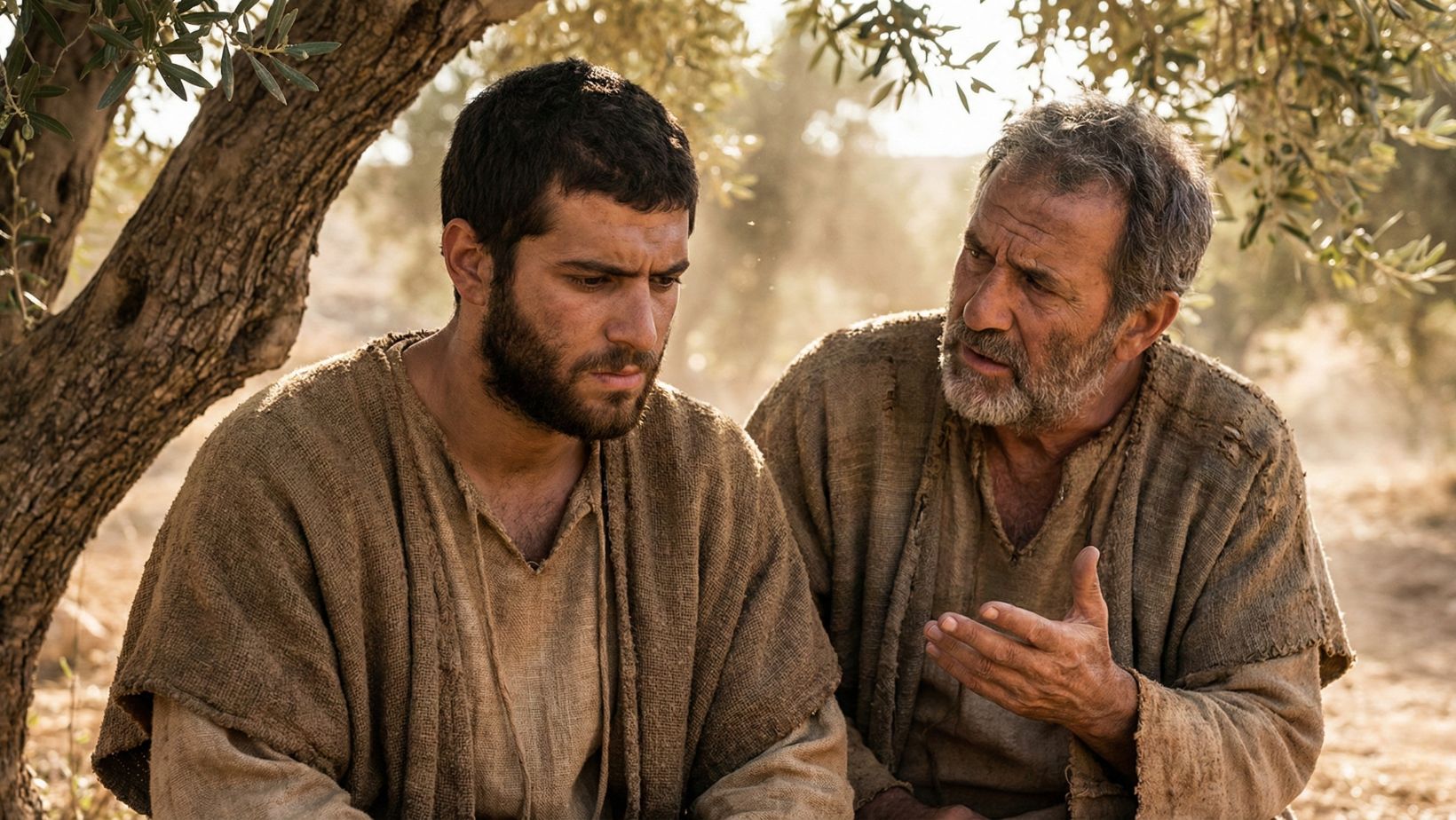
1 Samuel 10 marks a pivotal moment in Israel’s history: the private anointing of its first king, Saul. The chapter begins with the prophet Samuel secretly anointing Saul, confirming God’s choice. Samuel then provides Saul with three specific signs to validate this divine calling, all of which come to pass, culminating in the Spirit of God coming upon Saul, causing him to prophesy. The narrative then shifts to Saul’s return home, where he conceals his new status from his family. The chapter concludes with the public selection of Saul by lot at Mizpah, where he is famously found hiding among the baggage, yet proclaimed king to the acclaim of the people.
1. The Uncle’s Inquiry and Saul’s Response (1 Samuel 10:14–16 NLT)
14 Later, Saul’s uncle asked him and his servant, “Where have you been?” “We were looking for the donkeys,” Saul replied, “but we couldn’t find them. So we went to Samuel.”
15 “Oh?” the uncle said. “What did Samuel say to you?”
16 “We found the donkeys,” Saul replied. “But Saul didn’t tell his uncle that Samuel had anointed him to be king.”
Commentary
The Interrogation (v. 14–15)
- The Uncle’s Identity: Scholars often identify this uncle as Ner, the father of Abner (who later becomes the commander of Saul’s army). If this is the case, the uncle is a significant political figure within the tribe of Benjamin, making his questioning more than just casual family chatter.
- The Question: The uncle asks, “Where have you been?” The phrasing implies a lengthy absence or an awareness that something significant has occurred. In a close-knit tribal society, the movements of a prominent young man like Saul would be noticed.
- The Mention of Samuel: Saul admits they went to see Samuel. In Israel, Samuel was a figure of immense authority—judge, prophet, and king-maker. Mentioning Samuel would immediately pique the uncle’s curiosity. The uncle presses, “What did Samuel say to you?” sensing that a meeting with the prophet involved more than just livestock.
The Partial Truth (v. 16)
- Focus on the Mundane: Saul answers the question about the donkeys: “We found the donkeys.” This is technically true; Samuel had informed him the donkeys were found (1 Samuel 10:2). By leading with this, Saul attempts to normalize the encounter, framing it as a successful errand rather than a coronation.
- The Great Omission: The text explicitly states, “But Saul didn’t tell his uncle that Samuel had anointed him to be king.” This is the crux of the verse. Saul omits the most earth-shattering news in the history of his nation—that the theocracy is shifting to a monarchy and he is the chosen ruler.
Motivations for Silence
- Humility (The Traditional View): Many classical commentators view this as evidence of Saul’s modesty. He had just been given the highest honor in the land but refused to boast about it. This aligns with his later reluctance when he hides among the baggage (v. 22).
- Insecurity and Fear: A more psychological reading suggests Saul was overwhelmed. The burden of kingship was immense, and the “matter of the kingdom” was politically dangerous. Announcing his kingship prematurely to a politically connected uncle could have sparked tribal jealousy, skepticism, or immediate conflict before Saul was publicly confirmed.
- Divine Restraint: There is a wisdom in his silence. Saul had the private anointing but not yet the public acclamation. To speak too soon might have looked like arrogance or madness. He waited for God to reveal what God had decided.
- Lack of Confidence: Throughout the narrative, Saul often displays a passive nature. He is led by his servant, questioned by his uncle, and later directed by Samuel. His silence may stem from a lack of internal conviction that he is truly capable of being king.
The Contrast of “Matter of the Kingdom”
- The Hebrew phrase used for “that Samuel had anointed him to be king” literally translates to “the matter of the kingdom.” This phrase creates a stark contrast between the “matter of the donkeys” (which Saul discusses freely) and the “matter of the kingdom” (which he keeps hidden). It highlights the tension between his old life as a farmer and his new life as a monarch.
Theological Significance
The Private vs. The Public Call
- This verse illustrates the gap between God’s private call and public commissioning. Just as David was anointed long before he wore the crown, and Jesus lived in obscurity before his public ministry, Saul experiences a period where he carries a divine secret. It teaches that a call from God often requires a season of incubation before manifestation.
The Burden of Leadership
- Saul’s silence underscores the weight of divine calling. It is not always a matter of immediate celebration; often, it is a burden that separates the called individual from their peers and family. The secret created a distance between Saul and his uncle, symbolizing how leadership often necessitates a degree of isolation.
The Sovereignty of Timing
- By not speaking, Saul allowed God’s plan to unfold on God’s terms. Had Saul announced his kingship immediately, he might have tried to seize power through human political maneuvering (or his uncle’s influence). By waiting, the public confirmation at Mizpah (v. 17-24) became a clear act of divine sovereignty rather than human ambition.
Practical Applications
Discretion is a Virtue
- Not everything God shows us or speaks to us is meant for immediate public consumption. There is wisdom in keeping spiritual experiences or future plans close to the chest until the proper time. As Mary “treasured up all these things and pondered them in her heart” (Luke 2:19), we too must learn when to speak and when to stay silent.
Avoiding Premature Announcement
- Saul’s silence prevented unnecessary conflict or skepticism. Often, sharing a vision before it has matured can invite criticism that kills the vision. We should allow our character to grow to match our calling before we announce our titles.
Focusing on the “Kingdom” not the “Donkeys”
- While Saul spoke of the donkeys, his mind was surely on the kingdom. We often have to engage in the mundane tasks of life (jobs, chores, obligations) while carrying a greater purpose in our hearts. We must be faithful in the small things (finding donkeys) even when we know we are destined for greater things.
Final Insight
1 Samuel 10:16 captures the precise moment of transition where the ordinary meets the extraordinary. Saul stands before his family looking like the same man who left to find livestock, but internally he is the Anointed One. The verse serves as a reminder that God’s work is often invisible to the outside observer until the appointed time of revelation. We never truly know the divine secrets the people around us might be carrying.







Leave a Reply