
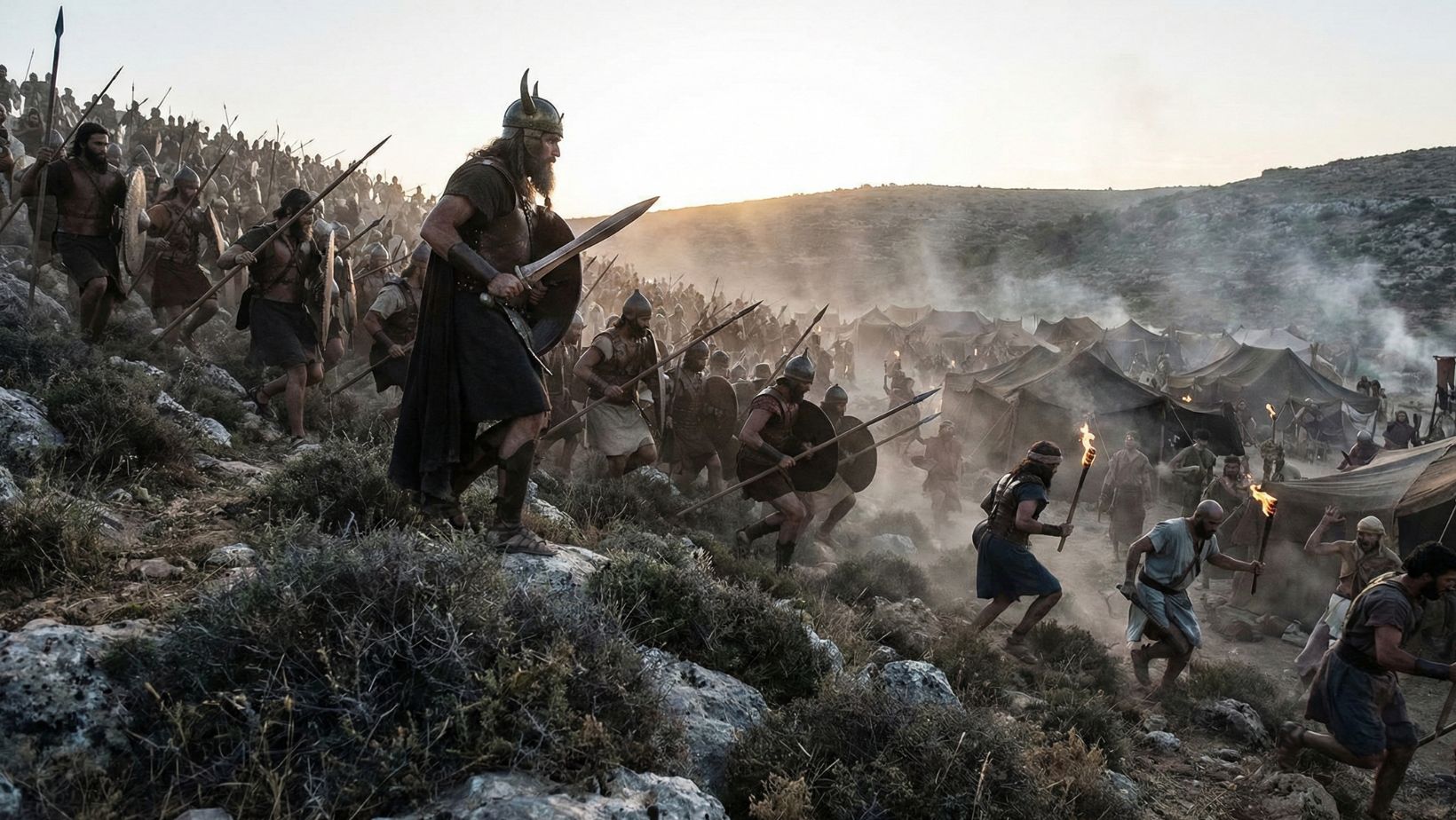
1 Samuel 11 is the action-packed sequel to Saul’s coronation. While Chapter 10 gave Saul the title of king, Chapter 11 gives him the validity. The narrative begins with a brutal siege by Nahash the Ammonite against the Israelite city of Jabesh-gilead. When the terrifying news reaches Saul, the “farm boy king” is transformed by the Spirit of God into a “warrior king.” He rallies the fragmented tribes into a unified army of 330,000 men and delivers a crushing defeat to the Ammonites. The victory silences Saul’s critics, and the chapter concludes with a joyful ceremony at Gilgal where the monarchy is reaffirmed, solidifying Saul’s rule.
1. The Cruel Ultimatum (1 Samuel 11:1–3 NLT)
1 About a month later, Nahash the Ammonite led his army against the Israelite town of Jabesh-gilead. But all the citizens of Jabesh asked for peace. “Make a treaty with us,” they pleaded, “and we will be your servants.” 2 “I’ll make a treaty with you only on one condition,” Nahash replied. “I will gouge out the right eye of every one of you! That way I will bring disgrace on all Israel.” 3 “Give us seven days to send messengers throughout Israel!” replied the elders of Jabesh. “If no one comes to save us, we will surrender to you.”
Commentary:
- The Aggressor (v. 1): Nahash (whose name means “Serpent”) was the king of the Ammonites, enemies to the east. The Septuagint and Dead Sea Scrolls suggest he had been oppressing the Gadites and Reubenites for some time before this.
- Jabesh-gilead (v. 1): Located east of the Jordan River.
- The Brutal Condition (v. 2): Nahash demands the gouging out of the right eye.
- Military Strategy: In ancient warfare, a soldier held his shield with the left arm, covering the left eye. He needed his right eye to aim and fight. Blindness in the right eye effectively disarmed the entire male population.
- Psychological Warfare: The goal was “disgrace.” Nahash wanted a city of one-eyed slaves as a living billboard of Israel’s weakness.
- The Seven Days (v. 3): Nahash’s arrogance is staggering. He allows them seven days to find help, fully confident that Israel is too disjointed and leaderless to mount a rescue.
2. The Spirit of Anger (1 Samuel 11:4–8 NLT)
4 When the messengers arrived at Gibeah, Saul’s hometown, and told the people about their plight, everyone broke into tears. 5 Saul had been plowing a field with his oxen, and when he returned to town, he asked, “What’s the matter? Why is everyone crying?” So they told him about the message from Jabesh. 6 Then the Spirit of God came powerfully upon Saul, and he became very angry. 7 He took two oxen and cut them into pieces and sent the messengers to carry them throughout Israel with this message: “This is what will happen to the oxen of anyone who refuses to follow Saul and Samuel into battle!” And the fear of the Lord fell on the people, and they turned out with one accord. 8 When Saul mobilized them at Bezek, he found that there were 300,000 men from Israel and 30,000 from Judah.
Commentary:
- The Farmer King (v. 5): Despite being crowned in Chapter 10, Saul is still “plowing a field.” There is no standing army and no royal bureaucracy. He is a king in name only until this moment.
- Holy Anger (v. 6): “The Spirit of God… he became very angry.”
- Anger is often sinful, but here it is a fruit of the Spirit. It is righteous indignation—a refusal to tolerate the abuse of God’s people. Passivity in the face of evil is not a virtue.
- The Bloody Summons (v. 7): Saul cuts up his livelihood (the oxen).
- Echo of Judges: This mirrors the gruesome Levite in Judges 19 who cut up his concubine to rally the tribes. Saul uses oxen instead of a human body, signaling a move from chaos to ordered leadership, but the visceral message remains: “Join or be destroyed.”
- “Saul and Samuel”: Saul wisely links his name with the respected prophet to legitimize his command.
- Unity (v. 7): “The fear of the Lord fell on the people.” For the first time in centuries (since Joshua), the tribes acted with “one accord.”
- The Muster (v. 8): 330,000 men gather at Bezek. This massive turnout vindicates the decision to have a king.
3. The Rescue Mission (1 Samuel 11:9–11 NLT)
9 So they sent the messengers back to Jabesh-gilead to say, “We will rescue you by noontime tomorrow!” There was great joy throughout the town when that message arrived! 10 The men of Jabesh then told their enemies, “Tomorrow we will come out to you, and you can do to us whatever you wish.” 11 But before dawn the next morning, Saul arrived with his army divided into three detachments. He attacked the Ammonites and slaughtered them until high noon. The rest of the Ammonites were scattered so severely that no two of them were left together.
Commentary:
- The Deception (v. 10): The men of Jabesh play along with Nahash’s timeline. “We will come out to you” sounds like surrender, lulling the Ammonites into a false sense of security.
- Tactical Brilliance (v. 11): Saul proves to be a capable general.
- Forced March: He marches his army from Bezek to Jabesh (approx. 10-15 miles, crossing the Jordan river) overnight.
- Three Detachments: He splits his forces to surround the enemy camp.
- The Morning Watch: Attacking “before dawn” (approx. 3:00 AM – 6:00 AM) caught the Ammonites sleeping and unprepared.
- Total Victory (v. 11): The siege is broken, and the enemy is not just defeated but “scattered.”
4. Mercy and Renewal (1 Samuel 11:12–15 NLT)
12 Then the people exclaimed to Samuel, “Where are those men who said, ‘Why should Saul be our king?’ Bring them here and we will kill them!” 13 But Saul replied, “No one will be executed today, for today the Lord has rescued Israel!” 14 Then Samuel said to the people, “Come, let us all go to Gilgal to renew the kingdom.” 15 So they all went to Gilgal, and in a solemn ceremony they made Saul king in the presence of the Lord. There they sacrificed peace offerings to the Lord, and Saul and all the Israelites were filled with joy.
Commentary:
- The Mob’s Reaction (v. 12): Success breeds loyalty. The people remember the “scoundrels” from Chapter 10:27 and want to execute them for treason.
- Saul’s Amnesty (v. 13): This is arguably Saul’s finest moment as a leader.
- He refuses to mar the victory with civil bloodshed.
- Theological Correctness: He gives credit where it is due: “The Lord has rescued Israel.” He recognizes he was just the instrument.
- Gilgal (v. 14): A site of historical beginnings (where Israel first camped after crossing the Jordan).
- “Renew the Kingdom” (v. 14): The kingship is ratified. What was done in private (anointing) and in dispute (Mizpah) is now confirmed in unity (Gilgal). Saul is now undeniably the King.
Theological Significance of 1 Samuel 11
- The Spirit as Warrior: The Holy Spirit does not just inspire prophecy or prayer; He inspires action and warfare against evil. Saul’s transformation shows that God equips leaders with the specific “fire” needed for the crisis at hand.
- Salvation belongs to the Lord: Even though Saul gathered the army and devised the strategy, he correctly identifies Yahweh as the Savior (v. 13). Human agency and Divine sovereignty work together.
- Unity through Leadership: Israel was fractured and vulnerable to abuse. Godly leadership (Saul empowered by the Spirit) unified the body to protect its weakest members (Jabesh).
Practical Applications
- Righteous Anger: There is a time to be angry. When we see injustice, abuse, or the enemy mocking God’s people, apathy is a sin. We should let “holy anger” move us to constructive action (prayer, advocacy, intervention).
- Defending the Vulnerable: The men of Jabesh were ready to submit to a horrific disability. The rest of Israel could have said, “That’s their problem, they are on the other side of the Jordan.” Instead, they risked their lives for their brothers. We are called to bear one another’s burdens.
- Grace in Victory: When we succeed or are vindicated, the temptation is to crush those who doubted us (the “scoundrels”). Saul teaches us to show mercy. The best revenge is not execution, but the undeniable evidence of God’s favor.
Final Insight
1 Samuel 11 is the high-water mark of Saul’s reign. He acts decisively, fights bravely, and forgives freely. It stands as a tragic “what could have been.” It shows that when Saul relied on the Spirit, he was the king Israel dreamed of. The tragedy is that he would soon trade this reliance on the Spirit for reliance on himself.







Leave a Reply