
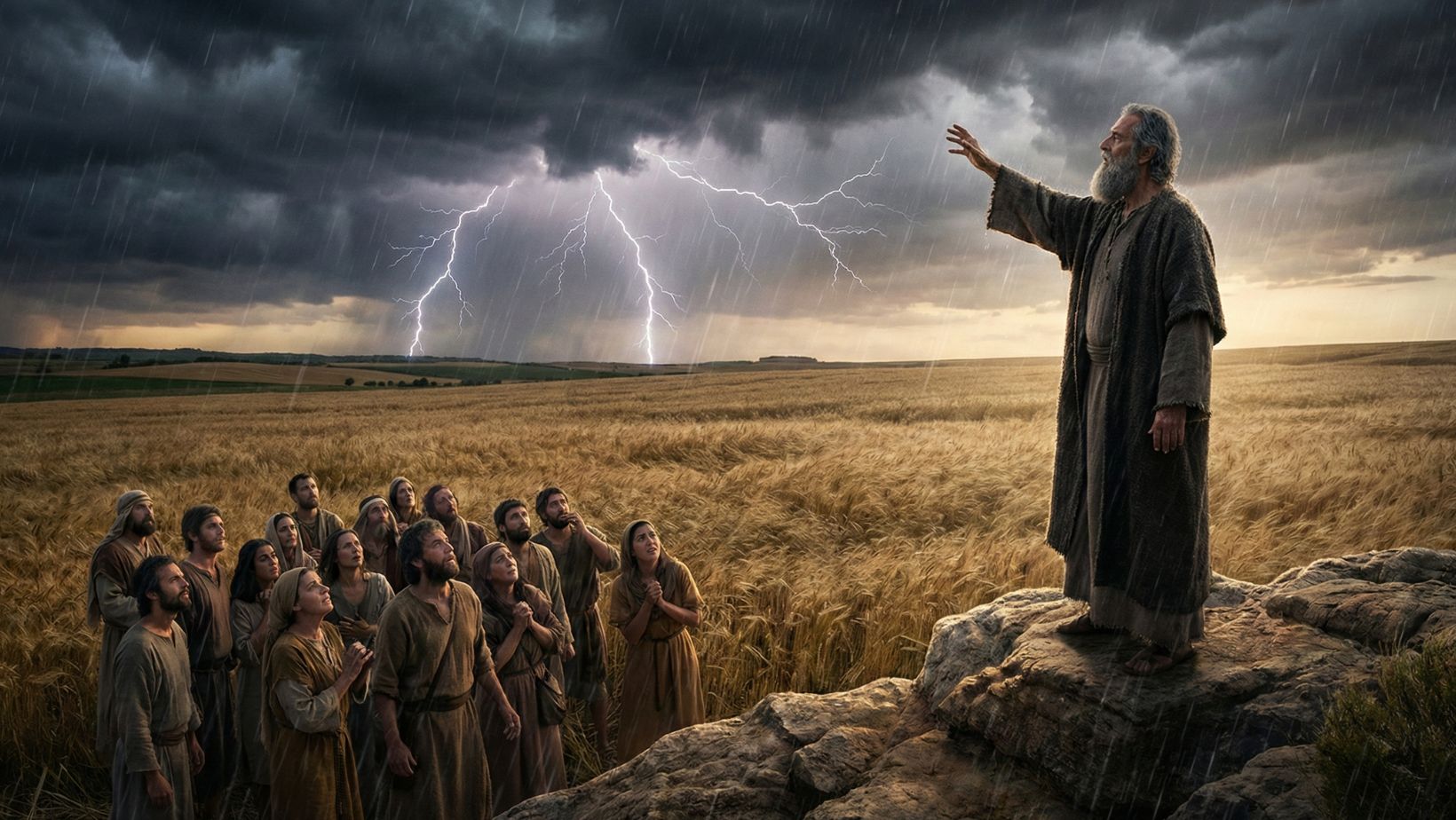
1 Samuel 12 serves as Samuel’s formal farewell address to the nation as their political leader. Having successfully installed Saul as king (confirmed in Chapter 11), Samuel transitions the nation from the era of the Judges to the era of the Monarchy. In this speech, often called a “covenant lawsuit” (Rib), Samuel vindicates his own integrity, reviews Israel’s history of rebellion, and calls down a miraculous storm during the dry season to prove that their demand for a king was indeed evil. However, he concludes with a message of profound hope: God will not abandon His people for the sake of His own name, provided they—and their new king—remain faithful.
1. Samuel’s Vindication (1 Samuel 12:1–5 NLT)
1 Then Samuel addressed all Israel: “I have done as you asked and given you a king. 2 Your king is now your leader. I stand here before you—an old, gray-haired man—and my sons are with you. I have served as your leader from the time I was a boy to this very day. 3 Now testify against me in the presence of the Lord and before his anointed one. Whose ox or donkey have I stolen? Have I ever cheated any of you? Have I ever oppressed you? Have I ever taken a bribe and perverted justice? Tell me and I will make right whatever I have done wrong.” 4 “No,” they replied, “you have never cheated or oppressed us, and you have never taken even a single bribe.” 5 “The Lord and his anointed one are my witnesses today,” Samuel declared, “that my hands are clean.” “Yes, he is a witness,” they replied.
Commentary:
- The Transition (v. 1-2): Samuel acknowledges the new reality: “Your king is now your leader.” He refers to himself as “old, gray-haired.” This is a peaceful transfer of power, rare in the ancient world.
- Public Audit (v. 3): Samuel opens himself to public scrutiny. He asks specific questions regarding abuse of power:
- Economic Exploitation: “Whose ox… have I stolen?”
- Judicial Corruption: “Taken a bribe?”
- This stands in stark contrast to the warning in 1 Samuel 8, where Samuel warned that a king would take their oxen, donkeys, and money. Samuel is effectively saying, “I never took from you, but the king you asked for will.”
- “His Anointed One” (v. 3): This refers to Saul (the Mashiach). Samuel elevates Saul’s status by making him a legal witness alongside Yahweh.
- Clean Hands (v. 5): Samuel steps down with his reputation intact. This gives him the moral authority to rebuke them in the next section. He is not speaking out of bitterness, but out of righteousness.
2. A History of Deliverance and Rebellion (1 Samuel 12:6–12 NLT)
6 Then Samuel said to the people, “It was the Lord who appointed Moses and Aaron and who brought your ancestors up from the land of Egypt. 7 Now stand here quietly before the Lord as I remind you of all the great things the Lord has done for you and your ancestors. 8 “When the Israelites were in Egypt and cried out to the Lord, he sent Moses and Aaron to rescue them from Egypt and to bring them into this land. 9 But the people soon forgot the Lord their God, so he handed them over to Sisera, the commander of Hazor’s army, and to the Philistines and to the king of Moab, who fought against them. 10 “Then they cried to the Lord again and confessed, ‘We have sinned by turning away from the Lord and worshiping the images of Baal and Ashtoreth. But if you will rescue us from our enemies, we will worship you.’ 11 Then the Lord sent Gideon, Bedan, Jephthah, and Samuel to save you, and you lived in safety. 12 “But when you saw that Nahash, king of the Ammonites, was moving against you, you said to me, ‘No, we want a king to reign over us,’ even though the Lord your God was already your king.
Commentary:
- The Courtroom Setting (v. 7): “Stand here… as I remind you.” Samuel acts as the prosecuting attorney. The evidence is history.
- The Cycle of Judges (v. 9-11): Samuel recaps the pattern of the Book of Judges:
- Who is “Bedan”? (v. 11): This name does not appear in the Book of Judges. Most scholars believe it is a copyist error for Barak (associated with Sisera) or Abdon, or possibly a nickname for Samson (meaning “Son of Dan”). The Septuagint reads “Barak.”
- “And Samuel” (v. 11): Samuel includes himself in the list of deliverers. He is reminding them that his leadership was successful—God saved them through him (e.g., Ebenezer in Ch 7).
- The Real Reason (v. 12): Samuel reveals that the demand for a king was triggered by fear of Nahash the Ammonite. They didn’t trust God to handle the Ammonite threat (even though God did handle it in Ch 11), so they panic-requested a king.
3. The Condition and the Sign (1 Samuel 12:13–19 NLT)
13 “Now here is the king you chose, the one you asked for. Look, the Lord has set a king over you. 14 If you fear the Lord and serve him and listen to his voice and do not rebel against his commands, and if you and your king follow the Lord your God, then all will be well. 15 But if you do not listen to the Lord’s commands and if you rebel against them, the Lord will be against you and your king. 16 “Now stand here and see the great thing the Lord is about to do. 17 You know that it does not rain at this time of the year during the wheat harvest. I will ask the Lord to send thunder and rain today. Then you will realize how wicked you have been in asking the Lord for a king!” 18 So Samuel called to the Lord, and the Lord sent thunder and rain that same day. And all the people were terrified of the Lord and of Samuel. 19 “Pray to the Lord your God for us, or we will die!” they all said to Samuel. “For now we have added to our sins by asking for a king.”
Commentary:
- The “If… Then” Clause (v. 14-15): The monarchy does not replace the Covenant; it is subject to it.
- The Miracle of Rain (v. 17):
- The Confession (v. 19): The thunder works. The people finally admit the specific sin: “We have added to our sins by asking for a king.” They realize that the political shift was a spiritual rebellion.
4. Comfort and Commitment (1 Samuel 12:20–25 NLT)
20 “Don’t be afraid,” Samuel reassured them. “You have certainly done wrong, but make sure now that you worship the Lord with all your heart, and don’t turn your back on him. 21 Don’t go back to worshiping worthless idols that cannot help or rescue you—they are totally useless! 22 The Lord will not abandon his people, because that would bring dishonor to his great name. For it has pleased the Lord to make you his very own people. 23 “As for me, far be it from me that I should sin against the Lord by failing to pray for you. And I will continue to teach you the good and right way. 24 But be sure to fear the Lord and faithfully serve him. Think of all the wonderful things he has done for you. 25 But if you continue to sin, you and your king will be swept away.”
Commentary:
- Grace for the Future (v. 20): “You have certainly done wrong… but…”
- Idols are “Useless” (v. 21): The Hebrew word used here is tohu (empty/nothingness). Samuel reminds them that only Yahweh has power.
- God’s Reputation (v. 22): Why won’t God wipe them out? “For the sake of his great name.” God’s reputation is tied to Israel’s survival. If they perish, His name is dishonored among the nations.
- The Sin of Prayerlessness (v. 23): This is one of the most famous verses on intercession.
- The Final Warning (v. 25): “Swept away.” The monarchy is not eternal. If they persist in sin, the system they begged for will be destroyed (prophesying the eventual Exile).
Theological Significance of 1 Samuel 12
- The Continuity of Covenant: Even though the form of government changed (Theocracy to Monarchy), the foundation did not. Obedience to God’s Word remains the only guarantee of national security.
- Prayer as Ministry: Samuel models that when active leadership ends, the ministry of prayer begins. A leader’s greatest work is often done on their knees, not the podium.
- God’s Commitment to His Name: Our security rests not on our performance, but on God’s jealous love for His own reputation. He saves us because “it pleased the Lord to make you his very own.”
Practical Applications
- Finishing Well: Samuel’s ability to ask “Whose ox have I taken?” challenges every leader. Can we reach the end of a tenure (job, ministry, parenting season) with a clear conscience? Integrity is built daily.
- Moving Past “Plan B”: Israel chose “Plan B” (a king). God didn’t leave them; He blessed them within Plan B, provided they obeyed. We may have made life choices that weren’t God’s “perfect” will, but we can still serve Him faithfully from where we are.
- The Duty to Pray: We often say, “I’ll pray for you” as a filler. Samuel saw it as a binding duty. We should take our role as intercessors for our families and churches as seriously as our active work.
Final Insight
1 Samuel 12 closes the door on the era of the Judges. It is a chapter of thunder and grace. The thunder proved that God was not to be trifled with, but the grace proved that God was not to be abandoned. The people have their king, but Samuel reminds them that the King has them.







Leave a Reply