
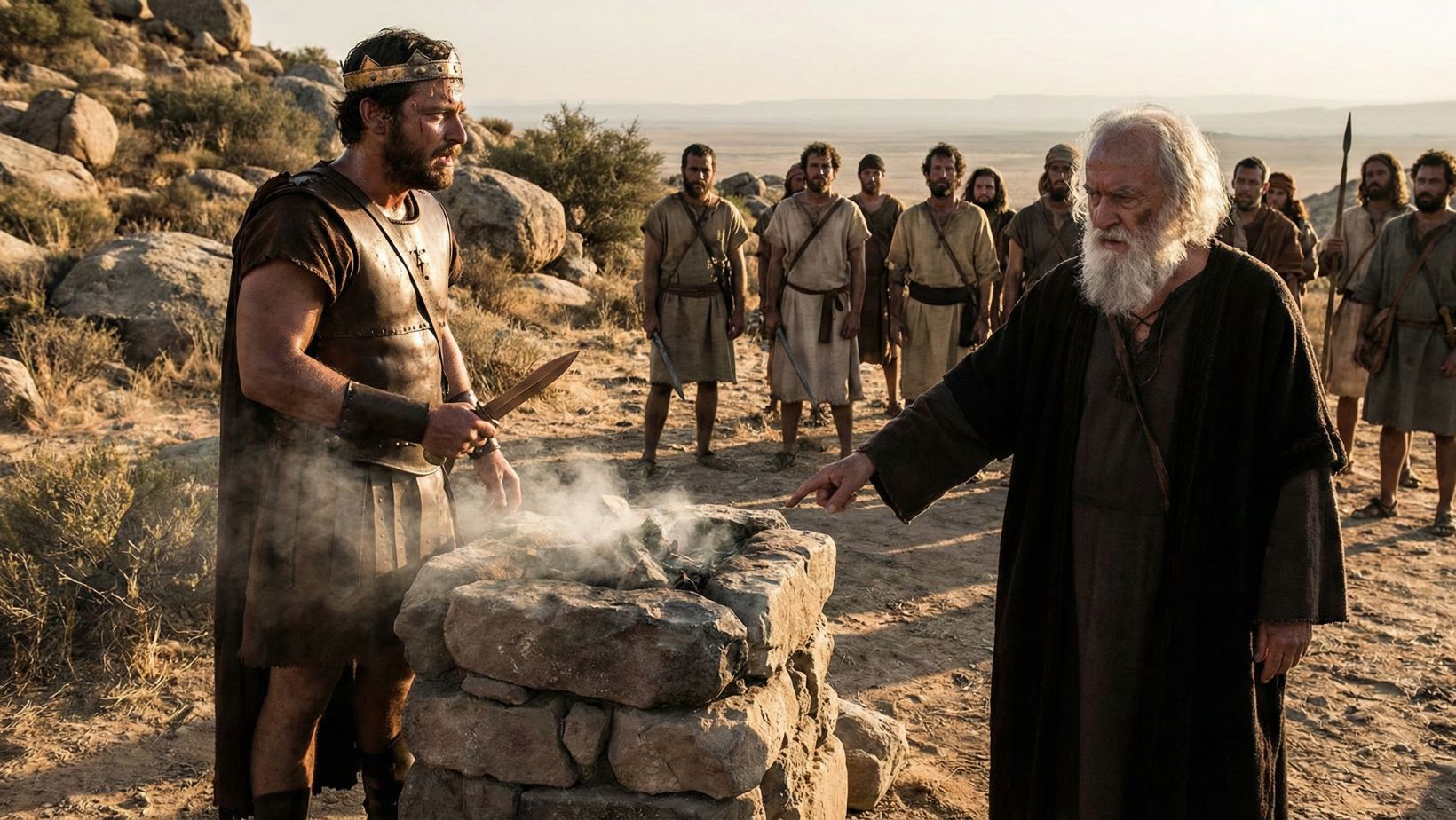
1 Samuel 13 details the first major failure of King Saul, marking the beginning of the end for his dynasty. The narrative opens with military tension as Saul’s son, Jonathan, attacks a Philistine outpost, triggering a massive retaliation. Facing an overwhelming enemy force and a deserting army, Saul succumbs to fear and impatience. He unlawfully assumes the priestly role to offer a sacrifice before battle, directly violating Samuel’s earlier command. Samuel arrives immediately after the act, rebuking Saul and prophesying that his kingdom will be torn away and given to a “man after God’s own heart.” The chapter concludes by highlighting Israel’s dire military disadvantage: they possess almost no metal weapons due to a Philistine monopoly on blacksmithing.
1. The Revolt and the Philistine Response (1 Samuel 13:1–7 NLT)
1 Saul was thirty years old when he became king, and he reigned for forty-two years. 2 Saul selected 3,000 special troops from the army of Israel and sent the rest of the men home. He took 2,000 with him to Michmash and the hill country of Bethel, and 1,000 went with his son Jonathan to Gibeah in the land of Benjamin. 3 Soon after this, Jonathan attacked and defeated the garrison of Philistines at Geba. The news spread quickly among the Philistines. So Saul blew the ram’s horn throughout the land, saying, “Hebrews, hear this!” 4 And all Israel heard the news that Saul had destroyed the Philistine garrison and that the Philistines now hated the Israelites. So the entire Israelite army was summoned to join Saul at Gilgal. 5 The Philistines mustered a mighty army of 3,000 chariots, 6,000 charioteers, and as many soldiers as the sand on the seashore. They camped at Michmash, which is east of Beth-aven. 6 When the men of Israel saw that they were in trouble and that their troops were totally outnumbered, they hid in caves and thickets and among the rocks and in holes and cisterns. 7 Some of the Hebrews even crossed the Jordan River to the land of Gad and Gilead. Meanwhile, Saul stayed at Gilgal, and his men were trembling with fear.
Commentary:
- Textual Note (v. 1): The Hebrew text here is damaged/difficult. It literally reads “Saul was a year old when he began to reign.” Most translations (like NLT) supply numbers (30 years old, 42-year reign) based on context and Greek manuscripts (Septuagint) or Acts 13:21.
- Jonathan’s Initiative (v. 3): This is the introduction of Jonathan, Saul’s son. While Saul is cautious, Jonathan is the aggressor. He strikes the garrison at Geba.
- Overwhelming Odds (v. 5): The Philistine response is “shock and awe.”
- 3,000 Chariots: Some manuscripts say 30,000, but 3,000 is historically more likely (still a massive force). Chariots were the “tanks” of the ancient world.
- Total Panic (v. 6-7): The Israelite army disintegrates. They hide in “holes and cisterns” (empty water tanks). Some even flee across the Jordan river. The phrase “trembling with fear” sets the stage for Saul’s test.
2. The Unlawful Sacrifice (1 Samuel 13:8–12 NLT)
8 Saul waited there seven days for Samuel, as Samuel had instructed him earlier, but Samuel still didn’t come. Saul realized that his troops were rapidly slipping away. 9 So he demanded, “Bring me the burnt offering and the peace offerings!” And Saul sacrificed the burnt offering himself. 10 Just as Saul was finishing with the burnt offering, Samuel arrived. Saul went out to meet and welcome him, 11 but Samuel said, “What is this you have done?” Saul replied, “I saw my men scattering from me, and you didn’t arrive when you said you would, and the Philistines are at Michmash ready for battle. 12 So I said, ‘The Philistines are ready to march against us at Gilgal, and I haven’t even asked for the Lord’s help!’ So I felt compelled to offer the burnt offering myself before you came.”
Commentary:
- The Test of Time (v. 8): In 1 Samuel 10:8, Samuel commanded Saul to wait seven days at Gilgal. This was a test of obedience under pressure.
- “Samuel still didn’t come”: Samuel likely waited until the very last hour of the seventh day to test Saul’s faith.
- Saul’s Pragmatism (v. 9): Saul acts on logic, not faith. Logic dictates that you need an offering to win a battle (superstition), and you need to act fast to stop the desertion (strategy).
- The Sin: It was not just that Saul offered a sacrifice (kings occasionally did participate in worship), but that he:
- The Excuses (v. 11-12): When confronted, Saul blames three things:
- The People: “My men scattering.”
- The Prophet: “You didn’t arrive.”
- The Circumstances: “Philistines are ready.”
- He claims he “felt compelled” (forced). He takes no personal responsibility.
3. The Rejection of the Dynasty (1 Samuel 13:13–15 NLT)
13 “How foolish!” Samuel exclaimed. “You have not kept the command the Lord your God gave you. Had you kept it, the Lord would have established your kingdom over Israel forever. 14 But now your kingdom must end, for the Lord has sought out a man after his own heart. The Lord has already appointed him to be the leader of his people, because you have not kept the Lord’s command.” 15 Samuel then left Gilgal and went on his way, but the rest of the troops went with Saul to meet the army. They went up from Gilgal to Gibeah in the land of Benjamin. When Saul counted the men who were still with him, he found only 600.
Commentary:
- “How foolish” (v. 13): In the Bible, a “fool” is not someone unintelligent, but someone morally deficient who disregards God’s Word.
- The Consequences (v. 14):
- “After his own heart”: This phrase is often misunderstood. It does not mean “sinless” (David committed adultery and murder). It means a man whose heart is aligned with God’s will, who obeys God’s commands (unlike Saul), and who trusts God’s timing (unlike Saul).
- The Remnant (v. 15): Saul started with 330,000 men (Ch 11), selected 3,000 (Ch 13:2), and is now left with only 600. His disobedience caused the very thing he feared—the loss of his army.
4. The Disarmed Nation (1 Samuel 13:16–23 NLT)
16 Saul and his son Jonathan and the men with them were staying at Geba in the land of Benjamin. The Philistines set up their camp at Michmash. 17 Three raiding parties soon left the camp of the Philistines. One went north toward Ophrah in the land of Shual, 18 another went west to Beth-horon, and the third moved toward the border above the valley of Zeboim near the wilderness. 19 There were no blacksmiths in the land of Israel in those days. The Philistines wouldn’t allow them for fear they would make swords and spears for the Hebrews. 20 So whenever the Israelites needed to sharpen their plowshares, picks, axes, or sickles, they had to take them to a Philistine blacksmith. 21 The charges were one small silver coin for sharpening axes and sickles and plowshares, and for fixing goads. 22 So on the day of the battle none of the people of Israel had a sword or spear, except for Saul and Jonathan. 23 The pass at Michmash had meanwhile been secured by a contingent of the Philistine army.
Commentary:
- Raiding Parties (v. 17-18): While Saul sits paralyzed with his 600 men, the Philistines freely pillage the country in three directions.
- The Iron Monopoly (v. 19): This is a fascinating historical detail. We are in the transition from the Bronze Age to the Iron Age. The Philistines (Sea Peoples) possessed the technology for smelting iron; the Israelites did not.
- Gun Control: This was an ancient form of arms control. By killing or removing all Israelite blacksmiths, the Philistines ensured the Hebrews remained an agricultural vassal state, unable to revolt.
- Economic Dependency (v. 20-21): Not only were they disarmed, but they were economically exploited. They had to pay their enemies just to sharpen their farming tools.
- “Only Saul and Jonathan” (v. 22): The situation is militarily hopeless. Two swords against thousands of chariots. This sets the stage for the miraculous victory in Chapter 14, emphasizing that salvation comes from God, not military hardware.
Theological Significance of 1 Samuel 13
- Faith vs. Pragmatism: Saul represents the pragmatic believer who trusts God only until the situation gets “too dangerous.” True faith waits on God even when the “men are scattering.”
- The Nature of Worship: God desires obedience more than sacrifice (a theme Samuel reiterates in Ch 15). Saul thought the ritual of burning an animal would save him, regardless of his heart or obedience. God rejects mechanical religion.
- Qualifications for Leadership: The “Man after God’s own heart” is defined here by contrast to Saul. God is looking for leaders who fear Him more than they fear the people or the enemy.
Practical Applications
- Waiting on God: The “seventh day” test is common in the Christian life. God often waits until the last moment to act to test our trust. Will we take matters into our own hands (Ishmael/Saul), or wait for the promise (Isaac/David)?
- Excuses in Sin: When we mess up, do we own it (“I have sinned”), or do we blame our circumstances (“The traffic was bad,” “I was stressed,” “They made me do it”)? Saul’s excuses sealed his fate.
- God Uses the Weak: The chapter ends with a hopeless picture—600 men and 2 swords. Yet, this is exactly the setup God uses to show His glory in the next chapter. Our lack of resources is never a hindrance to God.
Final Insight
1 Samuel 13 is the tragedy of a man who thought he could manage God. Saul viewed God as a resource to be utilized rather than a King to be obeyed. In trying to save his kingdom through disobedience, he lost it. It stands as a warning that the ends (victory) never justify the means (disobedience).







Leave a Reply