
1 Samuel 14 contrasts the bold, active faith of Jonathan with the fearful, rash leadership of Saul. While Saul sits under a pomegranate tree with a diminished army, Jonathan and his armor-bearer single-handedly initiate an attack on a Philistine outpost, declaring that God is not limited by numbers. Their faith triggers a supernatural earthquake and panic, routing the Philistines. However, the victory is marred by Saul’s foolish vow forbidding his soldiers to eat, which weakens the army and nearly leads to the execution of the war hero, Jonathan. The chapter serves as a character study: Jonathan brings deliverance through faith, while Saul brings trouble through legalism and insecurity.
1. Jonathan’s Audacious Faith (1 Samuel 14:1–7 NLT)
1 One day Jonathan son of Saul said to his young armor-bearer, “Come on, let’s go over to the Philistine outpost on the other side.” But Jonathan did not tell his father. 2 Saul and his 600 men were camped on the outskirts of Gibeah, around the pomegranate tree at Migron. 3 Among the men was Ahijah the priest, who was wearing the ephod, the priestly vest. Ahijah was the son of Ichabod’s brother Ahitub, son of Phinehas, son of Eli, the priest of the Lord who had served at Shiloh. No one realized that Jonathan had left the Israelite camp. 4 To reach the Philistine outpost, Jonathan had to go down between two rocky cliffs that were called Bozez and Seneh. 5 The cliff on the north was in front of Michmash, and the one on the south was in front of Geba. 6 “Let’s go across to the outpost of those pagans,” Jonathan said to his armor-bearer. “Perhaps the Lord will help us, for nothing can hinder the Lord. He can save by many or by few.” 7 “Do what you think is best,” the armor-bearer replied. “I’m with you completely, whatever you decide.”
Commentary:
- The Contrast (v. 1-2): The scene shifts between two leaders.
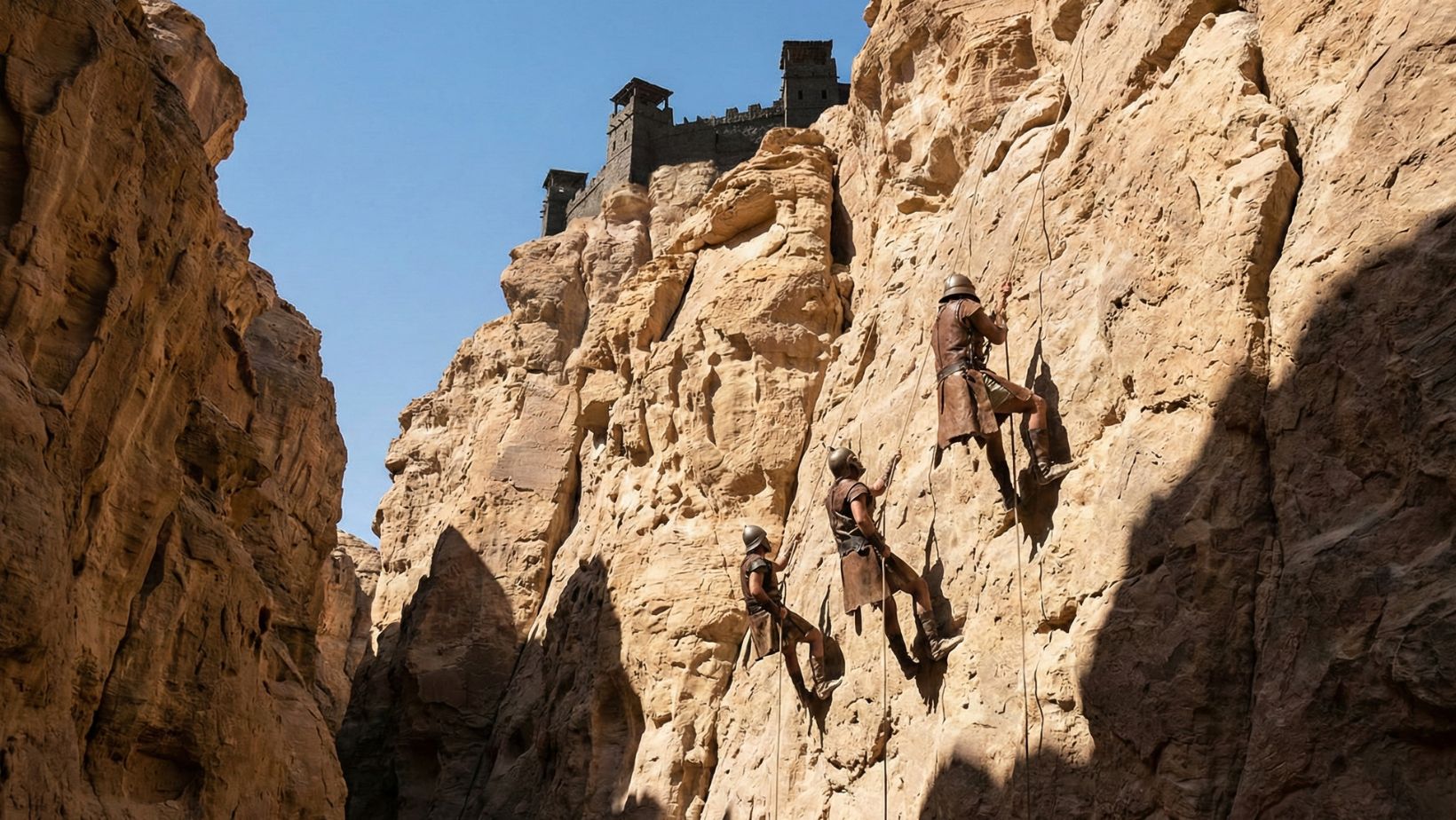
- The Geography (v. 4-5): The cliffs “Bozez” (Slippery/Shining) and “Seneh” (Thorny) formed a steep ravine. Militarily, this was a suicide mission—climbing a cliff into an enemy stronghold.
- The Theology of Faith (v. 6): This is one of the greatest statements of faith in the Old Testament.
- The Armor-Bearer (v. 7): This unnamed servant displays incredible loyalty and courage. He commits to follow Jonathan into death based solely on Jonathan’s faith.
2. The Sign and the Earthquake (1 Samuel 14:8–15 NLT)
8 “All right, then,” Jonathan told him. “We will cross over and let them see us. 9 If they say to us, ‘Stay where you are or we’ll kill you,’ then we will stop and not go up. 10 But if they say, ‘Come on up and fight,’ then we will go up. That will be the Lord’s sign that he will help us defeat them.” 11 When the Philistines saw them coming, they shouted, “Look! The Hebrews are crawling out of their holes!” 12 Then the men from the outpost shouted to Jonathan, “Come on up here, and we’ll teach you a lesson!” “Come on, climb right behind me,” Jonathan said to his armor-bearer, “for the Lord has betrayed them into the hands of Israel!” 13 So Jonathan climbed up using his hands and feet, and his armor-bearer followed him. The Philistines fell before Jonathan, and his armor-bearer killed those who came behind them. 14 They killed some twenty men in all, and their bodies were scattered over about half an acre. 15 Suddenly, panic broke out in the Philistine army, both in the camp and in the field, including even the outposts and raiding parties. And just then an earthquake struck, and everyone was terrified.
Commentary:
- The Proposed Sign (v. 9-10): Jonathan sets a condition.
- The Attack (v. 13): “Using his hands and feet.” They are literally crawling up the cliff face. It is an ambush from an impossible angle.
- The Supernatural Intervention (v. 15): Jonathan lights the match, but God causes the explosion.
- Panic: God sends a psychological terror upon the army.
- Earthquake: The ground shakes. The text calls it a “panic sent by God” (literally: “a trembling of God”). The physical earth joins the battle.
3. Saul’s Confusion and the Rash Vow (1 Samuel 14:16–23 NLT)
16 Saul’s lookouts in Gibeah of Benjamin saw a strange sight—the vast army of Philistines began to melt away in every direction. 17 “Call the roll and find out who’s missing,” Saul ordered. And when they checked, they found that Jonathan and his armor-bearer were gone. 18 Then Saul shouted to Ahijah, “Bring the ephod here!” For at that time Ahijah was wearing the ephod in front of the Israelites. 19 But while Saul was talking to the priest, the shouting and confusion in the Philistine camp grew louder and louder. So Saul said to the priest, “Never mind; let’s get going!” 20 Then Saul and all his men rushed out to the battle and found the Philistines killing each other. There was terrible confusion everywhere. 21 Even the Hebrews who had previously gone over to the Philistine side revolted and joined in with Saul, Jonathan, and the rest of the Israelites. 22 Likewise, the men of Israel who were hiding in the hill country of Ephraim joined the chase when they saw the Philistines running away. 23 So the Lord saved Israel that day, and the battle moved on beyond Beth-aven.
Commentary:
- Saul’s Reaction (v. 16-19): Saul is confused. He tries to be spiritual by calling for the Ark/Ephod (some texts say Ark, others Ephod; Ephod is more likely as it was used for inquiry).
- “Never mind” (v. 19): Literally “Withdraw your hand.” As the noise of battle gets louder, Saul gets impatient. He stops the prayer/inquiry mid-stream. He is driven by circumstances, not God.
- Friendly Fire (v. 20): The Philistines, in their panic, turn on each other. This confusion is a hallmark of Holy War (see Gideon in Judges 7).
- The Turncoats (v. 21): The Hebrews who had been drafted as mercenaries or slaves for the Philistines flip sides. The victory unifies the fragmented nation.
4. The Trouble with Honey (1 Samuel 14:24–30 NLT)
24 Now the men of Israel were pressed to exhaustion that day, because Saul had placed them under an oath, saying, “Let a curse fall on anyone who eats before evening—before I have full revenge on my enemies.” So no one ate a thing. 25 That day the people went into a forest and found honey dripping on the ground. 26 But no one dared touch the honey because they were afraid of the oath. 27 However, Jonathan had not heard his father’s command. So he dipped the end of his stick into a piece of honeycomb and ate the honey. After he ate it, he felt refreshed. 28 But one of the men saw him and said, “Your father made the army take a strict oath that anyone who eats food today will be cursed. That is why everyone is weary and faint.” 29 “My father has made trouble for us all!” Jonathan exclaimed. “A command like that only hurts us. See how refreshed I am now that I have eaten this little bit of honey. 30 If the men had been allowed to eat freely from the food they found among our enemies, think how many more we could have killed!”
Commentary:
- The Rash Vow (v. 24): Saul wants “full revenge.” His ego drives him to enforce a religious fast during a physical war.
- “My enemies”: Note the pronoun. Saul sees this as his personal war, not the Lord’s.
- The Cost of Legalism (v. 24): The army is “exhausted” (distressed). Saul’s rule weakens the people rather than empowering them.
- Jonathan’s Enlightenment (v. 27): “He felt refreshed” (literally: “his eyes brightened”). Physical sustenance gave him clarity and strength.
- Jonathan’s Rebuke (v. 29): “My father has made trouble for us” (literally: “troubled the land”). This is the same verb (achar) used for Achan in Joshua 7. Jonathan correctly identifies that Saul’s arbitrary rule prevented a greater victory.
5. Sin, Silence, and Rescue (1 Samuel 14:31–46 NLT)
31 They chased and killed the Philistines all day from Michmash to Aijalon, growing more and more faint. 32 That evening they rushed for the battle plunder and butchered the sheep, goats, and cattle and ate the meat with the blood still in it. 33 Someone reported to Saul, “Look, the men are sinning against the Lord by eating meat that still has blood in it.” “That is very wrong,” Saul said. “Find me a large stone and roll it over here. 34 …So that night each man brought his ox and slaughtered it there. 35 Then Saul built an altar to the Lord; it was the first one he had ever built. 36 Then Saul said, “Let’s chase the Philistines all night and plunder them until sunrise. Let’s destroy every last one of them.” …But the priest said, “Let’s ask God first.” 37 So Saul asked God, “Should I go after the Philistines? Will you help us defeat them?” But God made no reply that day. 38 Then Saul said to the leaders, “Something’s wrong! I want all my army commanders to come here. We must find out what sin was committed today. 39 I vow by the name of the Lord who rescued Israel that the sinner will surely die, even if it is my own son Jonathan!” But no one would say a word. 40 …Saul and Jonathan stood on one side, and everyone else stood on the other. 41 …And Jonathan and Saul were chosen by the lot, and the people were cleared of guilt. 42 Then Saul said, “Cast the lot between me and Jonathan my son.” And Jonathan was chosen. 43 “Tell me what you have done,” Saul demanded of Jonathan. “I tasted a little honey,” Jonathan admitted. “It was only a little bit on the end of my stick. Does that deserve death?” 44 “Yes, Jonathan,” Saul said. “You must die! May God strike me and even kill me if you do not die for this.” 45 But the people broke in and said to Saul, “Jonathan has won this great victory for Israel. Should he die? Far from it! As surely as the Lord lives, not one hair on his head will be touched, for God helped him do a great deed today.” So the people rescued Jonathan, and he was not put to death.
Commentary:
- Eating with Blood (v. 32): The famished soldiers, driven by Saul’s ban, break God’s law (Leviticus 17:10-14) by eating meat without properly draining the blood. Saul’s man-made rule caused them to break God’s eternal rule.
- God’s Silence (v. 37): Saul inquires of God, but the Urim and Thummim (sacred lots) yield no answer. The channel is blocked.
- The Irony of the Oath (v. 39): Saul swears another rash oath to kill the sinner, “even if it is Jonathan.” He unwittingly speaks a death sentence over his own son.
- The Lot (v. 41-42): God sovereignly controls the lot. It points to Jonathan. Technically, Jonathan broke the king’s vow, but morally, the vow was foolish.
- The People’s Veto (v. 45): This is a remarkable moment of democracy/populism. The people recognize that God was with Jonathan (“God helped him”), not Saul. They overrule the King’s death sentence. Saul is publicly humiliated; his authority is checked by the common sense of the crowd.
6. Summary of Saul’s Reign (1 Samuel 14:47–52 NLT)
47 Now that Saul had secured his grasp on Israel’s kingdom, he fought against his enemies in every direction… wherever he turned, he was victorious. 48 He performed great deeds and conquered the Amalekites… 49 Saul’s sons were Jonathan, Ishbosheth, and Malkishua. His daughters were Merab, the older, and Michal, the younger. 50 Saul’s wife was Ahinoam… The commander of Saul’s army was Abner… 52 The Israelites fought constantly with the Philistines throughout Saul’s lifetime. So whenever Saul saw a young man who was brave and strong, he drafted him into his army.
Commentary:
- Military Success (v. 47-48): Despite his spiritual failures, Saul was a competent military defender. He established borders and fought off surrounding enemies (Moab, Ammon, Edom).
- Family Tree (v. 49-50):
- Conscription (v. 52): The chapter ends by noting Saul’s habit of drafting strong men. This foreshadows the recruitment of David.
Theological Significance of 1 Samuel 14
- Faith vs. Presumption: Jonathan acts in faith (“Perhaps the Lord will help”), trusting God’s ability. Saul acts in presumption (“Cursed be he who eats”), trusting in religious severity.
- The Danger of Legalism: Saul represents leaders who impose heavy, non-biblical burdens on people to appear spiritual. This inevitably leads to spiritual exhaustion and stumbling (the soldiers eating blood).
- God’s Sovereignty: Even when the leadership is corrupt (Saul), God can still save His people through a faithful remnant (Jonathan). God is not held hostage by bad leadership.
Practical Applications
- Taking Initiative: Sometimes we wait for God to “move,” but God is waiting for us to step out in faith. Like Jonathan, we must be willing to climb the cliff, trusting that God can save “by many or by few.”
- Evaluating Rules: We must be careful not to make vows or rules that hinder God’s work or harm people (like Saul’s fasting order). Spiritual discipline should lead to life, not exhaustion.
- Recognizing God’s Hand: The people saved Jonathan because they saw that “he has worked with God this day.” We should support those who visibly bear the fruit of the Spirit, even if they run afoul of institutional bureaucracy.
Final Insight
1 Samuel 14 exposes the widening gap between the King and the Kingdom. Saul holds the office, but Jonathan holds the power of God. The chapter is a tragedy of leadership: Saul is so obsessed with enforcing his own authority that he almost kills the very son who secured his victory.







Leave a Reply