
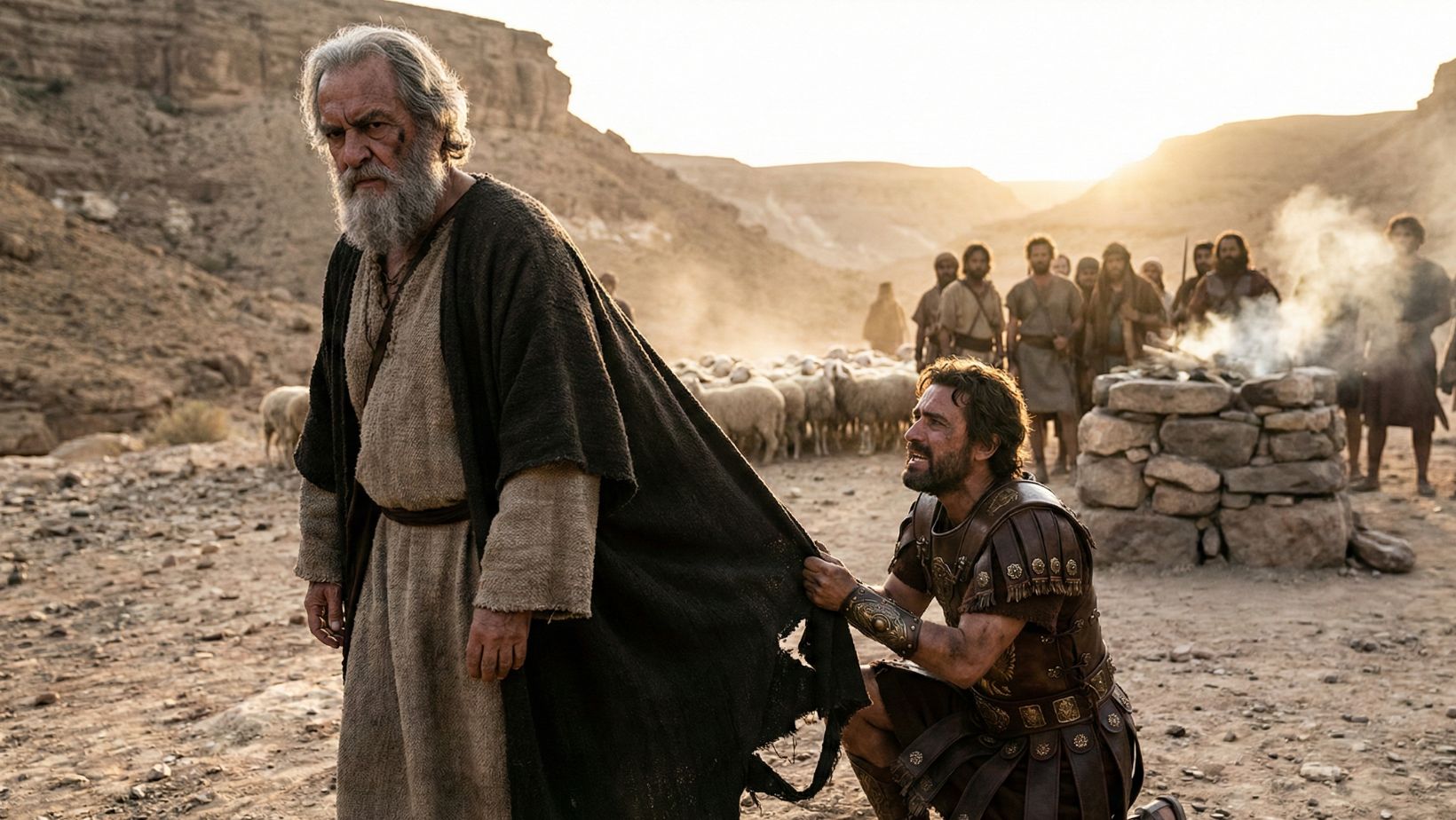
“As Samuel turned to go, Saul tried to hold him back and tore the hem of his robe.”
1 Samuel 15:27
1 Samuel 15 records the final, irrevocable rejection of Saul as King of Israel. It is a tragedy of partial obedience. God commissions Saul to execute judgment on the Amalekites, an ancient enemy of Israel. Saul achieves a great military victory but fails the spiritual test by sparing the opposing king (Agag) and the best livestock, presumably for a victory parade and a sacrificial feast. When confronted by Samuel, Saul shifts blame, justifies his sin with religious intent, and displays more concern for his reputation than his relationship with God. The chapter contains one of the most famous theological statements in the Old Testament: “To obey is better than sacrifice.”
1. The Divine Commission: Total Destruction (1 Samuel 15:1–3 NLT)
1 One day Samuel said to Saul, “It was the Lord who told me to anoint you as king of his people, Israel. Now listen to this message from the Lord! 2 This is what the Lord of Heaven’s Armies has declared: I have decided to settle accounts with the nation of Amalek for opposing Israel when they came from Egypt. 3 Now go and completely destroy the entire Amalekite nation—men, women, children, babies, cattle, sheep, goats, camels, and donkeys.”
Commentary:
- The Historical Vendetta (v. 2): The Amalekites were the first nation to attack Israel after the Exodus (Exodus 17:8–16). They cowardly targeted the stragglers—the weak and elderly—at the rear of the column (Deut 25:17–19). God had sworn to eventually blot them out; Saul is the instrument of that judgment 400 years later.
- Herem Warfare (v. 3): The command is to “completely destroy” (Hebrew: herem). This refers to the “ban” where everything is devoted to God through destruction. It was not for plunder; it was a divine execution.
- The Severity: The inclusion of children and animals is difficult for modern readers. Theologically, this was a specific judgment on a culture whose sin had reached “full measure” (Gen 15:16), preventing their corrupting influence on Israel.
2. Partial Obedience (1 Samuel 15:4–9 NLT)
4 So Saul mobilized his army at Telaim. There were 200,000 soldiers from Israel and 10,000 men from Judah. 5 Then Saul and his army went to a town of the Amalekites and lay in wait in the valley. 6 Saul sent this warning to the Kenites: “Move away from where the Amalekites live, or you will die with them. For you showed kindness to all the people of Israel when they came up from Egypt.” So the Kenites packed up and left. 7 Then Saul slaughtered the Amalekites from Havilah all the way to Shur, east of Egypt. 8 He captured Agag, the Amalekite king, but completely destroyed everyone else. 9 Saul and his men spared Agag’s life and kept the best of the sheep and goats, the cattle, the fat calves, and the lambs—everything, in fact, that appealed to them. They destroyed only what was worthless or of poor quality.
Commentary:
- Mercy to Kenites (v. 6): Saul shows he is capable of diplomacy and mercy. The Kenites (descendants of Moses’ father-in-law, Jethro) were allies.
- The Sin of Selection (v. 9):
- Agag: Sparing the king was likely a political move—a trophy to parade in triumph. It fed Saul’s ego.
- The Best Livestock: They kept what “appealed to them.” They destroyed only what was “worthless.”
- Definition: True obedience is doing exactly what God says. Doing 95% of it and modifying the other 5% to suit your preference is disobedience.
3. God’s Regret and Saul’s Monument (1 Samuel 15:10–12 NLT)
10 Then the Lord said to Samuel, 11 “I am sorry that I ever made Saul king, for he has not been loyal to me and has refused to obey my command.” Samuel was so moved that he cried out to the Lord all night. 12 Early the next morning Samuel went to find Saul. Someone told him, “Saul went to the town of Carmel to set up a monument to himself; then he went on down to Gilgal.”
Commentary:
- Divine Regret (v. 11): “I am sorry” (Hebrew: nicham).
- Samuel’s Grief (v. 11): Samuel cries “all night.” He loved Saul like a son. He is the model of a leader who weeps for the fallen rather than gloating.
- The Monument (v. 12): While Samuel is weeping, Saul is building a “monument to himself.” The contrast is stark. Saul is intoxicated by his victory, completely unaware of his spiritual precariousness.
4. The Confrontation: “What is this bleating?” (1 Samuel 15:13–23 NLT)
13 When Samuel finally found him, Saul greeted him cheerfully. “May the Lord bless you,” he said. “I have carried out the Lord’s command!” 14 “Then what is all the bleating of sheep and goats and the lowing of cattle I hear?” Samuel demanded. 15 “It’s true that the army spared the best of the sheep, goats, and cattle,” Saul admitted. “But they are going to sacrifice them to the Lord your God. We have destroyed everything else.” … 19 Why didn’t you obey the Lord? Why did you rush for the plunder and do what was evil in the Lord’s sight?” 20 “But I did obey the Lord,” Saul insisted… 21 “But my troops brought in the best of the sheep, goats, cattle, and plunder to sacrifice to the Lord your God in Gilgal.” 22 But Samuel replied, “What is more pleasing to the Lord: your burnt offerings and sacrifices or your obedience to his voice? Listen! Obedience is better than sacrifice, and submission is better than offering the fat of rams. 23 Rebellion is as sinful as witchcraft, and stubbornness as bad as worshiping idols. So because you have rejected the command of the Lord, he has rejected you as king.”
Commentary:
- Self-Deception (v. 13): Saul greets Samuel with “I have carried out the Lord’s command!” He has convinced himself that his partial obedience counts as total obedience.
- The Evidence (v. 14): The sound of animals betrays him. You cannot hide the noise of disobedience.
- Blame Shifting (v. 15): Saul blames “the army” (the people) and claims a religious motive (“to sacrifice”). He tries to cloak his greed in piety.
- Note: He says “The Lord your God,” distancing himself personally.
- The Great Axiom (v. 22): This is the core message of the chapter.
- Obedience > Sacrifice: God does not need our animals/money/rituals; He wants our listening ear and submissive heart. Ritual without obedience is empty religion.
- Rebellion = Witchcraft (v. 23): Why is rebellion like witchcraft (divination)? Because both seek to control the future and bypass God’s authority. Both elevate the human will above the Divine will. It is self-idolatry.
5. The Torn Robe and Final Rejection (1 Samuel 15:24–31 NLT)
24 Then Saul admitted to Samuel, “I have sinned. I have indeed disobeyed the Lord’s command and your instructions, for I was afraid of the people and did what they demanded. 25 But now, please forgive my sin and come back with me so that I may worship the Lord.” 26 But Samuel replied, “I will not go back with you! Since you have rejected the Lord’s command, he has rejected you as king of Israel.” 27 As Samuel turned to go, Saul tried to hold him back and tore the hem of his robe. 28 And Samuel said to him, “The Lord has torn the kingdom of Israel from you today and has given it to someone else—one who is better than you. 29 And he who is the Glory of Israel will not lie, nor will he change his mind, for he is not a human being that he should change his mind.” 30 Then Saul pleaded again, “I know I have sinned. But please, at least honor me before the elders of my people and before Israel by coming back with me…” 31 So Samuel agreed and went back with him, and Saul worshiped the Lord.
Commentary:
- False Repentance (v. 24): Saul finally says “I have sinned,” but immediately adds the qualification: “I was afraid of the people.”
- True repentance takes full responsibility.
- Saul’s main concern is not restoring his relationship with God, but maintaining his public image (“Honor me before the elders,” v. 30).
- The Symbolism of the Robe (v. 27): The hem of a garment signified authority/identity in the ancient Near East. Tearing Samuel’s prophetic robe symbolized the tearing of the Royal Kingdom from Saul.
- The “One Better Than You” (v. 28): A reference to David.
- God’s Immutability (v. 29): Samuel clarifies the “regret” language. When it comes to the decree of choosing a king, God “will not change his mind.” The verdict is sealed.
6. The Execution of Agag (1 Samuel 15:32–35 NLT)
32 Then Samuel said, “Bring King Agag to me.” Agag arrived full of hope, for he thought, “Surely the worst is over, and I have been spared!” 33 But Samuel said, “As your sword has killed the sons of many mothers, now your mother will be childless.” And Samuel cut Agag to pieces before the Lord at Gilgal. 34 Then Samuel went home to Ramah, and Saul returned to his house at Gibeah of Saul. 35 Samuel never went to meet with Saul again, but he mourned constantly for him. And the Lord was sorry he had ever made Saul king of Israel.
Commentary:
- Agag’s Delusion (v. 32): Agag thinks that because the King (Saul) spared him, he is safe. He underestimates the Prophet.
- Prophetic Justice (v. 33): Samuel, an old man and a Levite (not a soldier), executes the judgment Saul was too weak to perform. “Cut to pieces” is gruesome, reflecting the brutal nature of Agag’s own crimes (“your sword has killed sons”).
- The Final Separation (v. 35): The relationship ends. Samuel mourns Saul as one mourns the dead.
Theological Significance of 1 Samuel 15
- The Primacy of Obedience: God is not impressed by our religious contributions (worship services, donations, ministry) if we are living in willful disobedience to His known commands.
- The Fear of Man: Saul’s downfall was driven by his fear of the people (v. 24). A leader who fears the crowd cannot follow God.
- The Nature of Sin: Sin is not just “making a mistake”; it is a form of idolatry (“stubbornness is as bad as worshiping idols”) where we set our opinion above God’s word.
Practical Applications
- Audit Your “Herem”: Is there something in your life God has told you to cut off completely (a habit, a relationship, a practice), but you are keeping the “best of it” around? Partial obedience is still disobedience.
- Don’t Blame the “Sheep”: When confronted with sin, avoid the instinct to blame circumstances or other people. Own it immediately.
- Worship isn’t a Cover-up: We cannot use Sunday worship to make up for Monday through Saturday disobedience. God wants our daily life more than our Sunday songs.
Final Insight
1 Samuel 15 is the end of Saul’s spiritual legitimacy. He will remain on the throne for years, but he is a “lame duck” king in heaven’s eyes. He won the battle against the Amalekites but lost the war for his soul because he cared more about what people thought of him than what God knew of him.







Leave a Reply