
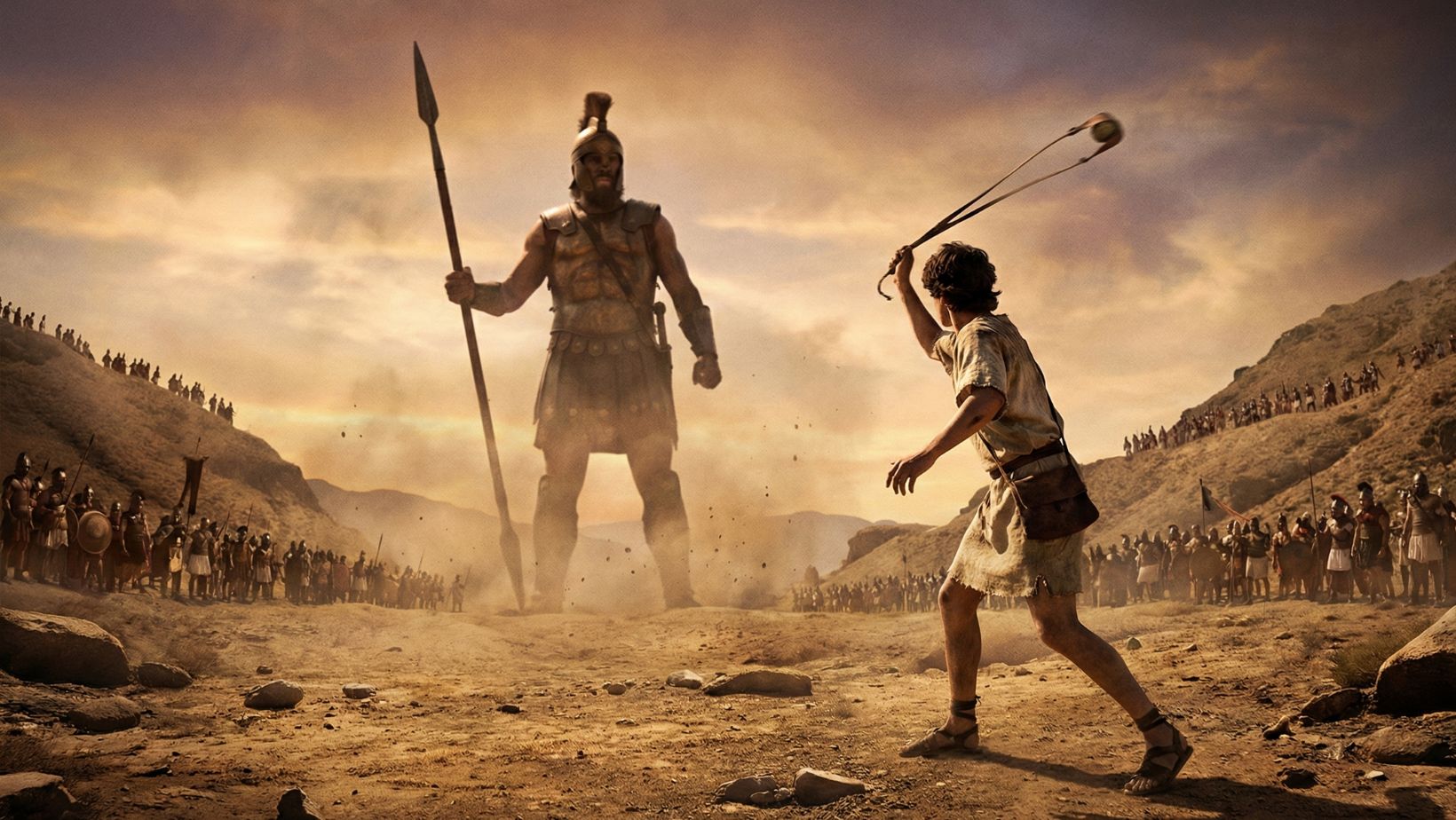
1 Samuel 17 contains perhaps the most famous narrative in the Old Testament: David and Goliath. It contrasts the paralysis of King Saul and the Israelite army with the courageous faith of the shepherd boy David. For forty days, the Philistine giant Goliath mocks the armies of Israel and their God. While the trained soldiers tremble, David, arriving on a humble errand to deliver cheese, is incensed that an “uncircumcised Philistine” would defy the living God. Rejecting the king’s conventional armor, David defeats the giant with a single stone from his sling, proving that “the battle is the Lord’s.” The victory routs the Philistines and elevates David as a national hero.
1. The Giant and the Standoff (1 Samuel 17:1–11 NLT)
1 The Philistines now mustered their army for battle and camped between Socoh and Azekah at Ephes-dammim, in Judah. 2 Saul countered by gathering his Israelite troops near the Valley of Elah. 3 So the Philistines and Israelites faced each other on opposite hills, with the valley between them. 4 Then Goliath, a Philistine champion from Gath, came out of the Philistine ranks to face the forces of Israel. He was over nine feet tall! 5 He wore a bronze helmet, and his bronze coat of mail weighed 125 pounds. 6 He also wore bronze leg armor, and he carried a bronze javelin on his shoulder. 7 The shaft of his spear was as heavy and thick as a weaver’s beam, tipped with an iron spearhead that weighed 15 pounds. His armor bearer walked ahead of him carrying a shield. 8 Goliath stood and shouted a taunt across to the Israelites. “Why are you all coming out to fight?” he called. “I am the Philistine champion, but you are only the servants of Saul. Choose one man to come down here and fight me! 9 If he kills me, then we will be your slaves. But if I kill him, you will be our slaves! 10 I defy the armies of Israel today! Send me a man who will fight me!” 11 When Saul and the Israelites heard this, they were terrified and deeply shaken.
Commentary:
- The Geography (v. 1-3): The Valley of Elah was a strategic corridor leading from the coastal plain (Philistine territory) up into the hill country of Judah. Losing this valley would open the heartland to invasion.
- Goliath’s Stature (v. 4): The Masoretic text (Hebrew) lists his height as “six cubits and a span” (approx. 9 feet 9 inches). Some ancient manuscripts (Dead Sea Scrolls, Septuagint) list “four cubits and a span” (approx. 6 feet 9 inches). Regardless, he was a giant among men (average height then was ~5’5″).
- The Technology Gap (v. 5-7): The text emphasizes “bronze” and “iron.” Goliath is a tank. His scale armor weighed ~125 lbs. The spearhead alone was 15 lbs. He represents the pinnacle of human military technology.
- Representative Warfare (v. 8-9): Goliath proposes “single combat.” Instead of thousands dying, two champions fight, and the winner takes all. This was efficient but required immense trust in your champion.
- The Taunt (v. 10): “I defy the armies of Israel.” The word charaph means to strip, expose, or treat with contempt. He is mocking their God by mocking His people.
- Saul’s Failure (v. 11): As the tallest man in Israel (Ch 9:2), Saul was the logical choice to fight Goliath. His terror demoralized the entire nation.
2. David’s Arrival and Indignation (1 Samuel 17:12–30 NLT)
17 One day Jesse said to David, “Take this basket of roasted grain and these ten loaves of bread, and carry them quickly to your brothers. 18 And give these ten cuts of cheese to their captain. See how your brothers are getting along, and bring back a report on how they are doing.” … 23 As he was talking with them, Goliath, the Philistine champion from Gath, came out from the Philistine ranks. Then David heard him shout his usual taunt to the army of Israel. 24 As soon as the Israelite army saw him, they began to run away in fright. 25 “Have you seen the giant?” the men asked. “He comes out each day to defy Israel. The king has offered a huge reward to anyone who kills him. He will give that man one of his daughters for a wife, and the man’s entire family will be exempted from paying taxes!” 26 David asked the soldiers standing nearby, “What will a man get for killing this Philistine and ending his defiance of Israel? Who is this pagan Philistine anyway, that he is allowed to defy the armies of the living God?” 27 And these men gave David the same reply… 28 But when David’s oldest brother, Eliab, heard David talking to the men, he was angry. “What are you doing around here anyway?” he demanded. “What about those few sheep you’re supposed to be taking care of? I know about your pride and deceit. You just want to see the battle!” 29 “What have I done now?” David replied. “I was only asking a question!”
Commentary:
- The Errand (v. 17-18): David is not a soldier; he is a courier bringing cheese. God uses a mundane errand to position him for destiny.
- The Forty Days: Goliath had been shouting for 40 days. In Scripture, 40 often represents a period of testing (wilderness, flood, Jesus in the desert). Israel was failing the test.
- The Incentive (v. 25): Saul tries to buy courage with three things: great wealth, his daughter (royal marriage), and tax exemption. Yet, even these rewards cannot motivate carnal men to face spiritual death.
- David’s Perspective (v. 26): Everyone else saw a “giant”; David saw an “uncircumcised Philistine” (someone outside the covenant). Everyone else heard him defying “Israel”; David heard him defying the “living God.”
- Theological Shift: David reframes the problem from a military one to a theological one.
- Eliab’s Jealousy (v. 28): Eliab attacks David’s character (“pride and deceit”) and his significance (“those few sheep”). This is likely resentment from Samuel’s anointing in Chapter 16. The enemy often attacks from within (family) before attacking from without (Goliath).
3. David vs. Saul: The Armor Test (1 Samuel 17:31–40 NLT)
31 Then David’s question was reported to King Saul, and the king sent for him. 32 “Don’t worry about this Philistine,” David told Saul. “I’ll go fight him!” 33 “Don’t be ridiculous!” Saul replied. “There’s no way you can fight this Philistine and possibly win! You’re only a boy, and he’s been a man of war since his youth.” 34 But David persisted. “I have been taking care of my father’s sheep and goats,” he said. “When a lion or a bear comes to steal a lamb from the flock, 35 I go after it with a club and rescue the lamb from its mouth. If the animal turns on me, I catch it by the jaw and club it to death. 36 I have done this to both lions and bears, and I’ll do it to this pagan Philistine, too, for he has defied the armies of the living God! 37 The Lord who rescued me from the claws of the lion and the bear will rescue me from this Philistine!” Saul finally consented. “All right, go ahead,” he said. “And may the Lord be with you!” 38 Then Saul gave David his own armor—a bronze helmet and a coat of mail. 39 David put it on, strapped the sword over it, and took a step or two to see what it was like, for he had never worn such things before. “I can’t go in these,” he protested to Saul. “I’m not used to them.” So David took them off again. 40 He picked up five smooth stones from a stream and put them into his shepherd’s bag. Then, armed only with his shepherd’s staff and sling, he started across the valley to fight the Philistine.
Commentary:
- Past Faithfulness (v. 34-36): David’s confidence isn’t reckless; it’s based on history. He had killed lions and bears in private.
- Application: Private victories prepare you for public battles. If you haven’t fought the “lion” in the secret place, you cannot fight the “giant” in the public place.
- Saul’s Armor (v. 38): Saul tries to make David fight like Saul.
- The Weapons (v. 40):
- Staff: For close quarters/support.
- Sling: Not a toy. In the ancient world, slingers were the equivalent of snipers. They could sling stones at 100+ mph with lethal accuracy up to 200 yards (see Judges 20:16).
- Five Stones: Why five? Some suggest Goliath had four brothers (2 Sam 21:22). Others suggest David simply wanted ammunition.
4. The Battle is the Lord’s (1 Samuel 17:41–54 NLT)
41 Goliath walked out toward David with his shield bearer ahead of him, sneering in contempt at this ruddy-faced boy. 42 … 43 “Am I a dog,” he roared at David, “that you come at me with a stick?” And he cursed David by the names of his gods. 44 “Come over here, and I’ll give your flesh to the birds and wild animals!” Goliath yelled. 45 David replied to the Philistine, “You come to me with sword, spear, and javelin, but I come to you in the name of the Lord of Heaven’s Armies—the God of the armies of Israel, whom you have defied. 46 Today the Lord will conquer you… and the whole world will know that there is a God in Israel! 47 And everyone assembled here will know that the Lord rescues his people, but not with sword and spear. This is the Lord’s battle, and he will give you to us!” 48 As Goliath moved closer to attack, David quickly ran out to meet him. 49 Reaching into his shepherd’s bag and taking out a stone, he hurled it with his sling and hit the Philistine in the forehead. The stone sank in, and Goliath stumbled and fell face down on the ground. 50 So David triumphed over the Philistine with only a sling and a stone, for he had no sword. 51 Then David ran over and pulled Goliath’s sword from its sheath. David used it to kill him and cut off his head. When the Philistines saw that their champion was dead, they turned and ran.
Commentary:
- The Curses (v. 43): Goliath engages in spiritual warfare, cursing David by his idols (Dagon/Baal). He insults David’s lack of armor (“stick”).
- David’s Sermon (v. 45-47): This is the climax. David declares three things:
- The Strike (v. 49): The stone hits the “forehead”—the only exposed spot on Goliath’s face (unless the helmet had a visor).
- “Sank in”: The velocity was high enough to fracture the skull and penetrate the brain.
- The Beheading (v. 51): David uses Goliath’s own sword to finish him. This fulfills the typology of the enemy being destroyed by his own weapon (like Haman on his gallows, or Satan defeated by the Cross).
5. The Mystery of Identity (1 Samuel 17:55–58 NLT)
55 When Saul saw David go out to fight the Philistine, he asked Abner, the commander of his army, “Abner, whose son is this young man?” “I really don’t know,” Abner declared. 56 “Well, find out who he is!” the king told him. 57 As soon as David returned from killing the Philistine, Abner brought him to Saul with the Philistine’s head still in his hand. 58 “Tell me about your father, young man,” Saul said. And David replied, “His name is Jesse, and we live in Bethlehem.”
Commentary:
- The Confusion: Why doesn’t Saul know David? (In Ch 16, David was his musician).
- Theory 1: Chronological rearrangement. Ch 16 and 17 might not be strictly chronological.
- Theory 2: Saul’s mental state. His “tormenting spirit” may have caused memory lapses or he saw David only in dark rooms as a servant.
- Theory 3 (Most likely): Saul knew David the musician, but he didn’t know David the warrior or his lineage. The question “Whose son is this?” (v. 55) focuses on his family. Since Saul promised tax exemption to the victor’s family, he needed to know the father’s name to grant the reward.
Theological Significance of 1 Samuel 17
- Christological Typology: David is a “type” of Christ.
- He is sent by his father to his brethren.
- He is rejected/mocked by his brethren (Eliab).
- He faces the enemy champion alone while the people watch.
- He defeats the enemy (Satan/Death) and decapitates him.
- His victory is imputed to the people—Israel shares the spoil even though they didn’t fight the giant.
- The Nature of Spiritual Warfare: The battle is not about resources (bronze/iron) but about alignment with God. Goliath had the resources; David had the relationship.
- God’s Glory: David’s primary concern was not his safety, but God’s reputation. Faith functions best when it is jealous for God’s glory.
Practical Applications
- Run Toward the Roar: While everyone ran away from Goliath (v. 24), David ran toward him (v. 48). Faith confronts problems rather than avoiding them.
- Use Your Own Stones: Don’t try to be someone else. Saul’s armor didn’t fit David. God uses your unique history, skills, and personality (your “sling”) to win battles.
- Remember the Lion and Bear: When facing a new, huge crisis, recall God’s past faithfulness in smaller crises. The God of yesterday is the God of today.
Final Insight
1 Samuel 17 is not just a story about an underdog; it is a story about a representative. David stood where Israel failed to stand. It reminds us that our victory over the “giants” of sin and death comes not from our own strength, but from the triumph of our Champion, Jesus, who defeated the enemy so we could join the shout of victory.







Leave a Reply