
1 Samuel 18 chronicles the immediate aftermath of the victory over Goliath, marking the beginning of the complex “Triangle of Relationships” that dominates the rest of the book: David, Jonathan, and Saul. While Jonathan (the Crown Prince) recognizes God’s hand on David and forms a covenant of love with him, Saul (the King) recognizes the same thing and reacts with murderous jealousy. The chapter details Saul’s descent into paranoia as he tries to kill David first with a spear, and then through political maneuvering, hoping the Philistines will do the job for him. Ironically, every trap Saul sets only serves to increase David’s fame and solidify his claim to the throne.
1. The Covenant: The Prince and the Shepherd (1 Samuel 18:1–4 NLT)
1 After David had finished talking with Saul, he met Jonathan, the king’s son. There was an immediate bond between them, for Jonathan loved David. 2 From that day on Saul kept David with him and wouldn’t let him return home to his father. 3 And Jonathan made a solemn pact with David, because he loved him as he loved himself. 4 Jonathan sealed the pact by taking off his robe and giving it to David, together with his tunic, sword, bow, and belt.
Commentary:
- The “Immediate Bond” (v. 1): The text says Jonathan’s soul was “knit” to David’s. This is the biblical model of platonic, covenantal male friendship. Jonathan, a warrior who climbed cliffs in faith (Ch 14), sees a kindred spirit in David.
- The Political Significance (v. 4): This is not just a gift; it is a transfer of power.
- The Robe: Represents his royal status as heir.
- The Weapons: In a land where iron weapons were scarce (see 1 Sam 13:22, only Saul and Jonathan had swords), giving David his sword and bow was an act of abdication.
- Insight: Jonathan is voluntarily surrendering his right to the throne to the one God has chosen. He is the anti-Saul; he yields to God’s will rather than fighting it.
2. The Song of Jealousy (1 Samuel 18:5–9 NLT)
5 Whatever Saul asked David to do, David did it successfully. So Saul made him a commander over the men of war, an appointment that was welcomed by the people and Saul’s officers alike. 6 When the victorious Israelite army was returning home after David had killed the Philistine, women from all the towns of Israel came out to meet King Saul. They sang and danced for joy with tambourines and cymbals. 7 This was their song: “Saul has killed his thousands, and David his ten thousands!” 8 This made Saul very angry. “What’s this?” he said. “They credit David with ten thousands and me with only thousands. Next they’ll be making him their king!” 9 So from that time on Saul kept a jealous eye on David.
Commentary:
- David’s Success (v. 5): David is “successful” (Hebrew: sakal, meaning wise/prudent). He isn’t just lucky; he is competent.
- The Viral Song (v. 7): The women celebrate David ten times more than Saul.
- In ancient culture, public acclaim determined political stability. If the people loved a war hero more than the king, a coup was often inevitable.
- Saul’s Reaction (v. 8): “Next they’ll be making him king!” Saul connects the dots. He realizes David is the “neighbor better than you” that Samuel prophesied in Chapter 15.
- The Evil Eye (v. 9): “Kept a jealous eye.” This marks the transition from appreciation to surveillance. Saul is no longer leading the kingdom; he is obsessed with protecting his position.
3. The Spear and the Spirit (1 Samuel 18:10–16 NLT)
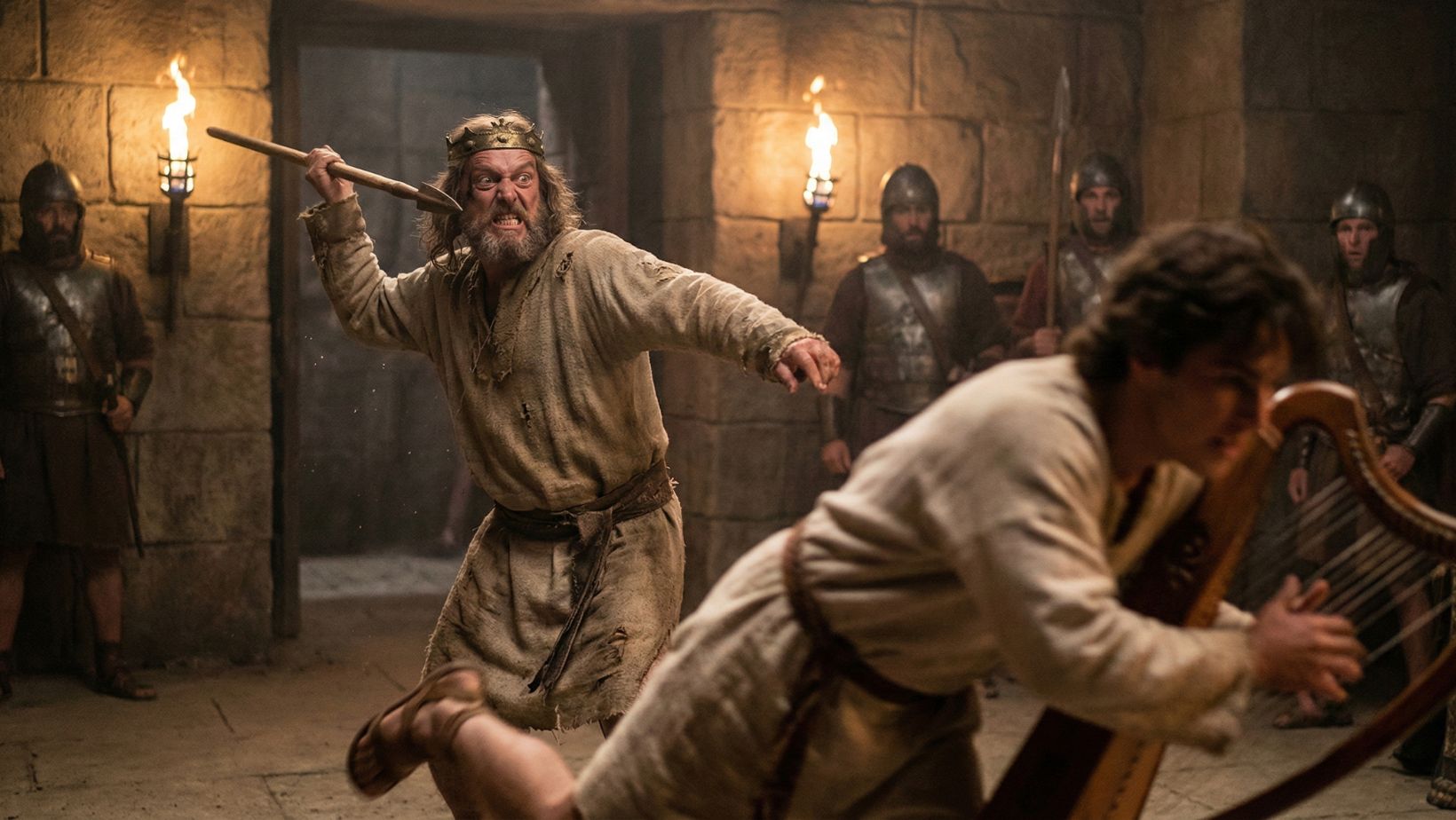
10 The very next day a tormenting spirit from God overwhelmed Saul, and he began to rave in his house like a madman. David was playing the harp, as he did each day. But Saul had a spear in his hand, 11 and he suddenly hurled it at David, intending to pin him to the wall. But David escaped him twice. 12 Saul was afraid of David because the Lord was with David but had left him. 13 So Saul sent him away to command a thousand men. David led the troops into battle and returned safely. 14 David continued to succeed in everything he did, for the Lord was with him. 15 When Saul recognized this, he became even more afraid of him. 16 But all Israel and Judah loved David because he was so successful at leading his troops into battle.
Commentary:
- Raving (v. 10): The Hebrew word used for “rave” is related to “prophesy.” It implies a frantic, ecstatic state of madness or demonic influence. Saul is out of control.
- The Attempted Murder (v. 11): Saul tries to pin David to the wall.
- David’s Reaction: He “escaped.” He did not throw the spear back. This establishes David’s character: he leaves vengeance to God (Romans 12:19).
- The Source of Fear (v. 12): Saul isn’t afraid of David’s sword; he is afraid of David’s anointing. “The Lord was with David.” There is nothing more terrifying to a carnal leader than a subordinate who clearly has God’s favor.
- Demotion as Promotion (v. 13): Saul removes David from the palace (safety) to the battlefield (danger), hoping he will die. But this backfires—it gives David command experience and increases his visibility among the troops.
4. The Marriage Trap (1 Samuel 18:17–30 NLT)
17 One day Saul said to David, “I am ready to give you my older daughter, Merab, as your wife. But first you must prove yourself to be a real warrior by fighting the Lord’s battles.” For Saul thought, “I’ll send him out against the Philistines and let them kill him rather than doing it myself.” … 20 In the meantime, Saul’s daughter Michal had fallen in love with David, and Saul was delighted when he heard about it. 21 “Here’s another opportunity to see him killed by the Philistines!” Saul said to himself. … 25 Saul told his men to say to David, “The king doesn’t want any money for the bride price. He only wants 100 Philistine foreskins to take revenge on his enemies.” Saul had it in mind that David would be killed by the Philistines. 26 …So he and his men went out and killed 200 Philistines. He brought their foreskins and presented the full number to the king so he could become the king’s son-in-law. Then Saul gave Michal to him to be his wife. 28 When Saul realized that the Lord was with David and how much his daughter Michal loved him, 29 Saul became even more afraid of him, and he remained David’s enemy for the rest of his life. 30 Every time the commanders of the Philistines attacked, David was more successful against them than all the rest of Saul’s officers. So David’s name became very famous.
Commentary:
- The Bait and Switch (v. 17-19): Saul promises Merab, but then gives her to another man (Adriel). This was a calculated public insult to provoke David to anger or rebellion. David remains humble.
- Michal’s Love (v. 20): Michal is the second child of Saul to fall in love with David. Saul’s own family is defecting to his rival.
- The Bride Price (v. 25): Poor men (like David) could not afford the dowry for a princess. Saul offers a “service” dowry: 100 foreskins.
- The Logic: To get 100 foreskins, David has to kill 100 men in close quarters. Saul assumes the odds will catch up with him.
- The Nature of the Trophy: It specifically targeted Philistines (who were uncircumcised), distinguishing them from other neighbors.
- Double for Your Trouble (v. 27): David brings 200. He over-delivers, turning Saul’s trap into a triumph.
- The Result (v. 28-29): Saul is now legally bound to David as a father-in-law. His plan failed completely. He realizes he cannot fight God.
Theological Significance of 1 Samuel 18
- Providence over Plots: This chapter illustrates the sovereignty of God over human schemes. Saul’s demotion of David gave him an army; Saul’s marriage trap gave him royalty. “You intended to harm me, but God intended it for good” (Gen 50:20).
- Covenant Love: Jonathan illustrates Christ-like love. He stripped himself of his glory to clothe the chosen one. He loved David when it cost him everything (his throne).
- The Irrationality of Sin: Saul’s hatred makes no sense. David is his best general, his son-in-law, and his musician. Sin (jealousy) blinds us to the blessings right in front of us.
Practical Applications
- Responding to Jealousy: When we succeed, others may envy us. David models the correct response: humility (“Who am I?”), wisdom (behaving prudently), and refusing to retaliate (dodging the spear but not throwing it back).
- True Friendship: We all need a “Jonathan”—someone who loves us for who we are, not what we can do for them. To have a friend like that, we must be a friend like that (self-sacrificial).
- Surviving Toxic Leadership: David served faithfully under a leader who wanted him dead. He proves that you can maintain your integrity even in a hostile work environment.
Final Insight
1 Samuel 18 sets the stage for the rest of the book: Saul will spend his energy trying to kill the future, while David will spend his energy trusting the God of his future. Saul is fighting a losing war against the inevitable will of God.







Leave a Reply