
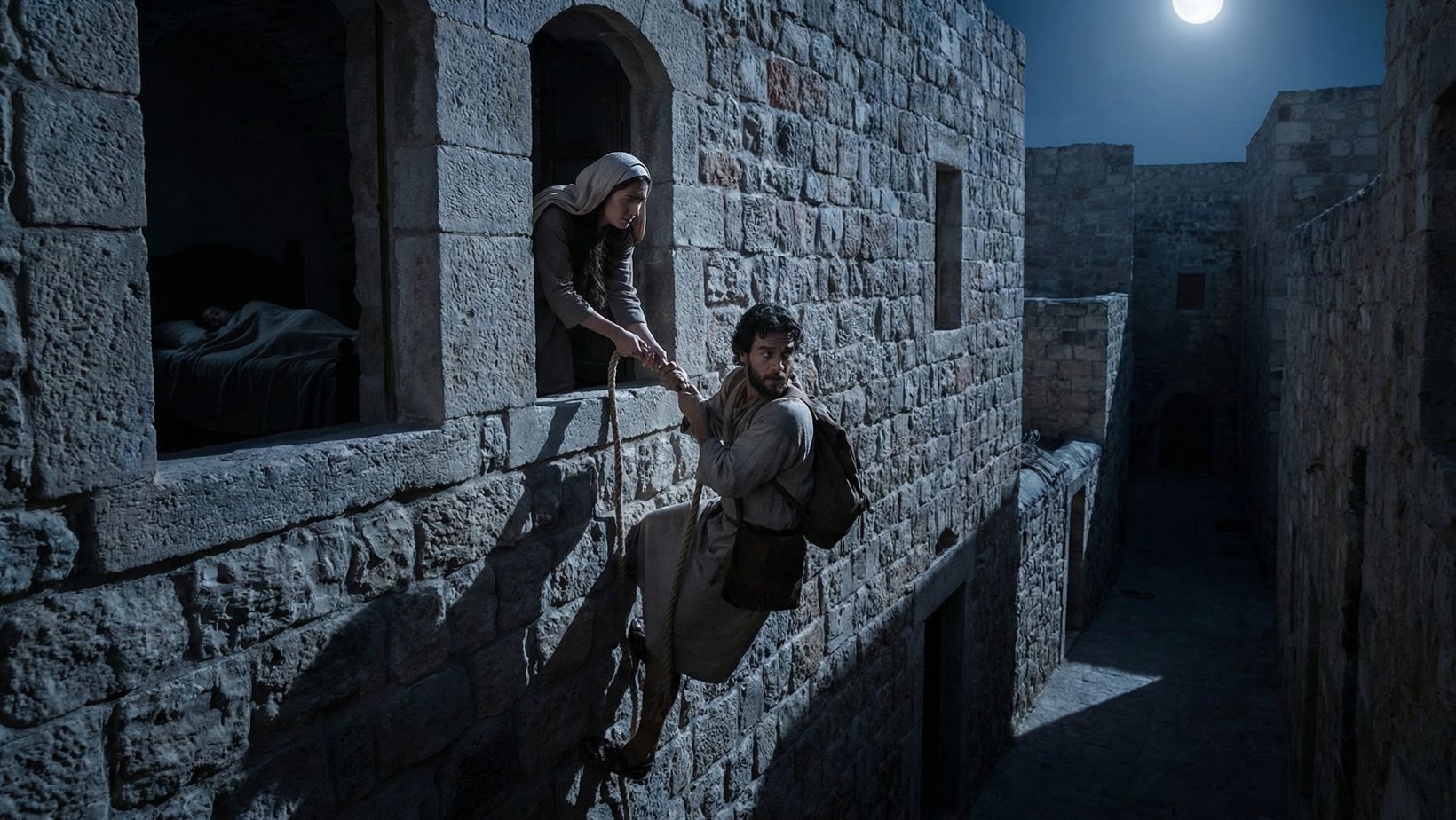
1 Samuel 19 marks the escalation of Saul’s hostility from private jealousy to public policy. Saul issues a general order for David’s execution. The chapter is a thrilling narrative of survival, detailing three distinct escapes of David, each facilitated by a different agent of God’s protection: first by Jonathan (through intercession), second by Michal (through deception), and third by Samuel and the Holy Spirit (through divine intervention). It concludes with a bizarre and powerful scene where Saul, intending to murder David, is overwhelmed by the Spirit of God and prophesies, proving that God can disarm His enemies simply by His presence.
1. Jonathan’s Intercession (1 Samuel 19:1–7 NLT)
1 Saul now urged his servants and his son Jonathan to assassinate David. But Jonathan, because of his strong affection for David, 2 told him what his father was planning. “Tomorrow morning,” he warned him, “you must find a hiding place out in the fields. 3 I’ll ask my father to go out there with me, and I’ll talk to him about you. Then I’ll tell you everything I can find out.” 4 The next morning Jonathan spoke with his father, Saul, about David, saying many good things about him. “The king must not sin against his servant David,” Jonathan said. “He’s never done anything to harm you. He has always helped you in any way he could. 5 Have you forgotten about the time he risked his life to kill the Philistine giant and how the Lord brought a great victory to all Israel as a result? You were certainly happy about it then. Why should you murder an innocent man like David? There is no reason for it at all!” 6 Saul listened to Jonathan and vowed, “As surely as the Lord lives, David will not be killed.” 7 Afterwards Jonathan called David and told him what had happened. Then he brought David to Saul, and David served in the court as before.
Commentary:
- The Assassination Order (v. 1): Saul no longer hides his intent. He invites his court and his son into a conspiracy of murder.
- Jonathan’s Loyalty (v. 2): Jonathan is put in the impossible position of choosing between his father (the King) and his friend (the Chosen). He chooses righteousness over bloodline.
- The Advocate (v. 4-5): Jonathan acts as a defense attorney. His argument is solid:
- Saul’s Oath (v. 6): Saul is impulsive. Swayed by the moment, he swears by Yahweh (“As surely as the Lord lives”) not to kill David. As the narrative shows, Saul’s oaths are meaningless.
2. The Spear and the Window (1 Samuel 19:8–17 NLT)
8 War broke out again after that, and David went out and led his troops against the Philistines. He attacked them with such fury that they all ran away. 9 But one day when Saul was sitting at home, with spear in hand, the tormenting spirit from the Lord suddenly came upon him again. As David played his harp, 10 Saul hurled his spear at David. But David dodged out of the way, and the spear stuck in the wall. David fled and escaped into the night. 11 Then Saul sent troops to watch David’s house. They were told to kill David when he came out the next morning. But Michal, David’s wife, warned him, “If you don’t escape tonight, you will be dead by morning.” 12 So she helped him climb out through a window, and he fled and escaped. 13 Then she took an idol and put it in his bed, covered it with blankets, and put a cushion of goat’s hair at its head. 14 When the troops came to arrest David, she told them he was sick and couldn’t get out of bed. 15 But Saul sent the troops back to get David. “Bring him to me in his bed,” he commanded, “so I can kill him!” 16 But when they came in, they found that it was only an idol in the bed… 17 “Why have you betrayed me like this and let my enemy escape?” Saul demanded of Michal. “I had to,” Michal replied. “He threatened to kill me if I didn’t help him.”
Commentary:
- The Trigger (v. 8): Once again, David’s military success triggers Saul’s insecurity.
- The Spear (v. 10): This is the second recorded spear attempt (see Ch 18). It signifies the breaking of Saul’s oath from verse 6.
- Michal’s Role (v. 11): Michal, Saul’s own daughter, chooses her husband over her father. This confirms Samuel’s warning in Ch 8 that a king would tear families apart.
- The “Great Escape” (v. 12): Lowering David through a window is a classic biblical motif (similar to Rahab and the spies, or Paul in Damascus).
- The Idol (v. 13): The Hebrew word is teraphim (household gods/idols).
- Michal’s Lie (v. 17): To protect herself from her father’s rage, she lies, claiming David kidnapped her (“He threatened to kill me”). This slander unfortunately paints David as violent, potentially damaging his reputation with Saul even further.
3. Saul Among the Prophets (1 Samuel 19:18–24 NLT)
18 So David escaped and went to Ramah to see Samuel, and he told him all that Saul had done to him. Then Samuel took David with him to live at Naioth. 19 When the report reached Saul that David was at Naioth in Ramah, 20 he sent troops to capture him. But when they arrived and saw Samuel leading a group of prophets who were prophesying, the Spirit of God came upon Saul’s men, and they also began to prophesy. 21 When Saul heard what had happened, he sent other troops, but they, too, prophesied! The same thing happened a third time. 22 Finally, Saul himself went to Ramah and arrived at the great well in Secu… 23 But on the way to Naioth in Ramah the Spirit of God came even upon Saul, and he, too, began to prophesy all the way to Naioth! 24 He tore off his clothes and lay on the ground naked and prophesying in the presence of Samuel all that day and all that night. This is the source of the saying, “Is Saul also a prophet?”
Commentary:
- Sanctuary at Ramah (v. 18): David runs to his spiritual father, Samuel. Naioth was likely a dormitory or compound for the “school of prophets.”
- Divine Defense (v. 20-21): This is one of the most unique scenes of spiritual warfare in scripture. Saul sends soldiers (hitmen) to arrest David.
- Instead of fighting them with swords, God fights them with His Spirit. The soldiers are overwhelmed by prophetic ecstasy—likely a trance state of praise or involuntary speech. They are neutralized by worship.
- Saul’s Final Attempt (v. 23): Saul, frustrated, comes personally. The Spirit is no respecter of persons; He hits Saul even “on the way.”
- Naked Prophecy (v. 24): Saul strips off his royal robes.
- Symbolism: Saul lays aside his royal dignity and armor, lying “naked” (or in his tunic) before Samuel. It is a visual enactment of his rejection. He is king no more; he is just a man stripped bare before God.
- The Proverb: “Is Saul also a prophet?” (Repeated from Ch 10). Originally it meant “Can a farm boy be spiritual?” Now it ironically means “Can a madman be spiritual?”
Theological Significance of 1 Samuel 19
- God’s Diverse Protection: God uses different means to save us. He used Jonathan’s voice (reason), Michal’s cunning (action), and the Spirit’s power (miracle). We shouldn’t limit how we expect God to work.
- The Sovereign Spirit: The Spirit of God is irresistible. When He moves, even the enemies of God can be swept up in His power, rendered harmless not by destruction, but by distraction (prophecy).
- Civil Disobedience: Both Jonathan and Michal demonstrate that when a government (or parent) commands something evil (murder), the righteous response is disobedience to man in order to obey God.
Practical Applications
- Being a Jonathan: We need to be willing to speak up for the innocent when they are being slandered or attacked, even if it risks our standing with the “King.”
- The Safety of the Sanctuary: When David was exhausted and hunted, he went to Ramah (the place of worship/word). When we are under attack, we should retreat to the presence of God and godly mentors (Samuel).
- The Futility of Opposing God: Saul’s three attempts to capture David at Naioth failed spectacularly. It reminds us that “no weapon formed against you shall prosper” (Isaiah 54:17).
Final Insight
1 Samuel 19 is a chapter of exposure. It exposes Saul’s murderous heart, Michal’s idols, and the irresistible power of the Holy Spirit. It ends with the ultimate image of exposure: the King of Israel lying naked on the floor, defeated not by an army, but by the overwhelming presence of the God he had rejected.







Leave a Reply